
Shopping Cart

Feroca, official and exclusive Polytek partner in Spain
We are the only authorised Polytek distributor in Spanish territory. You buy original product, straight from the factory, backed by a team with four decades of experience working with these materials.
- Original product, straight from the factory
- Permanent stock of the whole range
- Technical advice before and after
- Shipping from our Fuenlabrada warehouse
Start with what you want to make
A flexible silicone mould
Maximum detail fidelity and easy demoulding. For sculpture, resin, wax, soap or plaster.
PlatSil 73 and FS series ?
A mould that withstands heavy production
Urethane rubber resists the abrasion of concrete and repeated demoulding far better than silicone.
Poly 74/75 and PT Flex ?
Prosthetics and special effects
Ultra-soft platinum gels that move like skin. For encapsulated prosthetics, lifecasting and animatronics.
PlatSil Gel series ?
Reproducing parts by casting
1:1 polyurethane resins that demould in minutes. White, black, clear or lightweight.
EasyFlo series ?
Filling, lightening or sculpting in volume
Two-component rigid foams that expand and cure in minutes.
PolyFoam series ?
Fine-tuning the mix I already use
Speed up, slow down, harden, thicken, pigment or release without changing material.
Additives and ancillaries ?
PlatSil platinum silicones for moulds
Addition-cure silicones with a 1A:1B mix, translucent and with very little shrinkage. The 73 series gives you more working time; the FS series (fast set) cures in 25 minutes and has notably high tear strength, which is what extends the life of the mould when the part has undercuts.
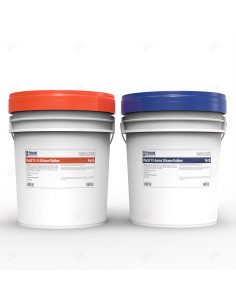 PlatSil FS-10
The softest in the mould range and highly tear resistant.
PlatSil FS-10
The softest in the mould range and highly tear resistant.
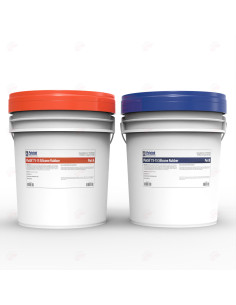 PlatSil 73-15
Fluid and with plenty of time for large or highly detailed moulds.
PlatSil 73-15
Fluid and with plenty of time for large or highly detailed moulds.
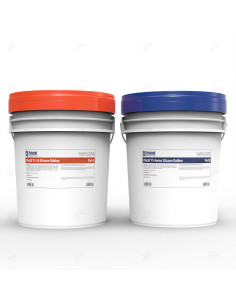 PlatSil FS-20
FS series speed with a bit more body. Production moulds.
PlatSil FS-20
FS series speed with a bit more body. Production moulds.
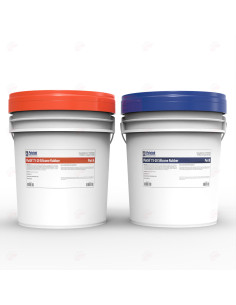 PlatSil 73-20
The most used balance: firm, fast and easy to demould.
PlatSil 73-20
The most used balance: firm, fast and easy to demould.
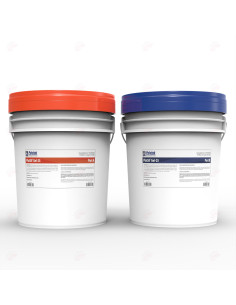 PlatSil Gel-25
Works as a firm mould or as a gel base with deadener.
PlatSil Gel-25
Works as a firm mould or as a gel base with deadener.
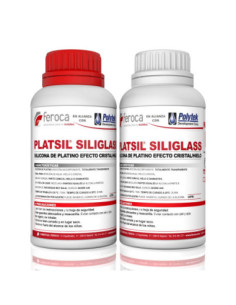 PlatSil SiliGlass
Simulates water and ice, encapsulates objects and shatters like glass.
PlatSil SiliGlass
Simulates water and ice, encapsulates objects and shatters like glass.
PlatSil Gel: prosthetics, lifecasting and special effects
The Gel series is what made Polytek famous in the world of character makeup. These are platinum silicones that, combined with a deadener, turn into ultra-soft gels that compress and recover like living tissue. They are used for encapsulated prosthetics, anatomical replicas, animatronics and medical simulation.
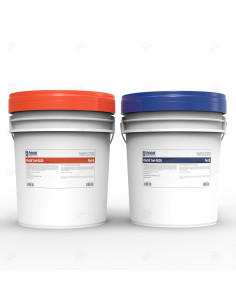 PlatSil Gel-0020
The softest. Long working time for large parts or slow pours.
PlatSil Gel-0020
The softest. Long working time for large parts or slow pours.
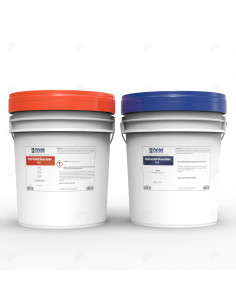 PlatSil Gel-0030
Slow-cure version for jobs that cannot be rushed.
PlatSil Gel-0030
Slow-cure version for jobs that cannot be rushed.
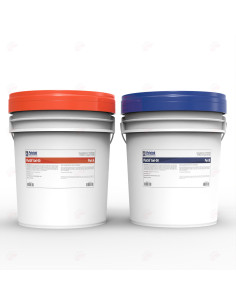 PlatSil Gel-00
The classic for encapsulated prosthetics. Fast and reliable.
PlatSil Gel-00
The classic for encapsulated prosthetics. Fast and reliable.
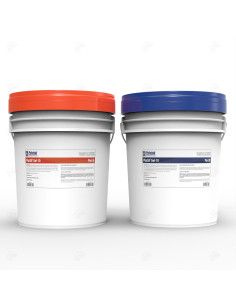 PlatSil Gel-10
More body for masks and parts that must hold their shape.
PlatSil Gel-10
More body for masks and parts that must hold their shape.
Gel series additives
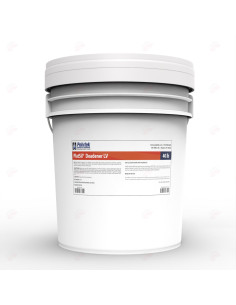 Deadener LV
Low viscosity. The more you add, the softer and more gel-like it gets.
Deadener LV
Low viscosity. The more you add, the softer and more gel-like it gets.
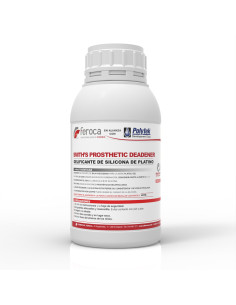 Smith's Prosthetic Deadener
The historic reference for giving the Gel series a gel consistency.
Smith's Prosthetic Deadener
The historic reference for giving the Gel series a gel consistency.
Polyurethane rubbers for moulds
When the mould is going to take a beating - concrete, polyester resin, hundreds of demoulds - urethane rubber outperforms silicone by a wide margin and costs less. In exchange you have to be strict with the release agent and with moisture: urethane forgives neither.
The Poly 74/75 series is the classic mould making line, with 25-40 minutes of working time and a 16-hour cure. The PT Flex series is the high-performance one: demoulding in 2 hours and far superior abrasion and impact resistance.
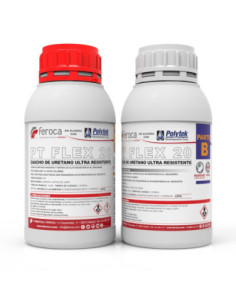 PT Flex 20
The softest in the series. Parts with pronounced undercuts.
PT Flex 20
The softest in the series. Parts with pronounced undercuts.
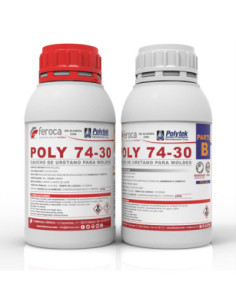 Poly 74-30
Decorative concrete moulds with deep relief.
Poly 74-30
Decorative concrete moulds with deep relief.
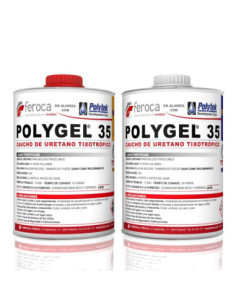 Polygel 35
Brushable. For vertical moulds and parts fixed to the ground.
Polygel 35
Brushable. For vertical moulds and parts fixed to the ground.
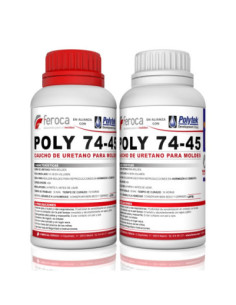 Poly 74-45
The most versatile of the 74 series for concrete production.
Poly 74-45
The most versatile of the 74 series for concrete production.
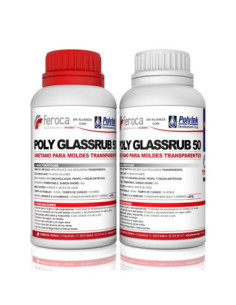 Poly GlassRub 50
Lets you see the part inside the mould as you demould.
Poly GlassRub 50
Lets you see the part inside the mould as you demould.
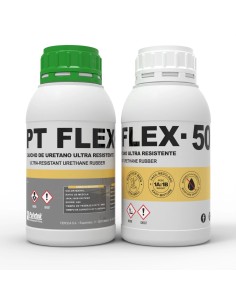 PT Flex 50
The most flexible in the PT series without losing strength.
PT Flex 50
The most flexible in the PT series without losing strength.
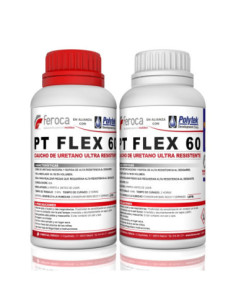 PT Flex 60
The best seller of the series. Heavy production without deformation.
PT Flex 60
The best seller of the series. Heavy production without deformation.
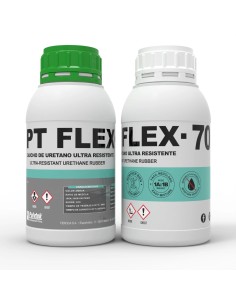 PT Flex 70
Rigid and extremely fast. Thin-walled moulds that must not give.
PT Flex 70
Rigid and extremely fast. Thin-walled moulds that must not give.
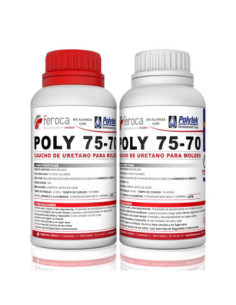 Poly 75-70
Long working time with high hardness. Large moulds.
Poly 75-70
Long working time with high hardness. Large moulds.
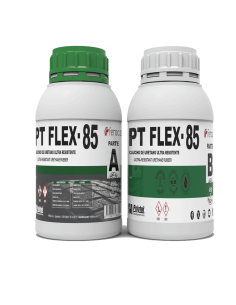 PT Flex 85
Almost rigid. Dies, rollers and technical wear parts.
PT Flex 85
Almost rigid. Dies, rollers and technical wear parts.
EasyFlo casting resins
Polyurethane resins with a 1:1 mix by volume that pour easily, pick up every detail of the mould and demould in minutes. It is the standard material for reproducing figures, props, prototypes and set pieces.
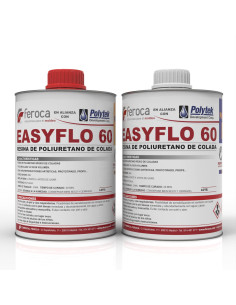 EasyFlo 60
Bright white and very fast. The benchmark casting resin.
EasyFlo 60
Bright white and very fast. The benchmark casting resin.
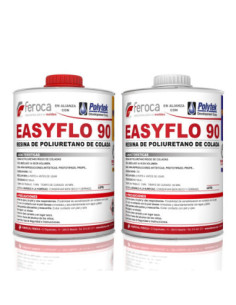 EasyFlo 90
Low viscosity and more margin. For parts with fine detail.
EasyFlo 90
Low viscosity and more margin. For parts with fine detail.
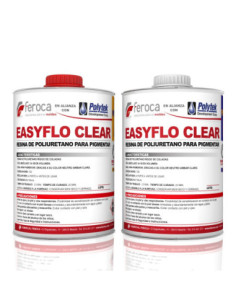 EasyFlo Clear
The base for pigmenting to any colour with PolyColor Dyes.
EasyFlo Clear
The base for pigmenting to any colour with PolyColor Dyes.
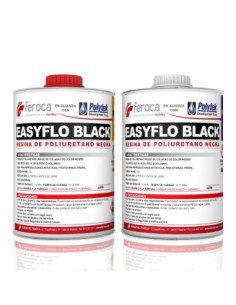 EasyFlo Black
Black from the factory, with no pigmenting or painting afterwards.
EasyFlo Black
Black from the factory, with no pigmenting or painting afterwards.
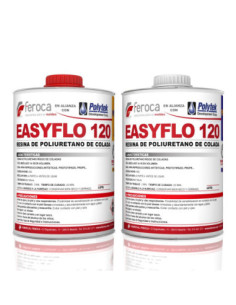 EasyFlo 120
Formulated for rotocasting and thin-walled hollow parts.
EasyFlo 120
Formulated for rotocasting and thin-walled hollow parts.
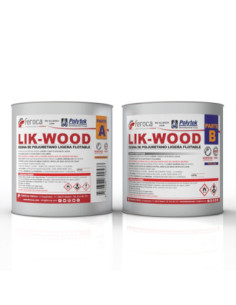 Lik-Wood
Lightweight resin for fishing lures and floating prototypes.
Lik-Wood
Lightweight resin for fishing lures and floating prototypes.
PolyFoam rigid foams
Two-component polyurethane foams that expand when mixed and cure in minutes. They are used to fill moulds, lighten sculptures, build up volumes that are later carved, and make lightweight cores.
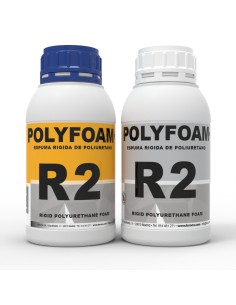 PolyFoam R2
The most expansive. Fill large volumes with little material.
PolyFoam R2
The most expansive. Fill large volumes with little material.
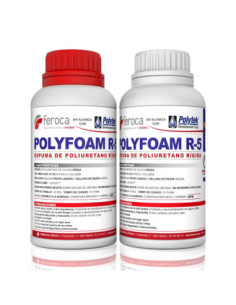 PolyFoam R-5
Medium density. The balance between lightness and carvability.
PolyFoam R-5
Medium density. The balance between lightness and carvability.
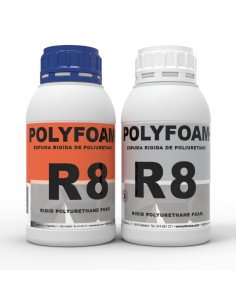 PolyFoam R-8
The densest and strongest. Structural parts and fine carving.
PolyFoam R-8
The densest and strongest. Structural parts and fine carving.
Additives and ancillaries
Almost every workshop problem - "it cures too fast", "it runs down the wall", "it will not release" - is solved with an additive, not by changing material.
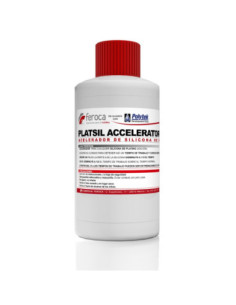 Accelerator Part X
Cuts the working time of PlatSil silicones to a third.
Accelerator Part X
Cuts the working time of PlatSil silicones to a third.
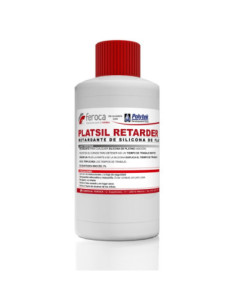 Retarder 71/73 R
1 % in Part A doubles the working time.
Retarder 71/73 R
1 % in Part A doubles the working time.
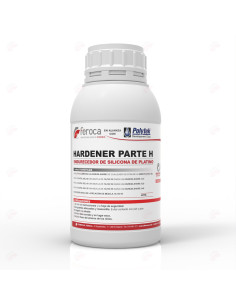 Hardener Part H
Raises the Shore hardness of the cured silicone.
Hardener Part H
Raises the Shore hardness of the cured silicone.
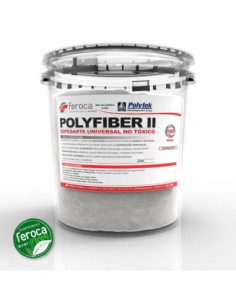 PolyFiber II
Adds thixotropy for brushing onto vertical surfaces.
PolyFiber II
Adds thixotropy for brushing onto vertical surfaces.
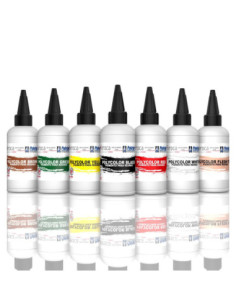 PolyColor Dyes
Concentrated liquid colourants specific to polyurethane.
PolyColor Dyes
Concentrated liquid colourants specific to polyurethane.
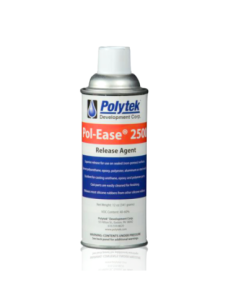 Pol-Ease 2500
Wax based, universal. Essential with urethane rubbers.
Pol-Ease 2500
Wax based, universal. Essential with urethane rubbers.
Hardness table: what to choose for each part
Shore hardness is the first thing to consider. The softer it is, the better it captures detail and the easier it releases a part with undercuts; the harder it is, the better it holds its shape and the more production it withstands. If you want to see it with physical samples, we have an interactive Shore hardness scale.
| Hardness | Product | Type | Typical use |
|---|---|---|---|
| Shore 00-20 | PlatSil Gel-0020 | Platinum silicone | Very soft prosthetic gel, filling large parts |
| Shore 00-30 | PlatSil Gel-00 · Gel-0030 | Platinum silicone | Encapsulated prosthetics, medical simulation, animatronics |
| Shore A10 | PlatSil Gel-10 | Platinum silicone | Masks and prosthetics with more body |
| Shore A13 | PlatSil FS-10 | Platinum silicone | Soft, fast-curing moulds |
| Shore A15 | PlatSil 73-15 | Platinum silicone | Large moulds or fine detail |
| Shore A20 | PlatSil FS-20 · PT Flex 20 | Platinum / urethane | Production moulds with undercuts |
| Shore A22-A25 | PlatSil 73-20 · Gel-25 | Platinum silicone | General-purpose mould, the usual starting point |
| Shore A30-A35 | Poly 74-30 · Polygel 35 | Urethane rubber | Decorative concrete with deep relief; Polygel brush-on |
| Shore A40-A50 | SiliGlass · Poly 74-45 · GlassRub 50 · PT Flex 50 | Platinum / urethane | Heavy production and transparent effects |
| Shore A60-A70 | PT Flex 60 · PT Flex 70 · Poly 75-70 | Urethane rubber | Thin-walled moulds that must not deform |
| Shore A85 | PT Flex 85 | Urethane rubber | Dies, rollers and technical wear parts |
| Shore 65D-72D | EasyFlo 60 · Black · Clear | Casting resin | The final part, not the mould |
To work out how much material you need before buying, use our material calculators.
Before using a platinum silicone: addition-cure silicones inhibit - they stay tacky and never cure - on contact with sulphur, amines, tin and some plasticisers. The usual suspects are sulphur-based modelling clays, latex, latex gloves, certain cyanoacrylate adhesives and residue from tin silicones on the workbench. When in doubt, always run a cure test on a corner before pouring the whole mould.
Frequently asked questions about Polytek
Platinum silicone or polyurethane rubber for my mould?
It depends on how many parts you are going to make and what material you are casting. Silicone captures detail better, needs no release agent for most castings and forgives mistakes; polyurethane rubber costs considerably less, withstands many more cycles and resists the abrasion of concrete, but it demands a release agent every time and does not tolerate moisture. For a one-off part or very fine detail, PlatSil silicone. For concrete production or hundreds of demoulds, a Poly 74/75 or a PT Flex.
What Shore hardness do I need for a mould?
As a starting point, Shore A20-A25 works for most moulds. Go down to A10-A15 if the part has pronounced undercuts or very fine detail, because the mould will have to stretch to release it. Go up to A40 or more if the mould has thin walls and you need it to hold its shape without deforming as you pour.
How do I get a soft gel for prosthetics?
Start with a silicone from the PlatSil Gel series and add a gelling agent (deadener). The proportion of deadener determines how soft the gel ends up: with Deadener LV you can go up to 300 % over the A+B mix. The more deadener, the closer it gets to soft tissue, but the less tear strength the part has, so it is worth running small tests before committing to the final prosthetic.
Can I speed up or slow down the cure without changing product?
Yes, and it is the recommended approach. Accelerator Part X cuts the working time of PlatSil silicones to a third, and Retarder 71/73 R doubles it by adding just 1 % to Part A. In both cases add the additive to Part A before mixing in Part B, and stir thoroughly.
Do I need a release agent with these materials?
With polyurethane rubbers always, without exception: without a release agent the mould sticks to the part and ruins both. With platinum silicones it is not needed for most castings, except when you pour silicone onto silicone. Pol-Ease 2500 aerosol works with polyurethanes, polyester, silicones and thermoplastics.
How much material do I need for my mould?
It depends on the volume of the mould, not the weight of the part. The quick way to work it out is to fill the space the silicone will occupy with rice or water and measure that volume. You can also use our material calculators, which convert it to kilos based on the density of each product.
Who distributes Polytek in Spain?
Feroca is the official and exclusive distributor of Polytek in Spain, the only authorised point of sale in Spanish territory. We work directly with the manufacturer and keep permanent stock of the range, shipping from our warehouse in Fuenlabrada. If you need an industrial format or a reference that is not listed on the site, write to us and we will source it for you.
Where Polytek materials are used
These are the applications where the Polytek range comes up most often. Each page lists the specific materials and the step-by-step process:
Mold making
Concrete molds
LifeCast
Hyperrealism
SFX makeup
Props and set dressing
Taxidermy
Prototyping
Sculpture and casting
Medical simulation
The full Polytek catalogue
38 references in stock, with prices and available formats.
Official and exclusive distributor in Spain.