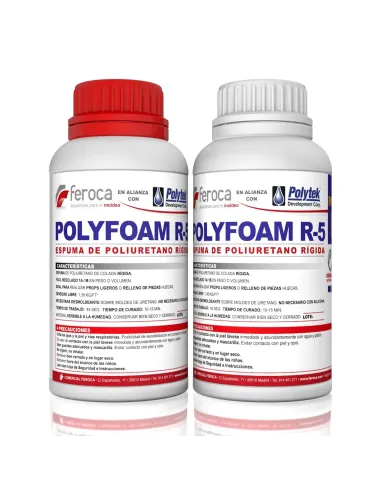
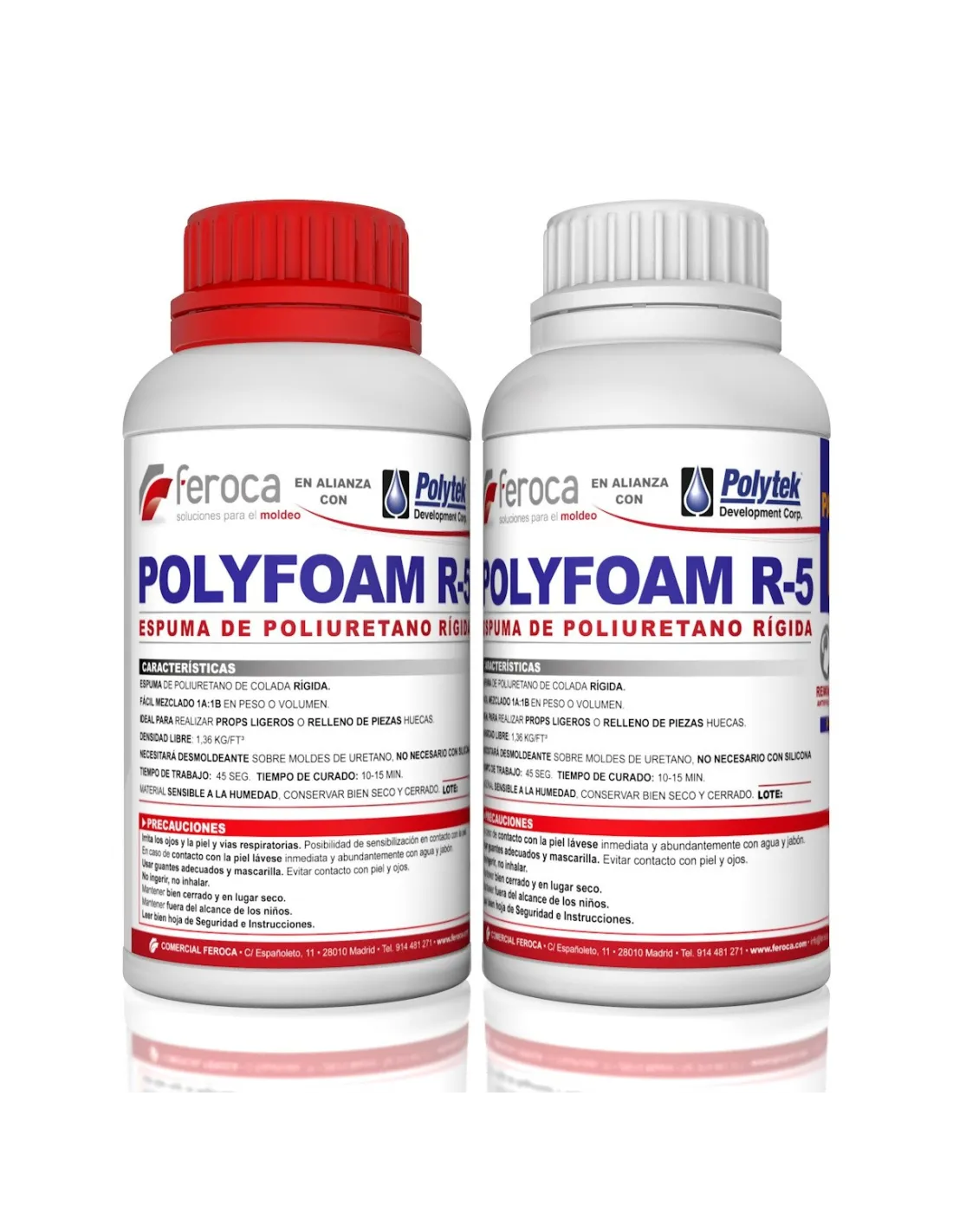
PolyFoam R-5 is a two-component rigid polyurethane foam (1A:1B by weight and volume) designed for casting in mould. With a free-rise density of 80 Kg/m³ and a working time of just 2 minutes, it generates a surface skin in closed mould that faithfully reproduces mould detail. It is virtually odourless and contains no TDI, MOCA, heavy metals or HCFC, making it a responsible choice for workshops in enclosed spaces.
Technical specifications
| Parameter |
Value |
| Application |
Casting |
| Mix ratio (weight) |
100A : 100B |
| Mix ratio (volume) |
100A : 100B |
| Mixed viscosity |
1100 cP |
| Cream time |
45 seconds |
| Working time |
2 minutes |
| Rise time |
2 minutes |
| Tack-free time |
3 minutes |
| Demould time |
10-15 minutes |
| Free-rise density |
80 Kg/m³ (1.36 Kg/ft³) |
| Moulded density |
128 - 320 Kg/m³ |
| Contains TDI / MOCA / HCFC |
No |
What it is used for
PolyFoam R-5 is designed for any application where a lightweight, rigid part with good surface reproduction is required. Its ability to form a skin in closed mould makes it especially useful when the external finish matters as much as structural lightness.
- Lightweight filling of hollow parts in series production
- Decorative objects, props and set dressing
- Duplicating masters and original models
- Prototype and scale model fabrication
- Lightweight counter-moulds for composites
- FX parts with a defined surface skin
- Scenography and fabrication of low-weight architectural elements
How to use it
- Prepare the mould: apply a suitable release agent to all mould surfaces. Wax-based or solvent-based release agents work well for polyurethane foams.
- Weigh or measure the components: mix in a 1:1 ratio by weight or volume (100A : 100B). Use a precision scale or graduated containers.
- Mix vigorously: combine component A (isocyanate) with component B (polyol) and stir vigorously for at least 30-45 seconds, making sure to scrape the sides and bottom of the container.
- Pour quickly: you have only 2 minutes of working time. Pour the mixture into the lowest point of the mould to avoid trapped bubbles.
- Close the mould: when casting in a closed mould, the foam will rise and form the characteristic skin against the walls. Secure both halves of the mould with clamps or staples.
- Wait for demoulding: the part can be demoulded after 10-15 minutes. Full cure takes longer; allow the part to rest before subjecting it to loads.
- Demould carefully: remove the part without forcing the edges. If the part is still warm from the exothermic reaction, wait a few more minutes before handling it.
Warning — exothermic reaction and moisture sensitivity: polyurethane curing generates heat. In large-volume pours the temperature can be significant; do not use moulds that cannot withstand moderate heat. Component A (isocyanate) reacts with ambient moisture: keep containers tightly closed when not in use and work in low relative humidity conditions. Wear nitrile gloves and eye protection during mixing and pouring.
Usage tips
Working temperature
The temperature of the components directly affects cream time and final expansion. The ideal working range is between 20 and 25 °C. At lower temperatures the mixture becomes more viscous, the reaction slows down and the foam may not fill the mould completely. At higher temperatures the working time shortens even further, so have the mould ready before you start mixing.
Pigmentation
If you need to colour the foam you can add PolyColor Dyes pigments to component B before mixing. Incorporate the pigment into the polyol, stir thoroughly to homogenise the colour, and then proceed with the normal mixing process. Note that some pigments may slightly affect working time.
Moulded density control
The free-rise density of PolyFoam R-5 is 80 Kg/m³, but in a closed mould you can raise it up to 320 Kg/m³ by controlling the amount of material you introduce. The more material you pour relative to the mould volume, the greater the internal pressure and the denser the finished part. This also improves surface detail reproduction and skin quality. Run tests with small quantities until you find the ratio that best suits your application.
Frequently asked questions
How much does this foam expand?
PolyFoam R-5 has a free-rise density of 80 Kg/m³. In open casting the foam rises freely until it reaches that density. In a closed mould the expansion is restricted and the final density depends on how much material you have introduced, and can reach up to 320 Kg/m³. There is no fixed volume multiplier: the actual expansion always depends on the amount of mixture and the mould volume.
What types of moulds can I use this foam with?
PolyFoam R-5 is compatible with platinum silicone moulds, urethane rubber moulds and rigid moulds (resin, fibreglass, wood). In all cases always apply a release agent before pouring. Platinum silicone moulds are especially recommended because they make demoulding easier and reproduce surface detail faithfully.
Can I use this foam as thermal insulation?
No. PolyFoam R-5 is formulated for part reproduction, model making and decoration, not for thermal or acoustic insulation. If you need an insulation material, contact us at [email protected] to evaluate other alternatives.
Can the cured foam bear weight or structural loads?
The cured rigid foam can be sanded, painted and machined (drilled, milled, cut), but it is not designed to bear high structural loads. It is suitable for decoration, props, prototypes and lightweight filling. For structurally demanding applications consider combining it with a resin or composite shell.
Can I pigment the foam?
Yes. You can add PolyColor Dyes pigments to component B (polyol) before carrying out the final mix. Thoroughly homogenise the pigment with the polyol before adding component A to ensure a uniform colour throughout the part.
How much time do I have to work with the mixture?
The working time of PolyFoam R-5 is approximately 2 minutes from the start of mixing. The foaming reaction begins at 45 seconds (cream time), so you must have the mould prepared and ready before you start mixing. Work quickly and do not attempt to use mixture that has already begun to expand.
Is this foam hazardous or toxic?
PolyFoam R-5 contains no TDI (toluene diisocyanate), MOCA, heavy metals or HCFC, making it considerably safer than other conventional polyurethane foams. Even so, component A contains isocyanate and must be handled with nitrile gloves and eye protection. Work in a ventilated space. Consult the safety data sheets (SDS) for each component before use.
Can I place orders for large quantities?
Yes. If you need significant quantities of PolyFoam R-5, contact us directly at [email protected] and our team will inform you about availability, formats and conditions for larger volume orders.
How much product do I need?Calculate the exact amount before buying and avoid wasting material.
Go to the calculator →