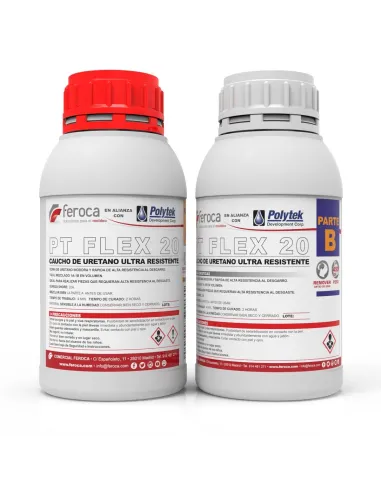
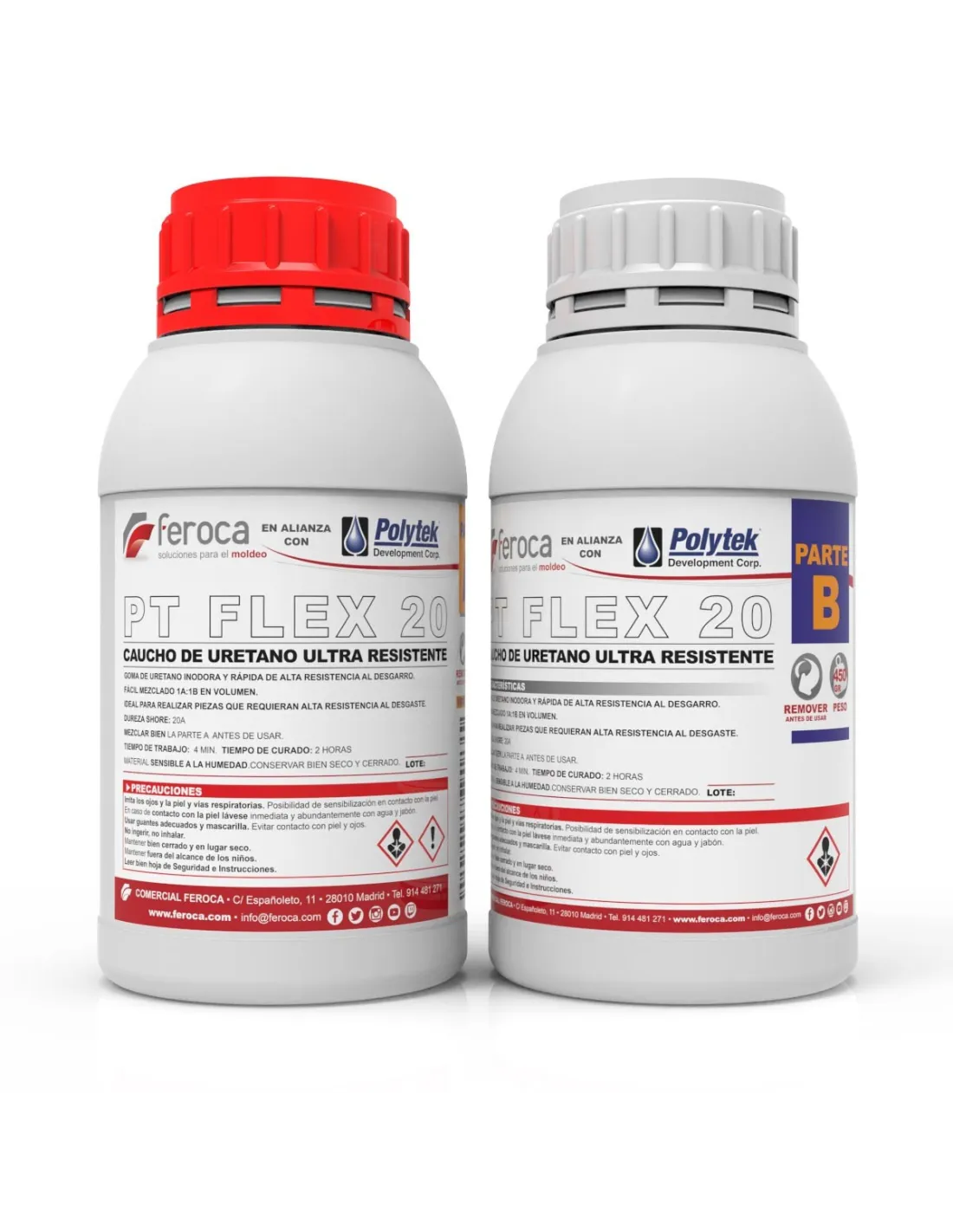
PT Flex 20 is a low-viscosity, fast-curing polyurethane rubber with Shore A20 hardness that offers exceptional resistance to abrasion, tearing and impact. Its odourless formulation, free from phthalates and MOCA, makes it a solid choice for flexible moulds, props and functional parts that must withstand intensive use. 1:1 mix ratio by weight and straightforward casting even for those with no previous experience.
Technical specifications
| Parameter |
Value |
| Application |
Casting |
| Cured colour |
Light brown |
| Shore Hardness |
A20 |
| Mix ratio (by weight) |
100A : 100B |
| Pot life |
4 minutes |
| Demould time |
2 hours |
| Mixed viscosity |
520 cps |
| Elongation at break |
770 % |
| Tear resistance |
50 pli |
| Density |
1.0 g/cm³ |
| Maximum service temperature |
60 °C |
| Phthalate-free / MOCA-free |
Yes |
What it is used for
Thanks to its extremely high elongation (770 %) and very low hardness, PT Flex 20 is ideal for all applications where the finished part must be extremely flexible and withstand continuous deformation cycles without breaking:
- Flexible moulds for resins, plaster, wax and decorative concrete.
- FX props and set dressing requiring high flexibility and tactile realism.
- Functional prototypes of soft parts (gaskets, buffers, light shock absorbers).
- Display and window-dressing pieces with complex geometries or deep bas-relief.
- Coatings and linings for rollers or surfaces subject to abrasion.
- Replicas of skin, organic tissue and soft elements in sculpture and character work.
- Soles and footwear parts in short runs or prototypes.
How to use it
- Prepare the mould or master pattern. Make sure the surface is clean, dry and dust-free. Apply a release agent suitable for polyurethane to ease demoulding and protect the original model.
- Condition the components. Bring Part A and Part B to workshop temperature (20–25 °C). Stir each component thoroughly before opening, especially Part A, which may settle.
- Weigh the parts. Use a precision scale and mix at a ratio of 100A : 100B by weight. Any error in the ratio directly affects curing and mechanical properties.
- Mix for 60–90 seconds. Stir slowly and evenly, scraping the walls and bottom of the container thoroughly. Avoid incorporating excess air. If desired, add PolyColor Dyes pigment at this stage to colour the finished part.
- Cast immediately. You have only 4 minutes of pot life. Pour in a thin stream from a low point in the mould to purge air. If you have a vacuum chamber, degas the mix for 1–2 minutes before casting.
- Leave to cure without moving the mould. Demoulding is safe after 2 hours at room temperature. In cold environments (< 18 °C) curing slows down; apply gentle heat (40–50 °C) to accelerate.
- Demould carefully. Thanks to the high elongation of PT Flex 20, it can be extracted from complex geometries without risk of tearing. Avoid sudden pulls in the first hours after demoulding; the material reaches its final properties after 24 h.
Important notice — Polyurethane rubber: Polyurethane rubbers are moisture-sensitive. Working with damp components or in environments with high relative humidity (> 70 %) can cause bubbles and affect curing. Close containers tightly after each use and, if components have been open for some time, check they have not absorbed moisture before mixing. Do not exceed 60 °C in service.
Tips and tricks
Managing pot life
With only 4 minutes of pot life, preparation is key. Have the mould ready, the release agent applied and the containers prepared before opening the components. If you need to cast large or complex pieces, consider working in a cooler environment (15–18 °C) to gain a few extra minutes, or divide the casting into layers if the mould allows.
Colouring and finishing
PT Flex 20 accepts the addition of PolyColor Dyes pigments directly into the mix to obtain solid-colour parts. Do not exceed 3–5 % by weight relative to the total mix to avoid compromising mechanical properties. Bear in mind that the cured colour may differ slightly from the liquid colour.
Storing the components
Store containers tightly sealed, in a cool dry place away from direct sunlight. Part B (isocyanate) is particularly sensitive to ambient moisture: if the container has been open for some time and you notice a significant increase in viscosity or the formation of lumps, discard that component. A degraded isocyanate will not cure correctly even if you adjust the ratio.
Frequently asked questions
What temperature can this polyurethane rubber withstand?
PT Flex 20 should not exceed 60 °C in continuous service. Above that temperature the mechanical properties progressively degrade. If your application involves exposure to elevated heat, consult other more suitable material families.
Can a release agent be used with polyurethane rubbers?
Yes, it is advisable to apply a release agent compatible with polyurethane both on the master model and on the mould you are filling. It makes part extraction easier, protects the original model and extends mould service life.
Can I colour the polyurethane rubber before casting?
Yes. PolyColor Dyes pigments are compatible with PT Flex 20 and with any polyurethane resin in the range. Add them to the already-homogeneous mix, before casting, without exceeding 5 % by weight.
What is the difference between PT Flex 20, PT Flex 60 and PT Flex 85?
All three are polyurethane rubbers from the same family with a 1:1 ratio by weight and a 2-hour demould time, but they differ in hardness: PT Flex 20 is the softest (Shore A20, 770 % elongation), PT Flex 60 offers a medium balance (Shore A60) and PT Flex 85 is the stiffest in the series (Shore A85), recommended for structural parts such as silent blocks or engine mounts.
Can this rubber be laminated with carbon fibre or fibreglass?
It is not recommended. Reinforcement fabrics such as carbon fibre or fibreglass are designed to work with rigid matrices. In flexible materials like PT Flex 20 they do not provide the expected structural stability and adhesion between the fabric and the rubber is poor.
Can I use PT Flex 20 to make silent blocks or engine mounts?
For those applications a higher-hardness rubber is more appropriate. PT Flex 20, at Shore A20, is too soft to correctly absorb vibrations in that context. Consider PT Flex 85, specifically indicated for silent blocks and structural damping elements.
What happens if I do not follow the mix ratio?
An error in the 100A:100B ratio causes incomplete curing: the part may remain tacky, excessively soft or completely uncured in specific areas. Always use a precision scale; volume measurements are unreliable because the density of each component may differ.
Is polyurethane rubber compatible with silicone moulds?
Yes, PT Flex 20 is compatible with both tin and platinum silicone moulds. For platinum silicone moulds, apply a release agent as well if you want to extend mould life, although in many cases polyurethane does not bond to silicone on its own.
How much product do I need?Calculate the exact amount before buying and avoid wasting material.
Go to the calculator →