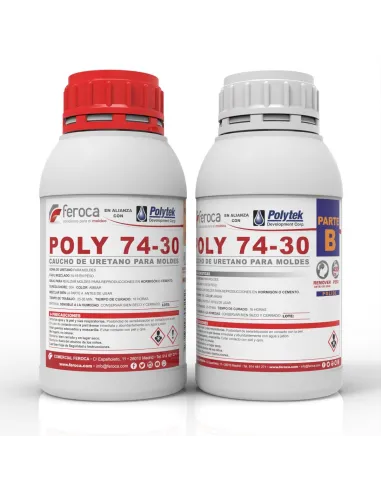
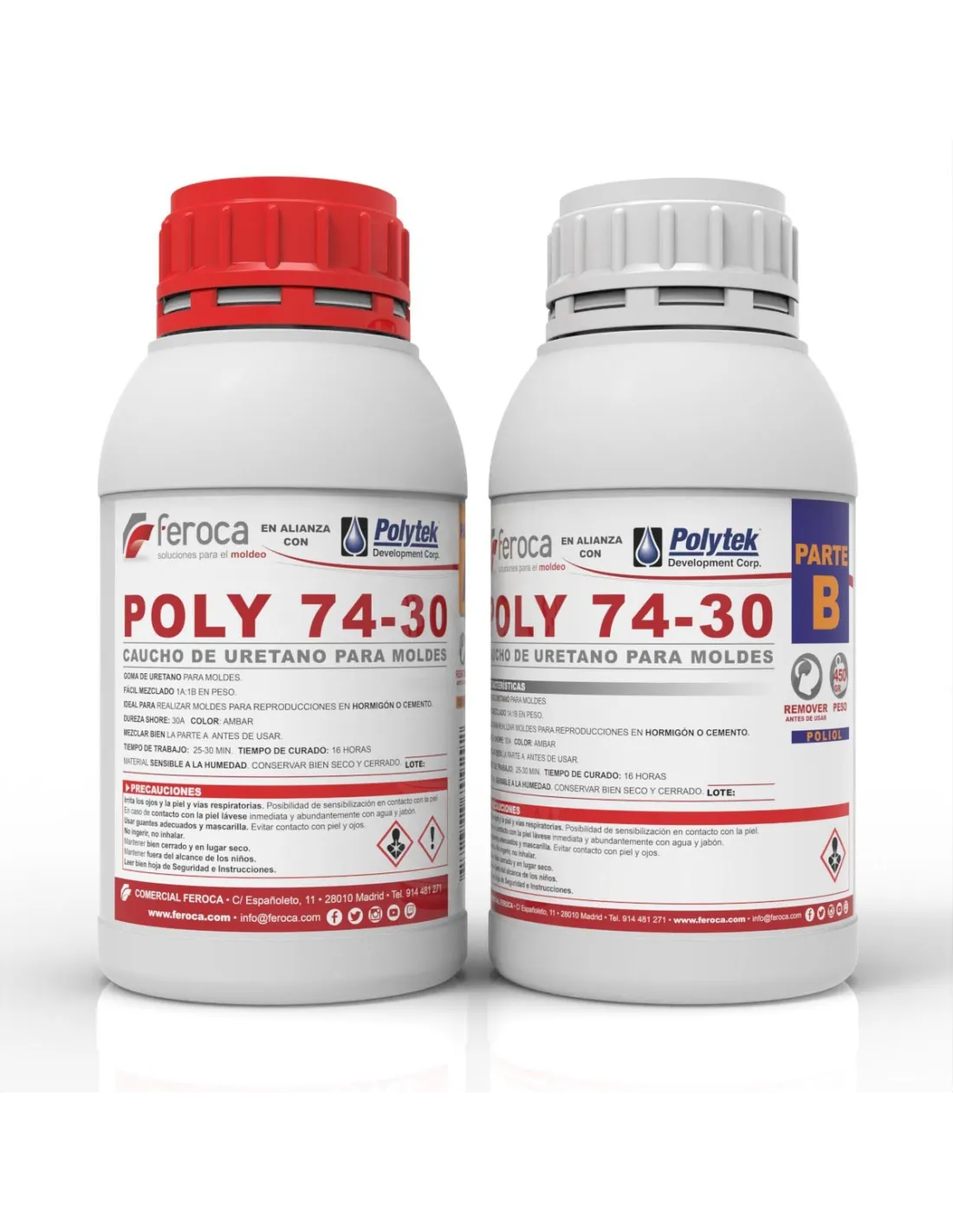
Poly 74-30 is a casting polyurethane rubber with Shore A30 hardness formulated for the production of high-output flexible moulds. Its equal-parts mix ratio, generous working time and excellent compatibility with concrete and cement make it a solid reference for architectural reproduction, sculpture and ornamentation workshops.
Technical specifications
| Parameter |
Value |
| Application |
Casting |
| Mix ratio (by weight) |
100A : 100B (1:1) |
| Shore Hardness |
A30 |
| Working time |
25-30 minutes |
| Cure time (demould) |
16 hours |
| Colour |
Amber |
What it is used for
Poly 74-30 is formulated for the production of flexible moulds that require a soft, tear-resistant rubber. Its behaviour with pigmented concrete is particularly noteworthy: the resulting castings show precise, uniform colours because the mould neither absorbs nor alters the pigment. It is a common choice in the following fields:
- Casting of decorative or architectural concrete and cement
- Reproduction and restoration of architectural elements: mouldings, bas-reliefs, capitals
- Decorative carpentry and ornamentation
- Sculpture and artistic casting
- Production of candles with complex geometry
- Reproduction of plaster or wax pieces
- Theming and set design
- Prototypes and medium-run industrial applications
How to use it
- Prepare the original model. Clean the piece and apply a release agent if the casting material requires it. For plaster or wax castings, a release agent is especially recommended to ease demoulding and extend mould life.
- Weigh the components. Mix part A and part B in a 1:1 ratio by weight. Use a precision scale to ensure the correct ratio; any significant deviation affects the cure and the final properties of the rubber.
- Mix thoroughly. Stir both components with slow, broad movements for at least 2-3 minutes, scraping the walls and bottom of the container well. Avoid vigorous stirring to prevent introducing air bubbles.
- Degas if you have a vacuum chamber. For fine-detail moulds, a 1-2 minute degassing cycle under vacuum removes microbubbles trapped during mixing.
- Pour slowly. Pour Poly 74-30 from the lowest point of the mould in a thin, continuous stream so that air displaces upwards without becoming trapped against the model.
- Monitor the working time. You have 25-30 minutes from the start of mixing. Plan the process so the casting is complete before the mixture begins to thicken.
- Allow 16 hours to cure. Keep the mould at room temperature (approximately 18 °C to 25 °C) without moving it during curing. Do not force demoulding prematurely.
- Demould carefully. Once 16 hours have elapsed, the rubber will have reached its working hardness. Remove the mould from the original model with gentle, even movements.
Warning: Polyurethane rubbers are sensitive to moisture. Always store the components with their lids tightly closed and use only the amount you need each time you open the container. Ambient humidity or the presence of water on the model can cause surface bubbles or poor curing. Work in a dry environment and ensure the model is completely dry before casting.
Usage tips
Temperature and cure time
Ambient temperature directly affects working time and cure. Below 18 °C the process slows down and demould time may exceed the stated 16 hours. Above 30 °C, pot-life shortens and you must work more quickly. For consistent results, always work between 20 °C and 25 °C. Do not subject the cured rubber to temperatures above 60 °C on a continuous basis.
Pigmentation and mould customisation
If you need to identify different moulds by colour or simply make it easier to detect surface defects, you can add polyurethane-compatible paste pigments directly into the mix before casting. Paste pigments are compatible with polyurethane rubbers and do not alter the material's mechanical properties as long as you use the manufacturer's recommended dosage. Do not use water-based pigments, as they can interfere with curing.
Counter-moulds and support shells
For moulds with complex geometry or large pieces, it is advisable to make a rigid support shell to keep the rubber mould in shape during casting. You can use mould and counter-mould plaster such as EXADURO, or a rigid polyurethane resin such as Feropur PR55+E55. This shell prevents mould distortion and extends its service life in series production.
Frequently asked questions
Is it necessary to use a release agent with this type of rubber?
It depends on the material of the original model. For porous models such as plaster, wood or gypsum, applying a release agent is essential: it prevents the rubber from penetrating the pores and adhering. For plastic, metal or cured resin models, a release agent eases demoulding and extends mould life. In any case, using a release agent is always a recommended practice with Poly 74-30.
Can I accelerate curing with heat?
Yes, a moderate temperature of between 40 °C and 50 °C can reduce the cure time of Poly 74-30. However, bear in mind that heat also shortens the available working time, so you should mix and pour before applying heat, not during mixing. Do not exceed 60 °C to avoid degrading the rubber.
How many castings can a mould made from this material withstand?
The number of castings depends on the material being poured, the use of a release agent and the care taken during demoulding. In decorative concrete production with a release agent and a good working process, Poly 74-30 moulds can deliver several dozen castings before showing appreciable wear. Service life increases significantly when the mould has a rigid support shell to prevent repeated distortion.
Can the rubber be pigmented before casting?
Yes. Polyurethane-compatible paste pigments can be added directly to Poly 74-30 during mixing. They are compatible with polyurethane rubbers and do not affect curing as long as the recommended dosages are observed. Avoid water-based pigments or those containing incompatible solvents, as they can interfere with the curing process.
Is it suitable for casting polyurethane resins, or only concrete?
Poly 74-30 is compatible with a wide variety of casting materials: concrete, cement, plaster, wax and rigid polyurethane resins such as Feropur PR55+E55. For resin castings into a polyurethane rubber mould, using a release agent is recommended, as some polyurethane systems can adhere to the mould if the surface is not protected.
What is the maximum temperature the cured rubber can withstand?
Polyurethane rubbers such as Poly 74-30 should not be subjected to temperatures above 60 °C on a continuous basis. Above this temperature they may soften, distort or degrade over time. If your application requires resistance to higher temperatures, consider using high-temperature silicones.
Why am I getting bubbles on the mould surface?
Surface bubbles in polyurethane moulds have two main causes: air trapped during mixing and moisture on the model or in the environment. To minimise them, mix with slow movements, pour in a thin stream and, if you have a vacuum chamber, degas the mixture before pouring. Also make sure the model is completely dry before pouring the rubber.
Can it be used to make candle moulds?
Yes, Poly 74-30 is a common choice for making candle moulds with complex geometry. Its Shore A30 hardness provides the flexibility needed to demould shapes with undercuts, and its smooth, non-porous surface allows a clean finish on the candle. For this use, a release agent is not necessary unless the wax you are pouring is particularly adhesive.
How much product do I need?Calculate the exact quantity before buying and avoid wasting material.
Go to the calculator →