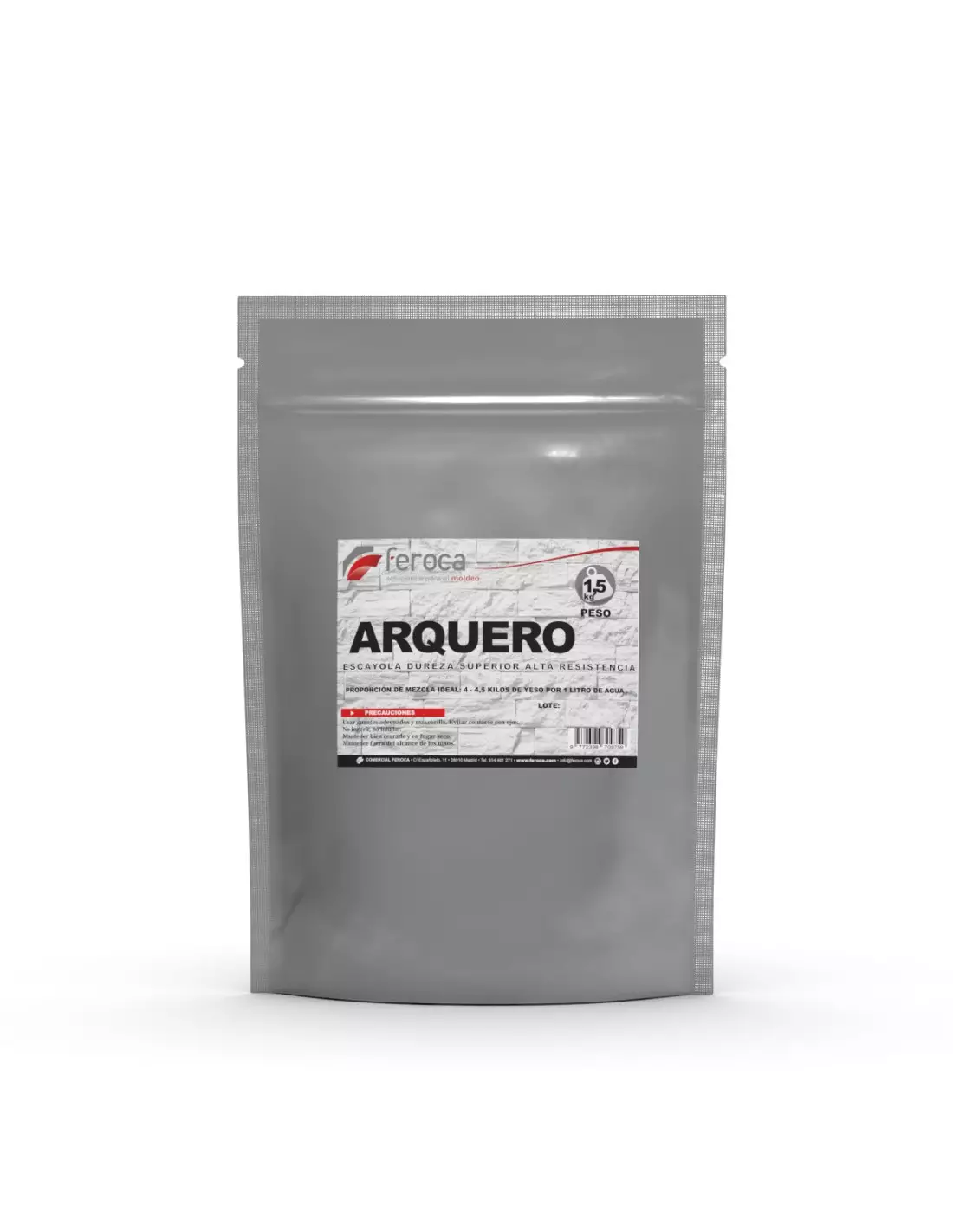
Arquero plaster is one of the hardest gypsum products available on the market: very low water/plaster ratio, minimal expansion, fast setting and exceptional surface hardness make it a solid alternative to epoxy, phenolic or polyester resins in prototyping and industrial tooling applications. If you need dimensional accuracy and extreme hardness, Arquero is your material.
Technical specifications
| Parameter |
Value |
| Material type |
Calcium sulphate (high-hardness plaster) |
| Water/plaster ratio |
Very low (maximum hardness and strength) |
| Setting expansion |
Very low |
| Surface hardness |
Very high |
| Water resistance |
High |
| Setting speed |
Fast (dependent on water temperature) |
| Powder colour |
White |
| Recommended working temperature |
Controlled ambient (see mixing instructions) |
| Presentation |
Powder |
What it is used for
Arquero is formulated for applications that demand a level of hardness and dimensional accuracy well beyond that of conventional plasters. It is especially valued in industrial and creative sectors where standard plasters do not provide sufficient mechanical strength:
- Manufacturing of dies for the ceramics industry
- Master models and high-precision prototypes
- Rigid mother moulds and jacket moulds for silicone moulds
- Casting and reproduction of decorative figures
- Faux marble and high-hardness decorative finishes
- Replacement of epoxy, phenolic or polyester resins in prototypes
- Professional Mold Making and FX applications
- Rigid support shells for flexible moulds
How to use it
- Prepare the water in a clean container at a controlled ambient temperature. Remember: the higher the water temperature, the shorter the setting time.
- Pour the Arquero plaster onto the water (never the other way around) and allow it to slake for a few seconds before mixing.
- Mix for approximately one minute using gentle, even movements, avoiding vigorous beating to prevent introducing air bubbles.
- Adjust the water/plaster ratio according to the application: less water means greater hardness and strength, but reduces the available pouring time.
- Apply a suitable Release agent (release wax) to the mould or support before pouring the mix.
- Pour the mix into the mould or support, making sure it fills all the details properly. You can gently tap the mould to release bubbles.
- Allow to set without moving the mould. Setting time varies with water temperature and plaster quantity.
- Once set, demould carefully and allow to dry completely in a ventilated environment before using or machining the piece.
Tips and advice
Water/plaster ratio: the key to hardness
The final hardness of Arquero depends directly on the amount of water you use. Working with the minimum possible amount of water maximises mechanical strength and reduces porosity. However, very dry mixes set quickly and leave little working time. Practise the optimal ratio for your application before making the final piece.
Temperature and environment control
Water and ambient temperature directly affect setting time. Cold water gives you more working time; warm or hot water accelerates setting. Always store the plaster and prepare the water in a space with a stable temperature. Never use hot water if you need time for fine details.
Correct storage to preserve properties
Store Arquero plaster in a dry place, on wooden pallets, keeping bags away from the wall and from each other to allow air circulation. Ambient moisture is this material's main enemy: a damp bag will begin to set in an uncontrolled way and loses strength. Close the packaging tightly after each use.
Frequently asked questions
What is the difference between this plaster and ordinary construction plaster?
Arquero plaster belongs to the high-hardness gypsum category, with a water/plaster ratio far lower than that of conventional construction plasters. This translates into far superior mechanical and surface strength, minimal setting expansion and a much lower absorption rate. Common plasters are not suitable for industrial tooling, precision prototypes or professional Mold Making, where Arquero delivers the required performance.
How do I avoid bubbles when mixing and pouring?
The most effective technique is to mix with gentle, even movements without beating hard. Once mixed, tap the container softly against the table to bring trapped bubbles to the surface. When pouring into the mould, do so in a thin, continuous stream from one side, letting the Arquero plaster flow and displace the air. You can gently tap the mould after pouring to release surface bubbles.
What release agent is recommended for plaster moulds and mother moulds?
For plasters like Arquero, release wax is the recommended option. Apply one or two thin coats to the surface, allowing each coat to dry before applying the next, before pouring the mix. Spray-type release agents such as Pol-Ease are not the most suitable for porous plaster surfaces.
Can I use this plaster as a shell or mother mould for a silicone mould?
Yes, this is one of its most common applications in Mold Making. Arquero is ideal for making rigid shells that support and position a flexible silicone mould. Its superior hardness and low expansion ensure that the shell does not distort either the mould or the reproduced pieces.
How much time do I have to work the mix before it starts to set?
Working time depends on the water/plaster ratio and the water temperature. At normal ambient water temperature and the recommended ratio, you have several minutes to pour and position. With less water or warmer water, the time is significantly reduced. If you need more time, work with cold water and do not reduce the amount of water excessively.
Is it suitable for reproducing figures in series or only for a single piece?
Arquero is used both for one-off pieces (prototypes, master models) and for series production when working with a flexible silicone or polyurethane rubber mould. The plaster itself is the fill or shell material; the longevity of the series depends on the flexible mould that contains it.
Can I machine or sand the piece once it has set?
Yes. Once completely dry and cured, Arquero accepts machining, sanding, milling and painting. Its high surface hardness makes it easy to achieve fine, precise finishes. Wait until the piece is completely dry inside before machining to avoid breakage.
What other plasters does Feroca offer if I need a different hardness?
Feroca distributes three professional plasters: Arquero (the hardest in the catalogue), Exaduro and Aladur. Each has its own specific characteristics in terms of hardness, setting time and water/plaster ratio. Check the data sheet for each product or contact the Feroca technical team to choose the most suitable one for your application.