Shopping Cart


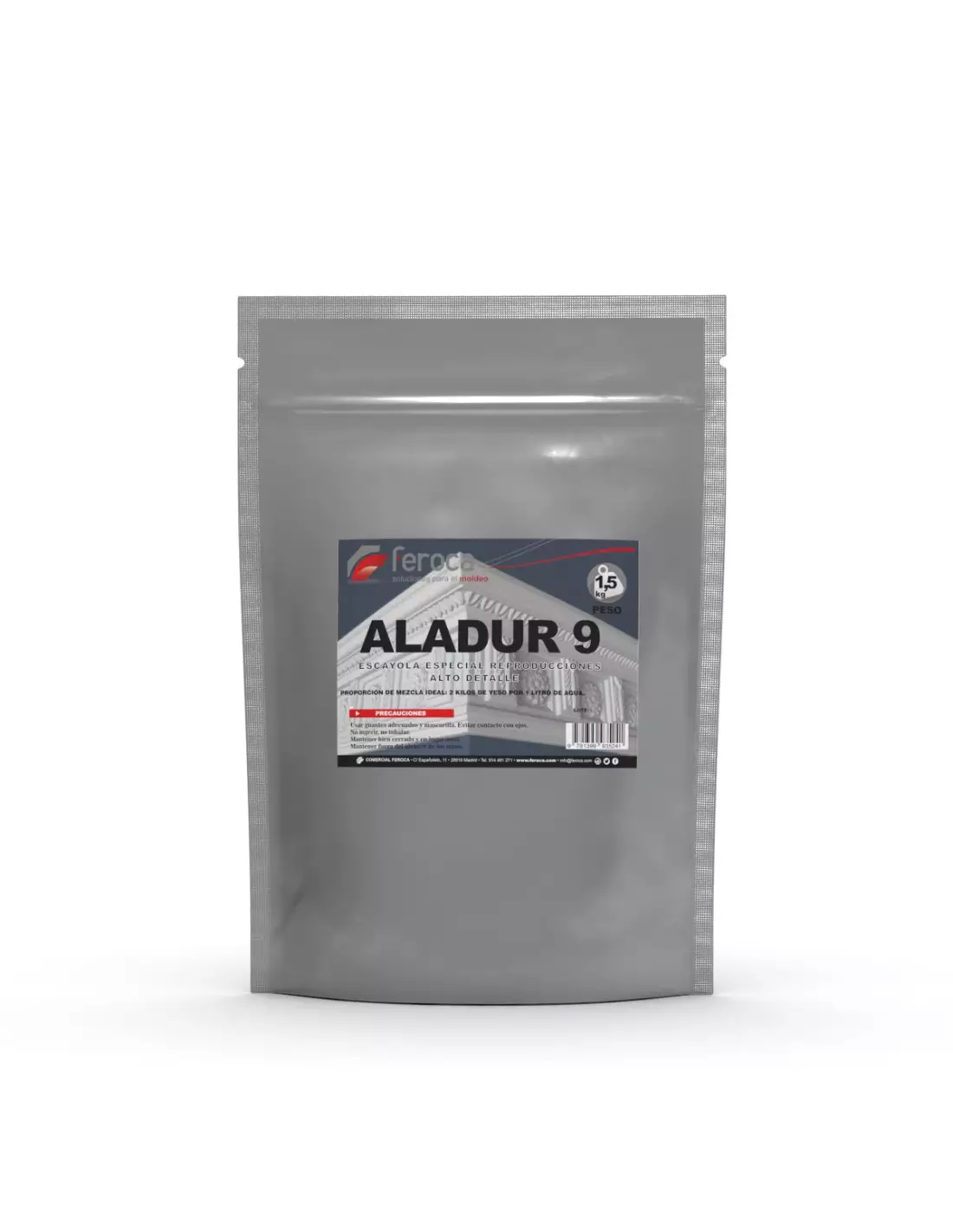
ALADUR 9 - Plaster for High Detail Reproductions
210072001
€7.00
8,47 € Tax incl.
8,47 € Tax incl.
High-strength casting plaster for fine-detail reproductions. Brinell hardness 650 kg/cm². 2:1 powder/water mix ratio. Ceramic white colour.
ALADUR 9 is a specialist casting plaster for high-detail reproductions, formulated with an extremely fine particle size and a Brinell hardness of 650 kg/cm² — well above conventional plasters. If you need copies with maximum definition, low absorption and a clean ceramic white finish, this is the right choice.
Technical specifications
| Property | Value |
|---|---|
| Mix ratio | 2 kg powder / 1 litre water |
| Setting start | 10 – 12 minutes |
| Demould time | From 28 – 30 minutes |
| Setting expansion | 0.20 % |
| Brinell hardness | 650 kg/cm² |
| Colour | Ceramic white |
| Particle size > 200 microns | Traces |
| Particle size > 86 microns | 0.5 % |
| Dihydrate solubility at 20 °C | 2.1 g/litre |
What it is used for
ALADUR 9 is designed for applications requiring maximum detail resolution and high mechanical strength in the finished piece. Its low absorption makes it especially suitable when used in combination with silicone or alginate moulds.
- Sculptural and artistic reproductions with fine detail
- Production of models for prosthetics, orthodontics and special effects
- casting in platinum or condensation silicone moulds
- casting in alginate moulds for hand, foot and body moulds
- Rigid shells or counter-moulds over flexible silicone moulds
- Replicas of industrial, archaeological or decorative pieces
- Master models for short production runs
How to use it
- Prepare clean containers and dry the work area. Any contaminant can affect the setting.
- Measure the water first: 1 litre for every 2 kg of ALADUR 9 powder.
- Add the powder to the water (never the other way round) and allow it to wet for 30 seconds without stirring.
- Mix gently and evenly for approximately 1 minute. Avoid vigorous beating to prevent incorporating air bubbles.
- Pour the mix into the mould. If working with a silicone mould, first apply a thin layer by tapping the mould to eliminate surface bubbles.
- Allow to set without moving the mould. Setting begins between 10 and 12 minutes.
- Demould from 28 – 30 minutes. The piece will continue to harden during the hours following demoulding.
- Allow to dry completely before sanding, painting or applying any surface finish.
Usage tips
Control the water/powder ratio
The 2:1 ratio (powder/water) is the reference mix. Reducing the amount of water will give greater final strength, but working time shortens noticeably and the mix becomes denser. Do not increase the water to gain more working time: it will weaken the piece and increase surface porosity.
Eliminate bubbles before setting
Gently tapping the mould on the bench during the first few minutes after pouring is enough to bring bubbles to the surface. If you have access to a vacuum chamber, degassing the mix for 30 – 60 seconds before pouring considerably improves the result. For moulds with complex geometry, slowly tilt and rotate the mould after the initial pour.
Correct storage to preserve properties
Store bags in a dry place, on wooden pallets and away from walls to allow air circulation. Moisture is the main enemy of plaster: a poorly sealed bag in a humid environment can partially pre-set and lose strength before use. Under correct conditions, ALADUR 9 retains its properties for months.
Frequently asked questions
What is the difference between a mould plaster and a reproduction plaster?
Mould plasters, such as Exaduro, are formulated to withstand multiple castings and the pressure of repeated demoulding. Reproduction plasters, such as ALADUR 9, prioritise grain fineness, surface hardness and low absorption so that the finished piece has maximum detail and finish. Using ALADUR 9 as a mould is possible, but it is not its optimal purpose.
Can it be poured directly into silicone moulds?
Yes. ALADUR 9 is fully compatible with silicone moulds, both condensation and platinum. Silicone does not require a Release agent with plasters, although if the mould has very enclosed areas a thin layer of release wax can help. The result is a white piece with all the detail of the mould.
Do I need a Release agent between plaster layers?
Yes, whenever you are joining two plaster layers or making a counter-mould over another plaster piece. Release wax is the most suitable option in this case. Apply one or two thin coats and allow to dry before pouring the second layer.
How much time do I have to work the mix before it starts to set?
With the standard 2:1 ratio, setting begins between 10 and 12 minutes. That is the available time to pour and position the mould. If you need more time, do not increase the water: work with smaller batches each time.
Can I use ALADUR 9 for body casting?
Not directly on skin. For body moulds the standard approach is to use alginate as the contact material and reinforce with plaster bandages to give rigidity to the assembly. ALADUR 9 is then used as the casting material inside the alginate mould to obtain the final replica with maximum detail.
Can the finished piece be painted or surface-treated?
Yes. Once fully dry, an ALADUR 9 piece accepts acrylic paints, lacquers, varnishes, patinas and sealers. To reduce absorption before painting, apply a coat of sealer or very diluted acrylic glue. The ceramic white base makes it easy to apply light colours without the need for a coloured primer.
What happens if the piece gets wet after setting?
ALADUR 9 has low absorption compared to conventional plasters, but it is not waterproof. Prolonged exposure to moisture can soften the surface and reduce strength. For outdoor use or in humid environments, always seal the piece with a suitable varnish or resin.
Can it be mixed with pigments to get a coloured piece?
Yes. Powder pigments or plaster-specific dyes can be added directly to the water before incorporating the powder. Bear in mind that some dyes can slightly alter setting time. Always run a test with a small amount before colouring a full batch.
No reviews
Tap to zoom