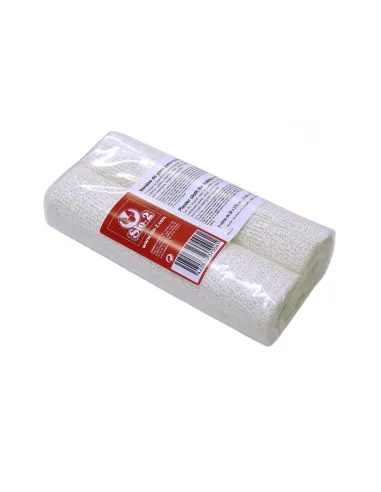
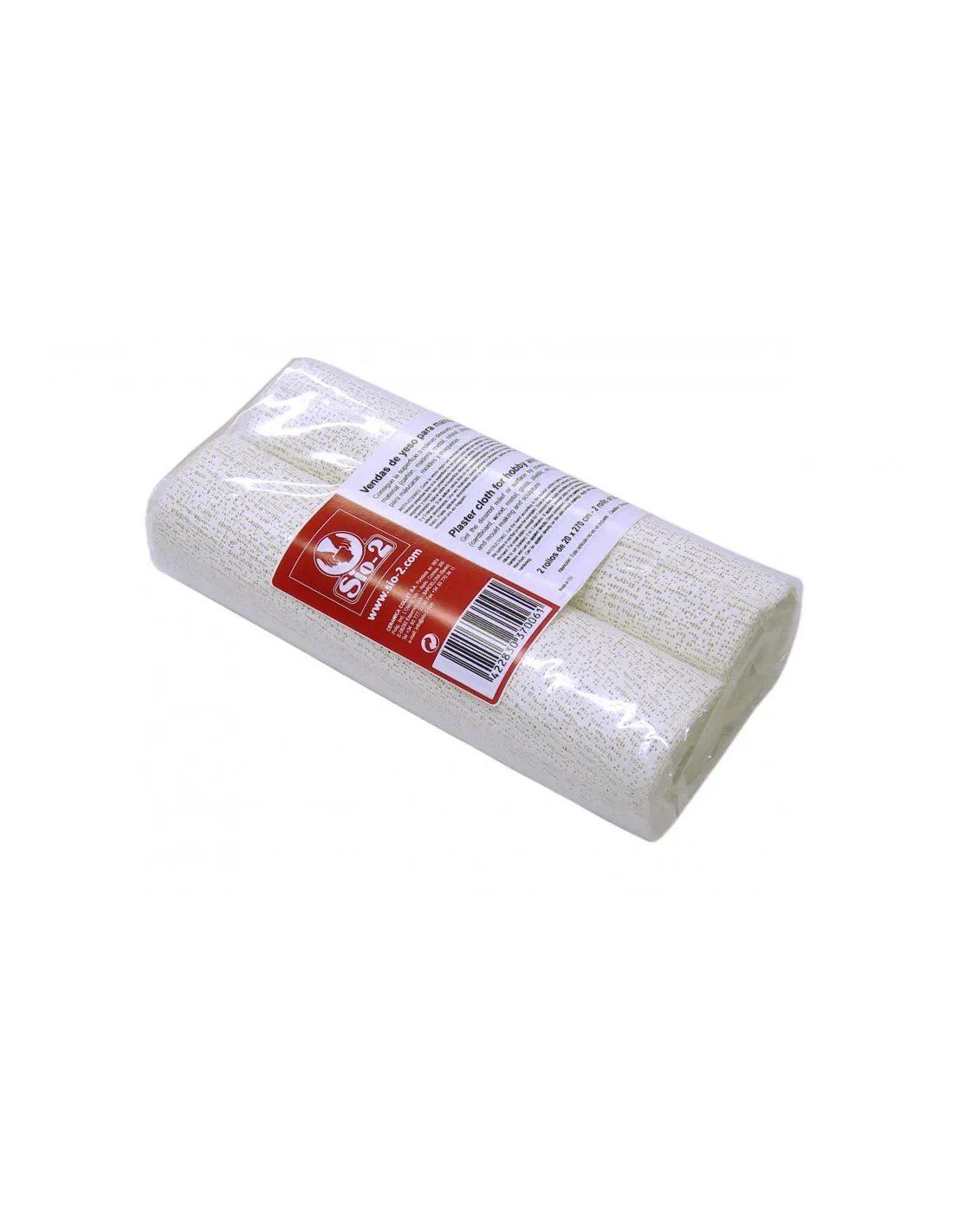
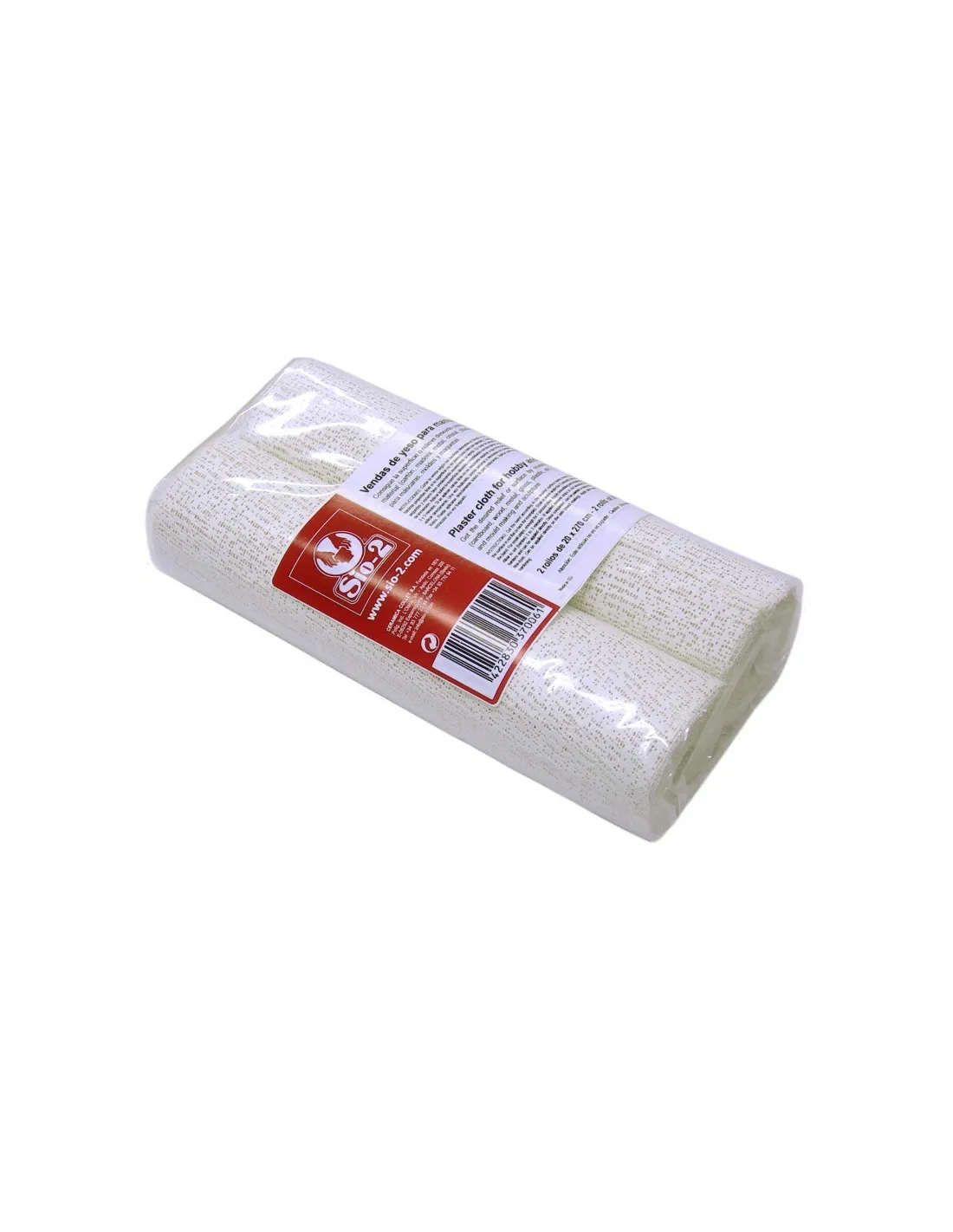
Sio-2 plaster bandages are the fastest and most versatile solution for creating rigid mother moulds in life casting, masks, scale models and modelling work on any surface. With a 20x270 cm format and a setting time of just 2-3 minutes, they give you the control and agility you need when working against the clock or directly on skin.
Technical specifications
| Format | 20 cm × 270 cm per roll |
|---|
| Units per pack | 2 rolls |
|---|
| Setting time | 2-3 minutes |
|---|
| Water immersion time | ~3 seconds |
|---|
| Recommended water temperature | Warm |
|---|
| Compatible surfaces | Skin, cardboard, wood, metal, glass, plastic and others |
|---|
| Application | Life casting, mother moulds, masks, scale models, sculpture |
|---|
What they are used for
Plaster bandages are essential in special effects workshops, life casting and modelling. Their fast cure and ease of application make them a go-to material for capturing three-dimensional forms with precision and without complications.
- Support mother moulds in life casting processes with silicone or alginate
- Making theatrical masks, special effects masks and carnival masks
- Architectural and industrial design scale models
- Textures and reliefs on cardboard, wood, metal, glass and plastic
- Sculptures and quick-volume prototypes
- Rigid support for flexible alginate moulds
- Educational projects and advanced craft work
How to use
- Cut the bandage into strips of the appropriate size for the surface you are covering. For complex areas, smaller strips give better results.
- If you are applying the bandages directly onto skin, apply a protective cream or petroleum jelly over the area to be moulded to avoid pulling hair and make removal easier.
- Dip each strip in warm water for approximately 3 seconds. No longer: excessive soaking softens the plaster too much.
- Gently squeeze the strip with your fingers to remove excess water without washing out the impregnated plaster.
- Apply the strip to the surface and smooth with your fingertips, shaping and adapting it to the form. Wet plaster integrates well between layers.
- Apply several overlapping layers without waiting for the previous one to dry: adhesion between strips is better when all of them are still wet.
- Allow to set for 2 to 3 minutes. Once set, the mother mould is rigid and ready to work with.
- For greater structural strength, apply a layer of high-strength plaster on the inside once demoulded.
Usage tips
Number of layers and strength
For a life casting mother mould that needs to bear the weight of silicone or alginate, apply a minimum of 3-4 crossed layers. Crossed layers (at 90° to each other) distribute stress more evenly and prevent the mother mould from distorting during demoulding. For areas with heavy relief or sharp edges, add an extra layer in those zones before closing the assembly.
Water temperature and working speed
Warm water activates setting faster than cold water. If you need a little more time to work on a complex area, use water at room temperature or slightly cool. In summer or in warm workshops, setting can be noticeably faster, so prepare your strips in advance and work in sequence to avoid losing time between strips.
Application on skin
When working on life casting projects on the human body alongside a lifecast silicone or a self-releasing body silicone, plaster bandages do not come into direct contact with skin: they are applied over the already cured layer of silicone or alginate. If for any reason there is direct skin contact (facial masks without an intermediate layer), cover the hair thoroughly with a cap and apply generous protective cream on the eyebrows and any hair-bearing area.
Frequently asked questions
What are plaster bandages used for in life casting?
In life casting, plaster bandages are used as a rigid mother mould layer over an already applied layer of silicone or alginate on the body. They give structure and rigidity to the flexible mould, preventing it from distorting when the casting material is poured inside. The Sio-2 20x270 cm bandages are ideal for this use due to their fast setting and ease of handling.
How many layers are needed for a strong mother mould?
For a functional life casting or sculpture mother mould, a minimum of 3 well-overlapped and crossed layers is recommended. For large or heavy pieces, 4-5 layers provide greater assurance. There is no need to wait between layers: apply all of them while the plaster is still wet so they bond better.
How long does the plaster in the bandages take to set?
Initial setting occurs within 2 to 3 minutes of application. However, full drying (when the mother mould reaches its maximum strength) can take several hours depending on layer thickness and ambient temperature. For workshop use, it is advisable to allow at least 20-30 minutes of drying before applying mechanical stress to the mother mould.
Can they be used on any surface?
Yes. Plaster bandages adhere well to cardboard, wood, metal, glass, plastic and skin (with protective cream). On non-porous surfaces (metal, glass, smooth plastic), adhesion is lower, so in those cases it is recommended to apply several crossed layers to increase cohesion between strips.
Can they be applied directly on skin without silicone or alginate?
Yes, although it is not the most common approach. If applied directly on skin, it is essential to first apply generous protective cream over the entire area and cover all hair thoroughly with a cap or petroleum jelly. Plaster generates a mild exothermic reaction during setting (slight heat), which under normal conditions is harmless, but you should inform the model before the session.
How long should the bandages be immersed in water?
Approximately 3 seconds in warm water. If immersed for too long, the plaster partially dissolves and the bandage loses strength. After immersion, gently squeeze with your fingers before applying.
Can the plaster surface be painted or finished once dry?
Yes. Once completely dry, the plaster surface accepts acrylic paint, latex, resins and other finishes. For decorative or display pieces, it is advisable to lightly sand the surface and apply a primer before the final finish.
What is the difference between using alginate and using plaster bandages for making moulds?
Alginate (such as Alga-Cast Slow or Alga-Cast Fast) is a flexible material that captures fine skin detail: pores, fingerprints, textures. Plaster bandages are rigid and do not capture that level of detail, but they are essential as structural support for the alginate or silicone mould. In a complete life casting process, both materials are used together: alginate or silicone in contact with the skin, plaster bandages on top as a rigid shell.