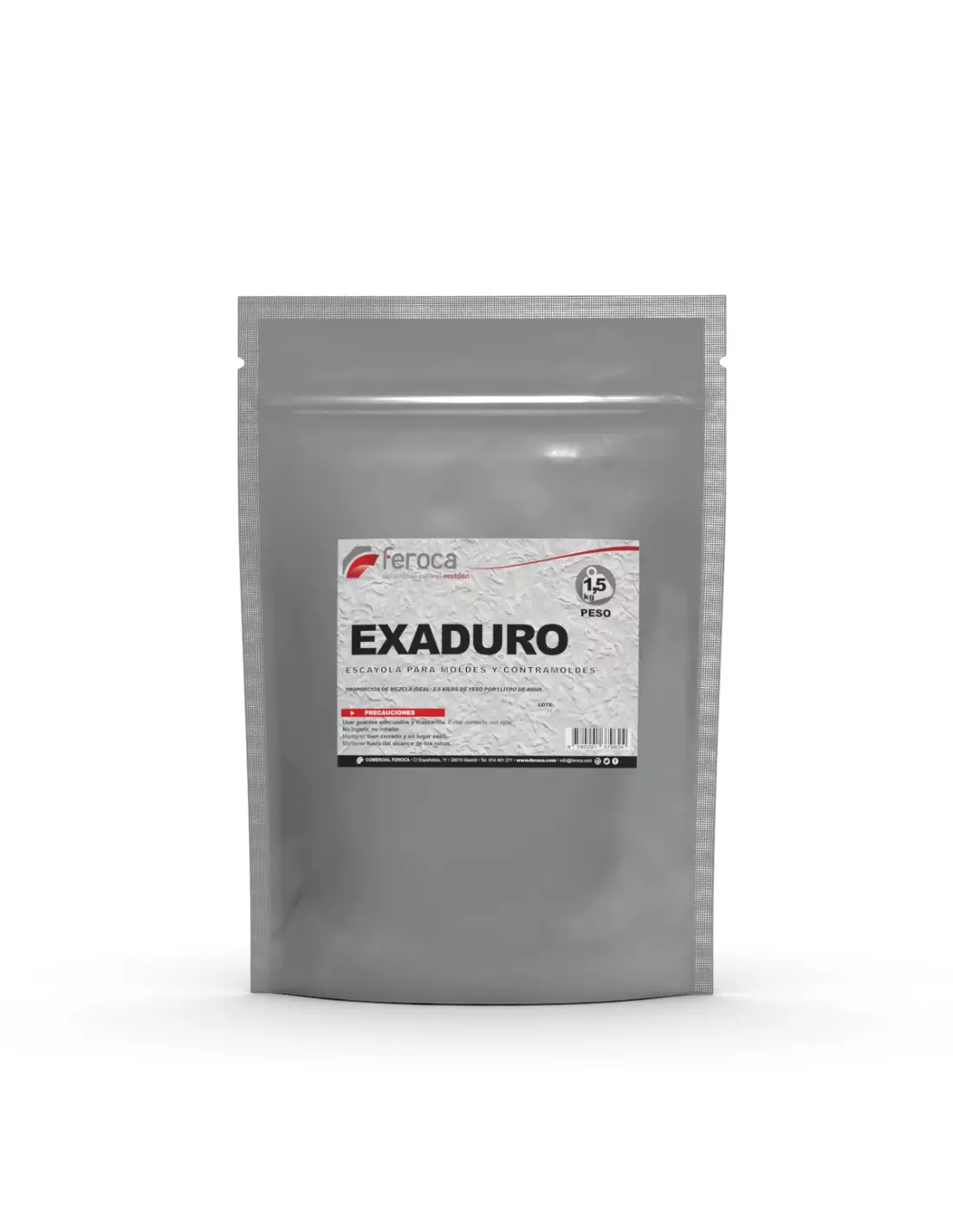
Exaduro is a very high-strength gypsum derived from calcium sulphate, specifically formulated for the production of models, moulds and counter-moulds that demand great surface hardness and low absorption. It is the standard choice in special effects workshops, the ceramic industry and figure casting when a technical plaster that far exceeds the performance of conventional plasters is required.
Technical specifications
| Parameter |
Value |
| Mixing ratio |
2.50 kg of plaster per 1 litre of water (water factor Wf 0.40) |
| Setting start |
8–10 minutes |
| Demoulding time |
From 30 minutes |
| Setting expansion |
0.25 % |
| Brinell hardness |
1,300 kg/cm² (130 N/mm²) |
| Colour |
Ceramic white |
| Particle size distribution >200 µm |
Traces |
| Particle size distribution >86 µm |
0.5 % |
| Dihydrate solubility at 20 ºC |
2.1 g/litre |
| Refractory use |
Not suitable |
What it is used for
Exaduro is designed for applications where mechanical strength and dimensional accuracy are critical. Its low setting expansion (0.25 %) guarantees faithful reproductions of the original, and its high Brinell hardness makes it resistant to wear during repeated casting processes.
- Rigid shells and counter-moulds for silicone moulds in special effects (FX) workshops
- Production of master models and matrices in the ceramic industry
- Casting of decorative figures and artistic reproductions
- Moulds for soaps and candles when hardness superior to standard plaster is required
- Rigid support for alginate moulds in facial and body lifecasting applications
- Counter-moulds in the shell mould (mother mould) technique, combined with platinum silicones or polyurethane rubber
How to use it
- Prepare the workspace: make sure both the water and the plaster are at a temperature between 18 and 22 ºC. The higher the water temperature, the shorter the setting time.
- Measure the proportions: use the ratio of 2.50 kg of Exaduro per litre of water (Wf 0.40). Using less water increases final strength but reduces the available pouring time.
- Pour the plaster into the water: always add plaster to water, never the other way around. Allow it to absorb for about 30 seconds before starting to mix.
- Mix: stir gently and evenly for approximately one minute. Avoid vigorous movements to prevent air bubbles from being incorporated. Containers must be clean and dry before use.
- Pour before setting begins: you have between 8 and 10 minutes from the start of mixing. Place the mixture into the mould or over the piece before it begins to harden.
- Apply release wax beforehand onto any surface that will be in contact with Exaduro if you need to separate the piece from the mould without damaging it.
- Demould from 30 minutes onwards: although the piece is already solid, full setting and maximum strength are reached after complete drying (24–48 h under normal conditions).
Usage tips
Temperature control and working time
Water temperature is the factor that most affects setting time. If you are working in summer or in a warm workshop, use cold water to gain pouring time. In winter, setting slows down: water at room temperature (18–22 ºC) will give more predictable results. Never use hot water: it accelerates setting in a way that is difficult to control and can reduce final strength.
Release agents: use wax, not solvent-based products
To separate Exaduro from itself (two-part counter-moulds) or from plaster models, apply several coats of paste release wax, allowing each coat to dry before applying the next. Solvent-based release agents are not suitable for porous surfaces such as plaster: they penetrate into the pores instead of forming a surface film. If you need to demould a silicone or polyurethane rubber piece housed in an Exaduro shell, the elastomeric nature of the material itself facilitates separation without any additional release agent.
Correct storage to preserve properties
Store Exaduro in a dry place, on wooden pallets or battens that keep the bags off the floor, and leave space between rows and walls so that air can circulate freely. Ambient humidity is the main enemy of plaster: it accelerates pre-setting inside the bag and reduces the strength of finished pieces. Correctly stored, Exaduro retains its properties for several months. If you notice that the mixture sets faster than normal or that pieces come out with lower hardness, this is a sign that the material has absorbed moisture.
Frequently asked questions
What is the difference between a high-strength plaster and a conventional plaster?
Conventional plasters have a Brinell hardness of around 200–400 kg/cm². Exaduro reaches 1,300 kg/cm², meaning a surface far more resistant to scratching, wear from repeated castings, and impacts during handling. In addition, its finer particle size and low setting expansion (0.25 %) provide greater dimensional accuracy in moulds and copies.
Can it be used for repeated casting moulds?
Yes. The high hardness of Exaduro makes it especially suitable for moulds that will receive multiple pours. Even so, always apply release wax between castings to protect the mould surface and facilitate demoulding without deteriorating the detail.
Is it suitable for refractory applications or high-temperature work?
No. Exaduro is not a refractory plaster and is not formulated to withstand high temperatures. If you need a mould for processes involving intense heat (metal casting, high-temperature ceramics, etc.), you must use specifically refractory materials. Feroca does not distribute refractory plasters.
With which materials can it be used as a counter-mould or shell?
Exaduro is compatible as a rigid shell for silicone moulds (both platinum and tin) and polyurethane rubber moulds. It is also used alongside alginates in lifecasting work, where the plaster acts as a rigid support for the flexible mould. Always apply the appropriate release agent between materials to ensure separation.
Can I use less water to obtain greater strength?
Yes, reducing the water factor (Wf) below 0.40 increases final mechanical strength. However, the mix becomes more viscous and the pouring time is considerably reduced. For pieces with complex geometry or when you need time to place the mixture correctly, stick to the recommended ratio of 2.50 kg of plaster per litre of water.
How do I avoid air bubbles on the surface of the piece?
Gentle and even mixing is key: avoid fast or vigorous movements that incorporate air. Pour the mixture in a thin stream from a certain height so that it flows into the detailed areas before filling the volume. If you have a vibrating table, use it during the first few minutes after pouring so that bubbles rise to the surface.
How long can the product be stored without losing its properties?
Stored correctly in a dry place, on battens that keep it off the floor and with ventilation between bags, Exaduro retains its properties for several months. The clearest sign of moisture degradation is faster-than-normal setting or a lower-than-expected final strength. If you notice either of these symptoms, discard the material.
What is the most suitable release agent for plaster on plaster?
Paste release wax is the most effective option for separating plaster from plaster. Apply two or three coats, allowing each one to dry before applying the next, and give a light buff with a soft cloth before pouring the second part. Liquid solvent-based release agents are not recommended on porous surfaces such as plaster, as they do not form a uniform film.