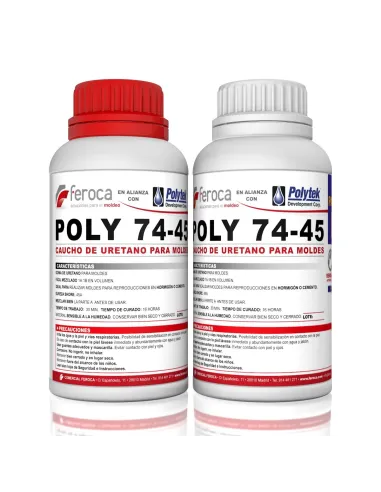
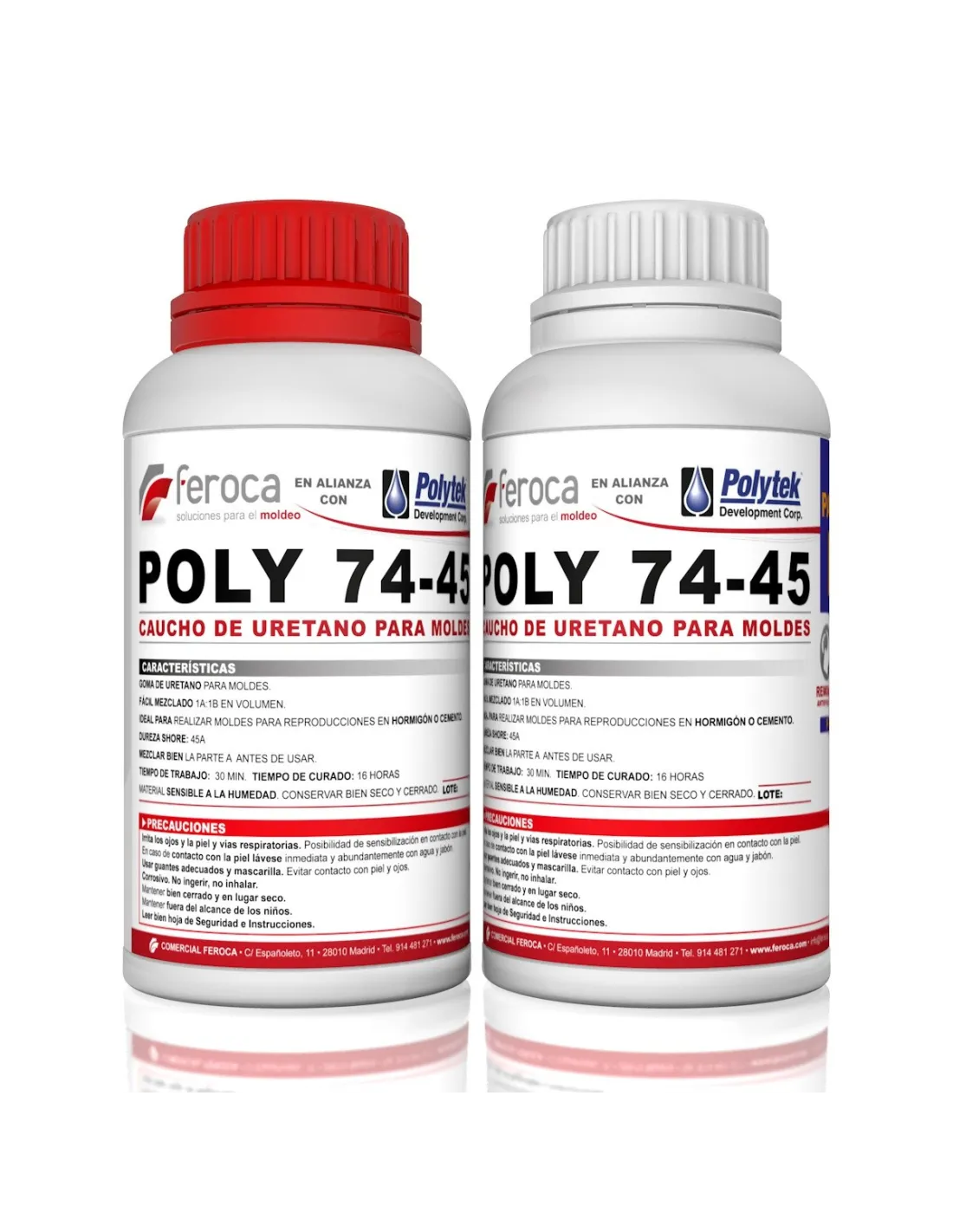
Poly 74-45 is a two-component polyurethane rubber with Shore A45 hardness designed for the production of flexible moulds with high production runs. It cures at room temperature with no appreciable shrinkage, mixes in equal parts by volume and requires no vacuum chamber, making it a straightforward and efficient option for professional workshops and semi-industrial environments alike. It excels particularly in applications with pigmented concrete, where it delivers reproductions with precise and uniform colours.
Technical specifications
| Parameter |
Value |
| System |
Two-component polyurethane (A+B) |
| Shore Hardness |
A45 |
| Mix ratio by weight |
100A : 100B |
| Mix ratio by volume |
100A : 100B |
| Working time (pot life) |
30 minutes |
| Cure time (demould) |
16 hours |
| Colour |
Yellow |
| Shrinkage |
No appreciable shrinkage |
| Vacuum requirement |
Not required |
| Maximum service temperature |
60 °C |
What it is used for
Poly 74-45 is a versatile rubber aimed at producing flexible moulds with a long service life. Its Shore A45 places it in a medium-soft range that allows demoulding of undercut geometries without damaging either the mould or the part. It is especially valued in applications involving decorative concrete and architectural reproduction.
- Casting of concrete and decorative cement, including pigmented concrete
- Reproduction and restoration of architectural elements (mouldings, reliefs, capitals)
- Ornamental joinery and manufacture of cornices, frames and decorative appliques
- Sculpture and artistic casting
- Manufacture of candles with complex shapes
- casting of plaster and wax in craft and industrial production
- Theming of spaces and theme parks
- Industrial applications of low to medium complexity
- Advanced crafts and hobbies
How to use it
- Preparation of the original: Make sure the model is clean, dry and free of dust. If the original material is porous (plaster, wood, concrete), apply a first coat of release agent such as Pol-Ease 2300 and allow it to dry.
- Conditioning the components: Bring both components to workshop temperature (18–25 °C). Stir or mix component A thoroughly before use, as it may settle over time.
- Weighing or measuring: Mix equal parts of A and B, both by weight and by volume (1:1 ratio). Use a precision scale or graduated containers to ensure the exact proportion.
- Mixing: Pour component B onto A and mix thoroughly for 2–3 minutes, scraping the sides and bottom of the container. The resulting mix will be a uniform colour when ready.
- Casting: Pour the material slowly over the lowest point of the model, allowing it to flow across the piece to displace air. You have 30 minutes of working time before gelation begins.
- Curing: Allow to cure at room temperature for a minimum of 16 hours before demoulding. Do not accelerate curing with excessive heat.
- Demoulding and cleaning: Once cured, demould carefully. The mould is ready for production. Clean tools with solvent before the material hardens.
Caution — Moisture inhibition: Polyurethane rubbers are sensitive to moisture. Component B (isocyanate) reacts with ambient water, generating CO₂ bubbles that ruin the cure. Always keep containers tightly sealed and store them in a dry place. If component B appears cloudy or shows crystals, it has absorbed moisture and must not be used. Work in conditions of low relative humidity whenever possible.
Usage tips
Release agent: when and how much
Plaster and wax generally do not require a release agent when cast into Poly 74-45 moulds, but concrete and polyurethane resins do. Always apply a suitable release agent in thin, even coats before the first casting. An insufficient coat can cause adhesion and damage both the mould and the part.
Temperature and series production
Ambient temperature directly affects working time and cure. Above 25 °C the pot life shortens and the material may gel before the casting is complete in large moulds. Below 18 °C the cure slows considerably and surface issues may appear. For series production, work in the 20–24 °C range and keep the components at a consistent temperature.
Pigmenting the rubber
If you need to colour the mould for identification or decorative purposes, paste pigments compatible with polyurethane resins can be mixed directly into Poly 74-45. Add the pigment to component A before incorporating B, mix well, then proceed with the usual mixing process. Keep the pigment percentage below 3% to avoid compromising the mechanical properties of the rubber.
Frequently asked questions
Do I need a vacuum chamber to degas this rubber?
No. Poly 74-45 is formulated so that vacuum degassing is not required. Pouring the material slowly in a thin stream over the lowest point of the mould is sufficient to minimise bubbles for most applications. Only for very fine-detail parts might vacuum be advisable.
How many times can I use a mould made with this rubber?
The service life of the mould depends on the material being cast and on correct use of release agent. When casting concrete with an appropriate release agent, Poly 74-45 moulds can withstand high production runs. Without release agent or with aggressive materials, the service life is dramatically reduced.
Can it be used to cast polyurethane resins?
Yes, but a suitable release agent must be applied before each casting. Polyurethane resins, such as Feropur PR55+E55, tend to adhere to polyurethane moulds if no release agent is applied. Without it, the part can bond permanently and destroy the mould.
What is the maximum temperature the finished mould can withstand?
Polyurethane rubber moulds should not exceed 60 °C in service. Above that temperature the material may deform or degrade, shortening the service life of the mould.
Can I add pigment directly to the rubber?
Yes. Paste pigments compatible with polyurethane are mixed directly with component A before adding component B. Keep the pigment percentage below 3% by weight to avoid altering the mechanical properties or the cure of Poly 74-45.
Does it work well with coloured decorative concrete?
This is one of the key strengths of Poly 74-45. Moulds made with this rubber deliver concrete reproductions with very precise and uniform colours, something particularly valued in the production of decorative and architectural pieces where colour consistency is critical.
Do I need a release agent to cast plaster or wax?
In general, plaster and wax do not require a release agent when cast into Poly 74-45 moulds. Even so, in series production it is advisable to apply a thin coat of release agent to extend the service life of the mould and ease demoulding.
What happens if component B has absorbed moisture?
If component B (isocyanate) appears cloudy, shows crystals or has an abnormal viscosity, it has reacted with ambient moisture and must not be used. The result would be a defective cure with internal bubbles. Always store containers tightly sealed and in a dry place to avoid this problem.
How much product do I need?Calculate the exact amount before buying and avoid wasting material.
Go to the calculator →