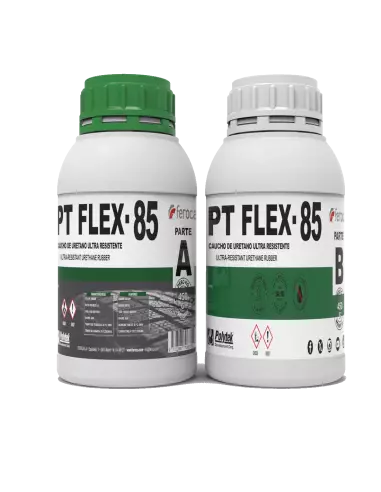
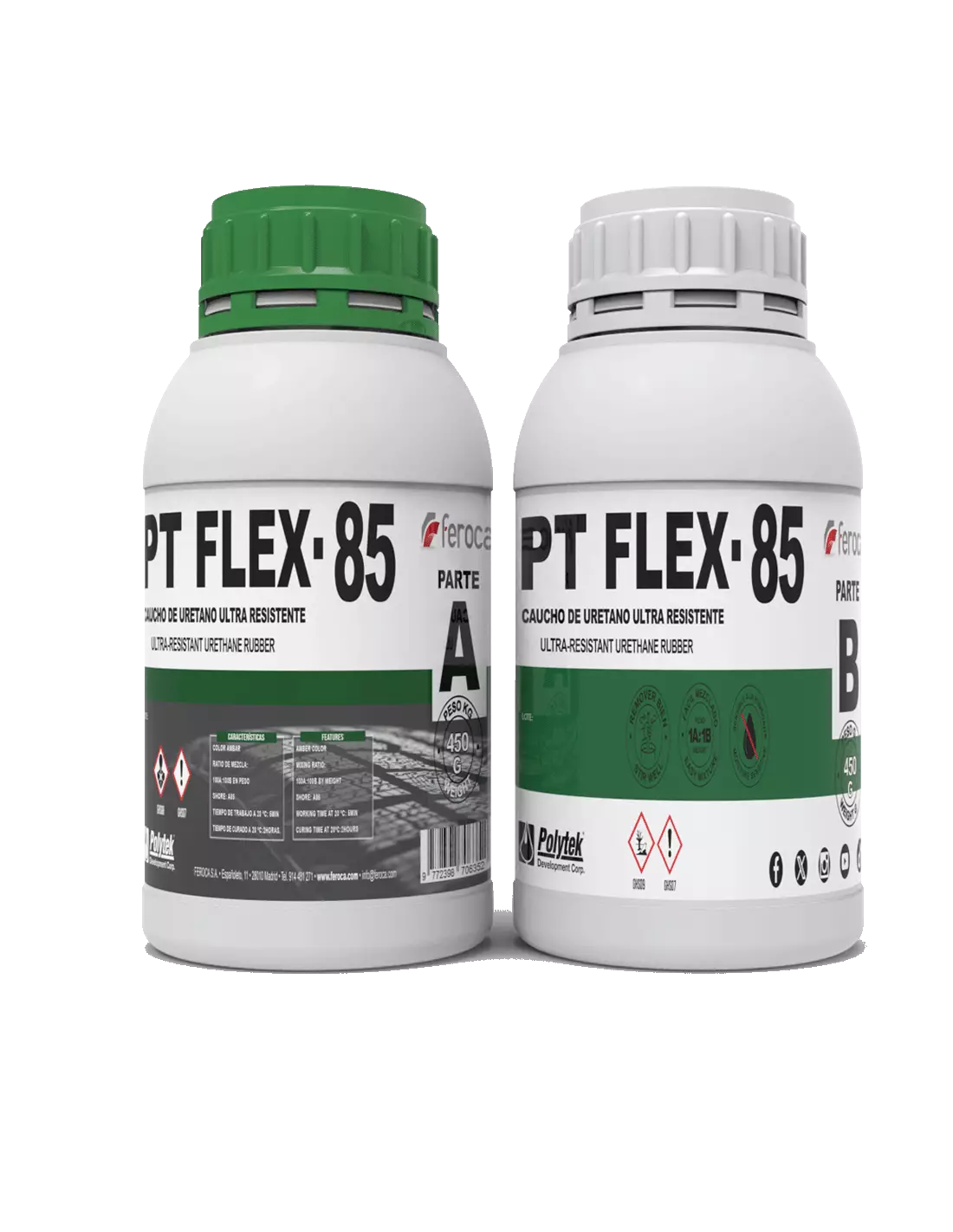
PT Flex 85 is a two-component polyurethane rubber with a Shore Hardness of 85A designed for applications that demand extreme resistance to tearing, abrasion and impact. Its phthalate-free, mercury-free and MOCA-free formulation, combined with its low viscosity and 1:1 mix ratio by weight and volume, makes it a very convenient material to work with in the workshop, delivering professional results and outstanding dimensional stability.
Technical specifications
| Parameter |
Value |
| Material type |
Two-component polyurethane rubber |
| Shore Hardness |
85A |
| Colour |
Amber |
| Mix ratio by weight |
100A : 100B |
| Mix ratio by volume |
100A : 100B |
| Pot life |
5 minutes |
| Cure time |
2 hours |
| Application method |
casting |
| Maximum service temperature |
60 °C |
| Phthalate-free / Mercury-free / MOCA-free |
Yes |
What it's used for
PT Flex 85 is the go-to polyurethane rubber when you need finished parts that can withstand demanding service conditions. Its Shore 85A places it in the semi-rigid-flexible range, ideal for components that must absorb impacts without permanently deforming. It pigments easily with PolyColor Dyes to produce parts with solid colour throughout the mass.
- Manufacturing of silentblocks and engine mounts for low thermal-demand applications
- Rollers, gaskets and industrial wear parts
- FX props and set dressing requiring durability
- Functional prototypes and display pieces
- Soles and technical footwear components
- Forming tools and workshop jigs
- Reproductions that must withstand continuous handling
How to use it
- Prepare the mould. Apply a suitable Release agent to the mould surface to aid demoulding. Silicone moulds do not always require it, but it is essential for rigid moulds.
- Condition the components. Bring both components (A and B) to workshop temperature (20–25 °C). Make sure the containers have not been left open for too long to prevent absorption of ambient moisture.
- Weigh or measure the components. Mix in a 1:1 ratio by both weight and volume. Use a precision scale for greater accuracy.
- Add pigment if needed. Incorporate PolyColor Dyes into component A before mixing with B for a homogeneous colour dispersion.
- Mix carefully. Stir vigorously for at least 60 seconds, scraping the sides and bottom of the container. Pot life is only 5 minutes, so work quickly.
- Pour into the mould. Cast in a thin, continuous stream, preferably at the lowest point of the mould, to minimise air bubble entrapment.
- Allow to cure. The material reaches functional cure in 2 hours at room temperature. Do not demould before this to avoid deformation.
- Demould and post-cure if necessary. For high mechanical-demand applications, a post-cure in an oven at 60 °C for 2–4 hours can improve the final properties.
Warning — Moisture sensitivity: PT Flex 85 is highly sensitive to moisture once opened. Exposure to air can generate bubbles in the mix and compromise the cure. Always seal containers tightly after use, store them in a dry place and, if possible, purge the headspace with an inert gas (nitrogen). Do not use the material in environments with relative humidity above 60% without appropriate precautions.
Usage tips
Control working temperature
Ambient temperature directly affects pot life and cure speed. Above 25 °C pot life shortens noticeably; below 18 °C curing may slow down and affect the final mechanical properties. Always work within a range of 20–25 °C for reproducible results. Remember that the maximum service temperature of the cured part is 60 °C; do not expose parts to heat sources above this.
Minimise bubbles during casting
Given the short pot life (5 min), there is no time to vacuum degas the mix once prepared. If your application is critical regarding porosity, degas each component separately under vacuum before mixing, or pre-heat the mould to 30–35 °C to encourage bubble release during filling. Pouring in a thin stream and slightly tilting the mould during filling also helps.
Pigmentation and customisation
PolyColor Dyes are the polyurethane-specific pigments in the Feroca catalogue and are fully compatible with PT Flex 85. Add the pigment to component A and mix thoroughly before incorporating component B. Feroca's paste pigment range is also compatible. Do not use water-based pigments, as they would react with the isocyanate and ruin the cure.
Frequently asked questions
What is the maximum service temperature of this polyurethane rubber?
PT Flex 85 should not exceed 60 °C in service. Above this temperature the mechanical properties degrade and the part may deform under load. For applications with higher thermal requirements, consider alternative materials from the Feroca catalogue.
Can I use this rubber to manufacture silentblocks or engine mounts?
Yes. PT Flex 85 with its Shore 85A is the recommended polyurethane rubber for manufacturing silentblocks and anti-vibration elements for low thermal-demand applications (up to 60 °C). For applications exceeding that temperature, other alternatives should be considered.
Is it necessary to use a Release agent with this material?
Yes, it is recommended to apply a Release agent whenever the mould is rigid (resin, plaster, wood, metal). With silicone moulds it may not be necessary, although a light application eases demoulding and extends mould life. Check the Feroca catalogue for the appropriate Release agent for your substrate.
Can I pigment the polyurethane rubber?
Yes. PolyColor Dyes and Feroca's paste pigment range are fully compatible with PT Flex 85. Always add the pigment to component A before mixing with B. Avoid water-based pigments.
Why should it not be mixed with silicone or silicone oil?
Silicone oils, such as DC Fluid 50, are formulated for tin silicones and are not compatible with polyurethane rubbers. Their incorporation can inhibit or alter the cure and degrade the mechanical properties of the material. To adjust the fluidity of PT Flex 85, work with the components at the appropriate temperature.
Can it be laminated with reinforcement fabrics such as carbon fibre or fibreglass?
This is not recommended. Reinforcement fabrics are designed for rigid materials; in flexible rubbers like PT Flex 85 they do not provide significant structural improvement and can compromise the flexibility of the part. If rigidity is needed, consider combining the rubber with a rigid resin such as Feropur PR55+E55 in specific areas of the part.
How long can I store the product unopened?
Check the expiry date indicated on the container. Storage must be carried out in a cool, dry place, away from heat sources and moisture. Once opened, the product is highly sensitive to ambient moisture, so containers must be sealed tightly and the material consumed as soon as possible.
What is the difference between PT Flex 85 and a polyurethane rubber for mould making?
Polyurethane rubbers for Mold Making, such as Poly 74-45, are formulated to reproduce fine details and withstand multiple demoulding cycles. PT Flex 85, with its Shore 85A and extreme resistance to abrasion and impact, is primarily aimed at the production of functional finished parts, not mould making.
How much product do I need?Calculate the exact amount before buying and avoid wasting material.
Go to the calculator →