Shopping Cart


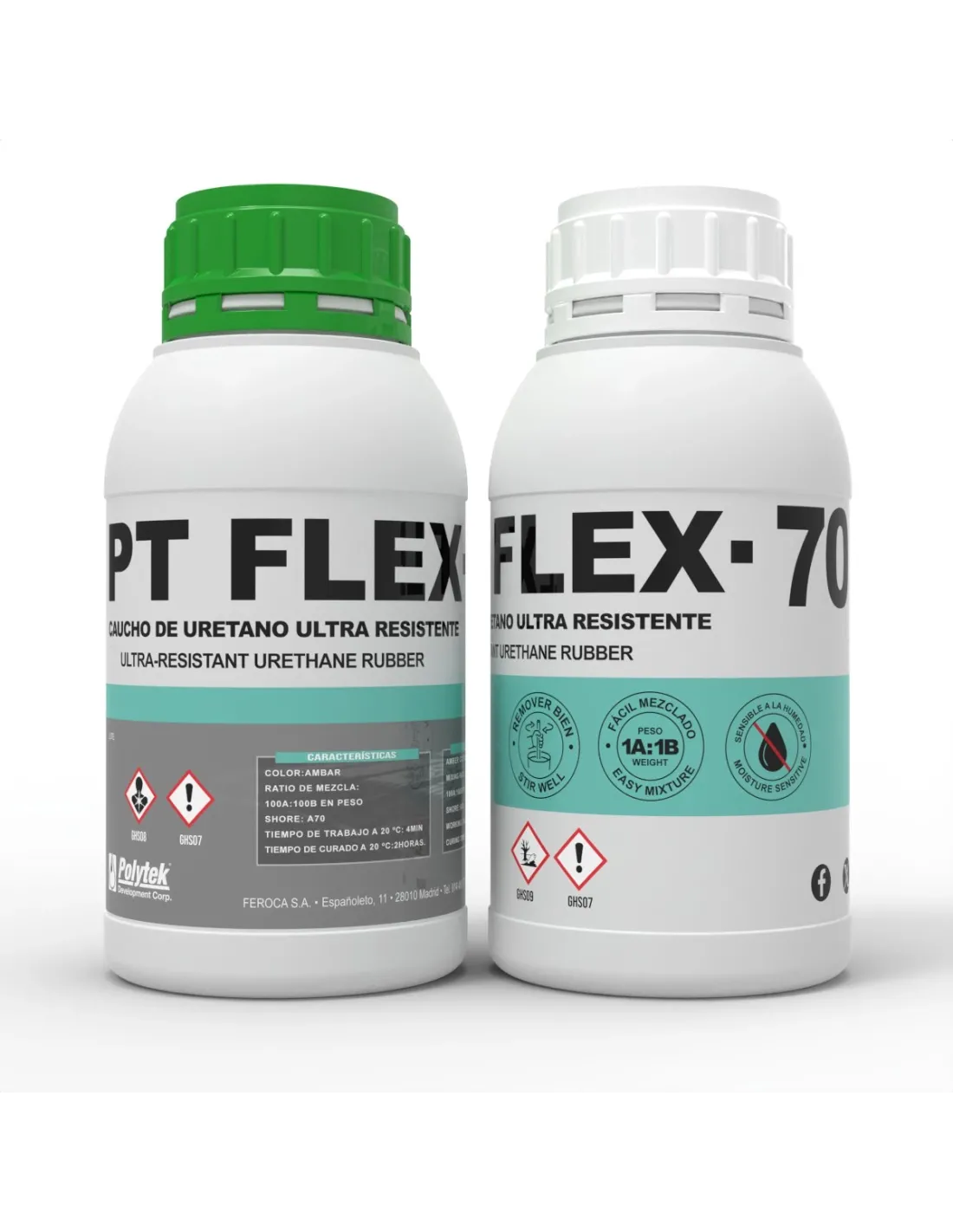
PT Flex 70 -Ultra Resistant Polyurethane Rubber -
432026101
€26.70
32,31 € Tax incl.
32,31 € Tax incl.
Shore A70 polyurethane rubber, 1A:1B mix ratio by weight, 4 min pot life and 2-hour cure. Ultra resistant to abrasion and impact.
PT Flex 70 is a two-part polyurethane rubber with Shore A70 hardness and exceptional resistance to tearing, abrasion and impact. Its low viscosity makes casting easy, its 1A:1B mix ratio simplifies workshop work, and the result is a flexible, stable part with a translucent amber finish. Free from phthalates, mercury and MOCA.
Technical specifications
| Parameter | Value |
|---|---|
| Material type | Two-part polyurethane rubber |
| Shore hardness | A70 |
| Colour | Amber |
| Mix ratio (weight) | 1A : 1B |
| Mixed viscosity | 700 cP |
| Specific gravity | 1.05 (water = 1) |
| Pot life | 4 minutes |
| Cure / demould time | 2 hours |
| Tensile strength | 5.0 MPa (730 psi) |
| Elongation at break | 175 % |
| Tear strength (Die C) | 22.8 kN/m (130 pli) |
| Maximum service temperature | 60 °C |
| Phthalates / Mercury / MOCA | Free from |
What it is used for
PT Flex 70 is aimed at manufacturing parts that need to absorb impacts, withstand continuous friction or maintain their shape under repeated loads. Its high hardness within the flexible range makes it a solid choice for industrial and special effects applications:
- Manufacture of wheels, rollers and parts subject to abrasion
- Silent blocks, anti-vibration mounts and medium-to-high demand damping elements
- Functional prototypes requiring structural flexibility with good mechanical strength
- Props and display pieces with a translucent amber finish
- Workshop tooling, shims and flexible clamping elements
- Reproductions and replicas with high wear and tear resistance
- Secondary moulds for short runs on resistant models
How to use it
- Prepare the mould or surface. Make sure the mould is clean, dry and free of residue from previous cures. Apply a suitable release agent for polyurethane to all surfaces that will come into contact with the material.
- Condition the components. Bring the part A and part B containers to workshop temperature (20–25 °C). Stir or agitate each component separately before mixing, as they may settle on standing.
- Weigh or measure the parts. Mix part A and part B in a 1A:1B ratio by weight. Use a precision scale for accuracy.
- Mix decisively. Combine both parts for 60–90 seconds, scraping the walls and bottom of the container thoroughly. The pot life is only 4 minutes, so work quickly.
- Add pigment if needed. If you want to colour the part, add a few drops of PolyColor Dyes to the mixture before casting. They are compatible and do not affect the cure.
- Pour into the mould. Cast the material in a thin, continuous stream to help air escape. Fill from the lowest point upwards whenever possible.
- Cure time. Leave undisturbed for at least 2 hours at room temperature. After this time the part can be demoulded.
- Demould and post-cure if necessary. For high-performance mechanical applications, a post-cure at moderate temperature (not exceeding 60 °C) can improve final properties.
Important notice — Two-part polyurethanes: polyurethane rubbers are moisture-sensitive. Part A (isocyanate) can gel if exposed to humid air for a prolonged time. Always seal containers immediately after use and store them in a dry place. If the material shows lumps or crystallisation, do not use it: the cure may be compromised. Work in an environment with stable temperature; cold slows down the cure and excessive heat speeds it up unevenly.
Usage tips
Managing the pot life
With only 4 minutes of pot life, planning is key. Have the mould ready and the release agent applied before you start mixing. For large pours or complex parts, split the mix into smaller batches or work with two people: one mixing while the other pours. Do not try to extend the pot life by adding more of one component; it alters the mechanical properties of the cure.
Temperature and humidity in the workshop
The ideal working temperature is between 20 and 25 °C. Below 18 °C the material becomes more viscous, mixing is harder and the cure slows down. Above 30 °C the pot life shortens further. Avoid working in environments with relative humidity above 70 %: the isocyanate (part A) reacts with water vapour and can generate bubbles or alter the cure.
Colouring and finishes
PT Flex 70 can be coloured with PolyColor Dyes, Feroca's special pigments for polyurethane. Add the pigment to part B before mixing with part A to ensure even dispersion. Do not exceed 3–5% of the total mix weight so as not to compromise the mechanical properties.
Frequently asked questions
How much temperature can this polyurethane rubber withstand?
PT Flex 70 should not exceed 60 °C in service. Above that temperature the mechanical properties degrade and the part can deform permanently. For applications with higher thermal exposure, check other references in the Feroca catalogue.
What is the difference between PT Flex 70 and other hardnesses in the range?
PT Flex 70 offers a good balance between flexibility and mechanical strength, with a tensile strength of 5.0 MPa and 175% elongation. If you need a more flexible part with greater elongation, consider PT Flex 60. If you're after maximum hardness and wear resistance in the range, PT Flex 85 is the recommended option.
Do I need a release agent to work with this type of rubber?
Yes, it's always recommended to use a suitable release agent for polyurethane on the mould before casting. Polyurethane tends to stick to porous surfaces and some plastics. The release agent ensures clean demoulding and extends the mould's service life.
Can I use pigments with this rubber?
Yes. PolyColor Dyes and pigment pastes formulated for polyurethane resins are fully compatible with PT Flex 70. Add the pigment to part B before mixing with part A for an even dispersion.
Is it suitable for making silent blocks or damping mounts?
PT Flex 70 is one of the recommended options for this type of application thanks to its Shore A70 hardness and excellent impact and tear resistance (22.8 kN/m Die C). For even more demanding damping applications, also consider PT Flex 85, with higher hardness.
Can it be laminated with carbon fibre or fibreglass?
It's not recommended. Reinforcement fabrics such as carbon fibre or fibreglass are designed to work with rigid materials. In a flexible rubber like PT Flex 70 they provide no structural advantage and adhesion between the fabric and the flexible matrix is problematic. For reinforced rigid parts, check rigid polyurethane resins such as Feropur PR55+E55.
What should I do if the material has gelled inside the container?
Gelling of part A (isocyanate) occurs from exposure to ambient humidity. Gelled material cannot be used: the cure will be incomplete and the mechanical properties won't be correct. To avoid this, always seal containers immediately after each use and store them in a dry place. If the product shows lumps or has noticeably thickened, discard it.
How does this rubber differ from a rigid polyurethane resin?
PT Flex 70 is an elastomer: once cured it's flexible, absorbs impacts and recovers after deformation. A rigid resin such as Feropur PR55+E55 offers structural rigidity, higher hardness and is suitable for parts that must not deform. The choice depends on whether the final part needs flexibility or rigidity.
No reviews
Tap to zoom