Shopping Cart


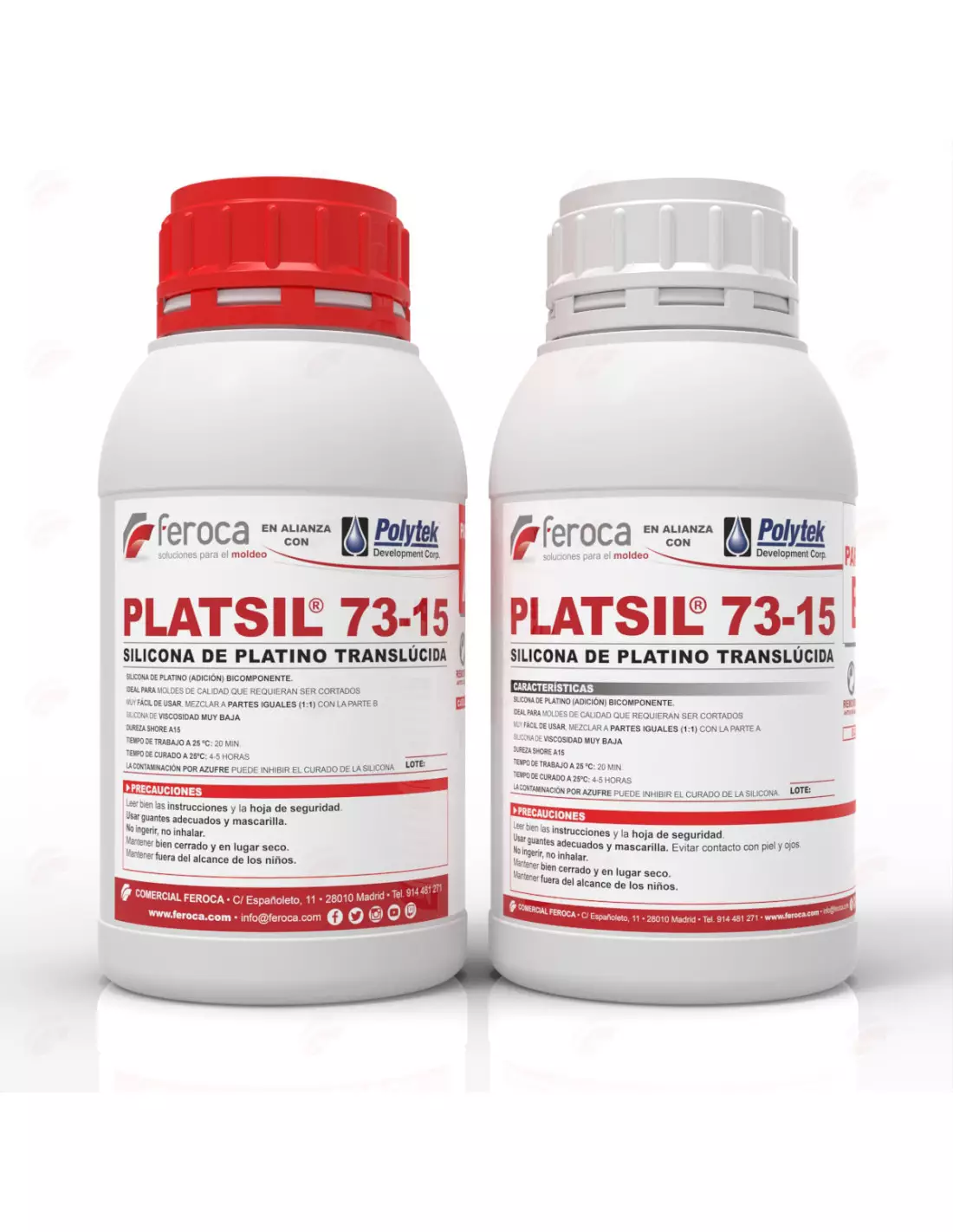
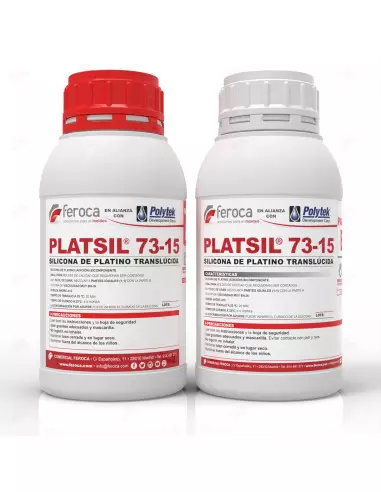
PlatSil 73-15 -Platinum Silicone-
290030101
€46.00
55,66 € Tax incl.
55,66 € Tax incl.
Translucent platinum silicone Shore A15, 1A:1B mix by weight or volume, 20 min working time and 4-5 hour cure.
PlatSil 73-15 is a two-component, translucent platinum (addition) silicone with a low Shore A15 hardness, mixing in equal parts (1A:1B by weight or volume). Developed by Polytek, it offers exceptional detail reproduction, virtually negligible shrinkage, and a flexible, durable rubber ideal for casting moulds with complex geometry. Its translucency once cured makes it easy to locate parting lines and ensures the silicone has penetrated all hard-to-reach areas of the model.
Technical specifications
| Parameter | Value |
|---|---|
| Type | Platinum silicone (addition) |
| Colour | Translucent white |
| Shore Hardness | A15 |
| Mix ratio by weight | 100A : 100B |
| Mix ratio by volume | 100A : 100B |
| Working time (25 °C) | 20 min |
| Cure time (25 °C) | 4-5 hours |
| Mixed viscosity | 2,500 cP |
| Specific volume | 25 in³/lb |
| Shrinkage | Negligible |
What it's used for
PlatSil 73-15 is a professional-grade casting silicone, particularly suited when a highly flexible, translucent, fine-detail mould is required. It can also be thickened with thixotropic agents such as PlatThix for brush application in blanket moulds. Its most common applications are:
- Casting moulds for reproductions in resin, plaster, wax or polyurethane.
- Moulds for parts with complex geometries, undercuts or fine textures where translucency helps detect bubbles or unfilled areas.
- Soft prosthetics for special effects and character make-up, including facial and body prosthetics.
- Moulds for Food Safe applications (FDA compatible), such as chocolate moulds, fondant moulds or artisan pastry.
- Casting moulds that will require cutting after demoulding, thanks to the visibility of the model through the rubber.
- Reproduction of artistic sculptures, collectible figures and special effects pieces.
- Manufacture of reborn dolls and hyperrealistic figures in combination with silicone pigments.
- Translucent silicone pieces tinted with specific pigments for platinum silicone.
How to use it
- Prepare the model: ensure the surface is clean, dry and free of contaminants (sulphur, latex, tin, uncured epoxy). Apply a release agent if the model material requires it.
- Weigh or measure the components: mix Part A and Part B in a 1:1 ratio by weight or volume. Use clean containers and spatulas, free of residues from other materials.
- Mix: stir slowly for at least 2-3 minutes, scraping the sides and bottom of the container thoroughly, to achieve a homogeneous mixture without streaks. Avoid incorporating excessive air.
- Degas (recommended): if you have a vacuum chamber, apply vacuum to the mixture for 1-2 minutes before casting to eliminate trapped bubbles.
- Cast: pour the silicone in a thin stream from a low point of the mould box so the material rises gradually and displaces air. You have 20 minutes of working time.
- Cure: allow to cure at room temperature (25 °C) for 4-5 hours without moving the mould. Curing can be slightly accelerated by raising the ambient temperature.
- Demould: once cured, the silicone will not adhere to most materials. Demould carefully and remove the model.
- Post-cure (optional): for demanding applications (food contact, prosthetics), a post-cure in an oven at 60-70 °C for 1-2 hours improves mechanical properties and eliminates any traces of free platinum.
Warning — Inhibition risk: PlatSil 73-15 is a platinum (addition) silicone and its cure may be inhibited by contact with certain materials. The most common are: sulphur-containing clays and modelling compounds, latex, tin silicones (condensation), freshly cast polyester, uncured epoxy resins, urethane rubbers, amines and some metals. Inhibition manifests as a sticky or uncured layer on the contact surface. Before using PlatSil 73-15, always perform a compatibility test with a small amount of material on the model or surface to be moulded.
Usage tips
Thixotroping for brush-on blanket moulds
PlatSil 73-15 has a viscosity of 2,500 cP, fluid enough for casting, but can be thickened by adding PlatThix (thixotropic agent for platinum silicones) in small proportions until achieving the consistency of thick paint or putty. This allows it to be applied in successive layers over vertical models without the silicone running, reducing the total material consumption compared to a solid block mould.
Tinting and prosthetic character work
The translucency of the cured rubber makes it an ideal base for hyperrealistic character work. Add specific pigments for platinum silicones directly to Part A before mixing with Part B. For special effects prosthetics requiring feathered edges on skin, combine it with an encapsulant such as Key-Cap Plastic to achieve imperceptible transitions during make-up application. If you need an even softer rubber for areas with greater movement, see the PlatSil Gel-00 range.
Temperature and cure time
The 4-5 hour cure time corresponds to 25 °C. At lower temperatures (cold workshops in winter) curing is considerably longer, potentially exceeding 8 hours at 15 °C. If you need to speed up the process, work in a heated environment or use a thermal blanket over the mould. Never use heat to compensate for inhibition: if the silicone does not cure under normal conditions, the problem is contamination and must be resolved by cleaning or sealing the model.
Frequently asked questions
What materials inhibit the cure of a platinum silicone?
The most common inhibitors are: clays and modelling compounds containing sulphur, latex, tin silicones (condensation), freshly cast polyester resins, uncured epoxy resins, polyurethane rubbers, amines, and some metals or unsealed surfaces. In the case of PlatSil 73-15, the symptom is a sticky or uncured layer in the contact area with the inhibiting material. Before moulding any model, always carry out a small compatibility test.
Can I use a tin silicone to make the mould and reproduce the piece with platinum silicone?
No. Platinum silicone such as PlatSil 73-15 will not cure on tin (condensation) silicone: tin compounds inhibit the platinum catalyst. If you want to reproduce a piece in platinum silicone, the mould must also be made of platinum silicone or a compatible material (resin, plaster, sealed plastic). Platinum and tin silicones are not interchangeable in the same process chain.
Is this silicone Food Safe?
Cured platinum (addition) silicones such as PlatSil 73-15 are generally compatible with FDA regulations for food contact once properly cured and post-cured. However, if you require specific certification for continuous food use, consult the official product technical data sheet or contact Feroca to verify the exact level of compliance for your application.
How can I make the mould more rigid or less flexible?
PlatSil 73-15 has a Shore A15 hardness, designed to be very flexible. If you need greater rigidity, you can opt for higher hardness versions within the PlatSil range (such as PlatSil 73-20, Shore A22) or combine the soft mould with a rigid shell mould of resin or plaster that provides structural support during reproductions. A shell mould is especially recommended with very soft silicones to avoid deformation when casting the reproduction material.
Can I thicken this silicone for brush application?
Yes. PlatSil 73-15 can be thixotroped by adding PlatThix, the specific thickening agent for platinum silicones from Polytek. The amount to add depends on the desired consistency: small proportions give a thick paint texture, larger proportions produce a putty-like paste. The thixotropic agent does not affect cure time, only viscosity and the silicone's ability to remain on vertical surfaces without running.
How long do I have to work with the mixture before it starts to gel?
The working time of PlatSil 73-15 is 20 minutes at 25 °C. After that time, viscosity increases rapidly and the silicone no longer flows properly. Prepare the mould and all materials before mixing, and cast as soon as possible after homogenising. If your working environment is above 25 °C, the working time shortens; below that, it extends slightly.
Is a release agent necessary with this silicone?
Cured platinum silicone does not adhere to most porous and semi-rigid materials, so in many cases a release agent is not required. However, it is advisable when the model is made of silicone (cured platinum), polished metal or very smooth plastic, to facilitate demoulding and protect the model surface. When moulding over platinum silicone, always use a release agent between layers to prevent them from fusing together.
What deadener proportions are used with a platinum silicone for prosthetic applications?
For encapsulated silicone prosthetics, the usual proportion of deadener (softener) relative to the silicone mixture is between 180% and 200%. That is, for every part of A+B mixture, between 1.8 and 2 parts of deadener are added. This proportion can be adjusted according to the desired degree of softness or skin effect. PlatSil 73-15, with its base Shore A15, is already a very soft starting point before adding any deadener.
- Color
- Translucent White
- Working Time
- 20min
- Curing Time
- 4-5horas
- Shore Hardness
- A15
- Volume Mixing Ratio
- 100A:100B
- Mixed Weight Ratio
- 100A:100B
No reviews
Tap to zoom