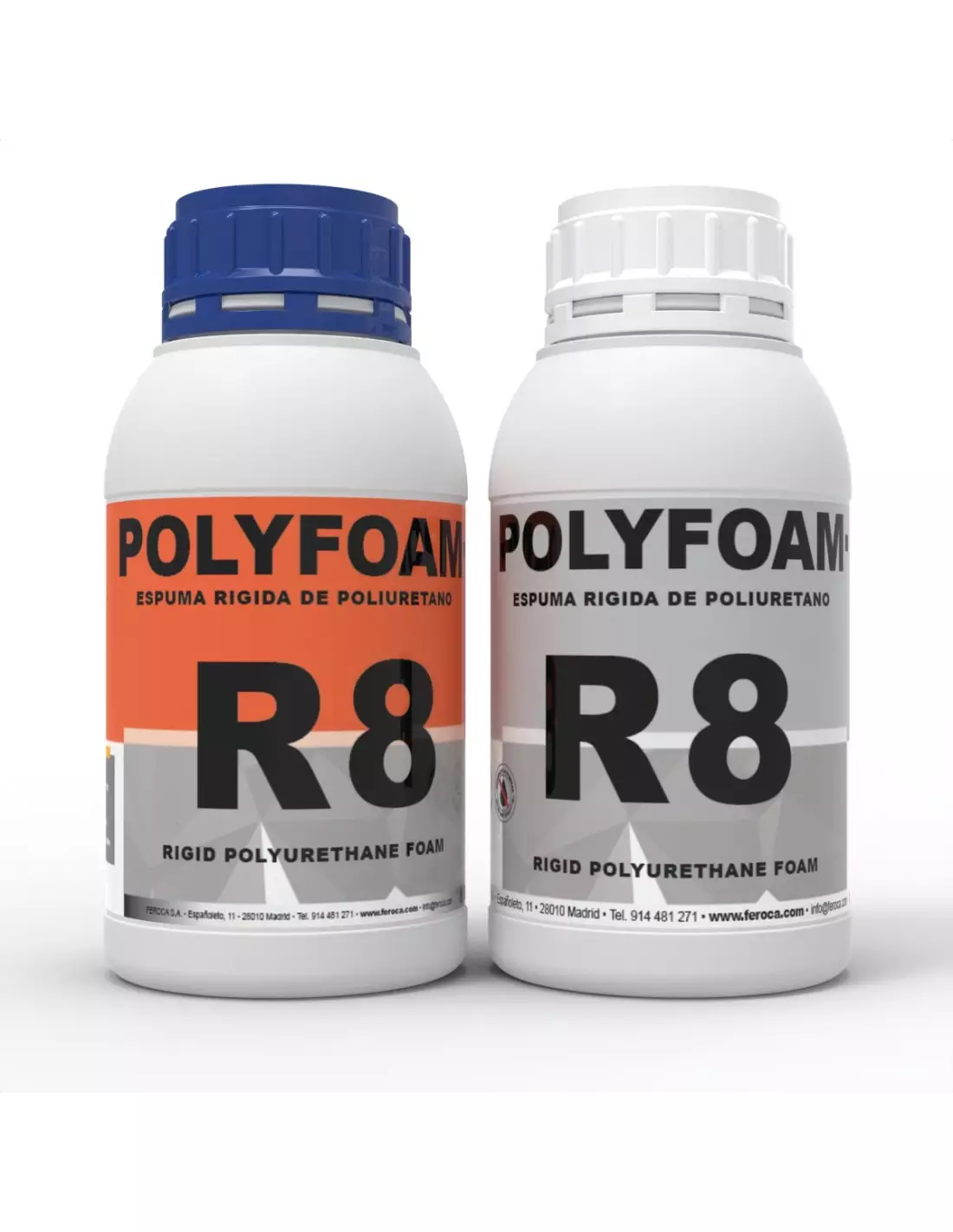
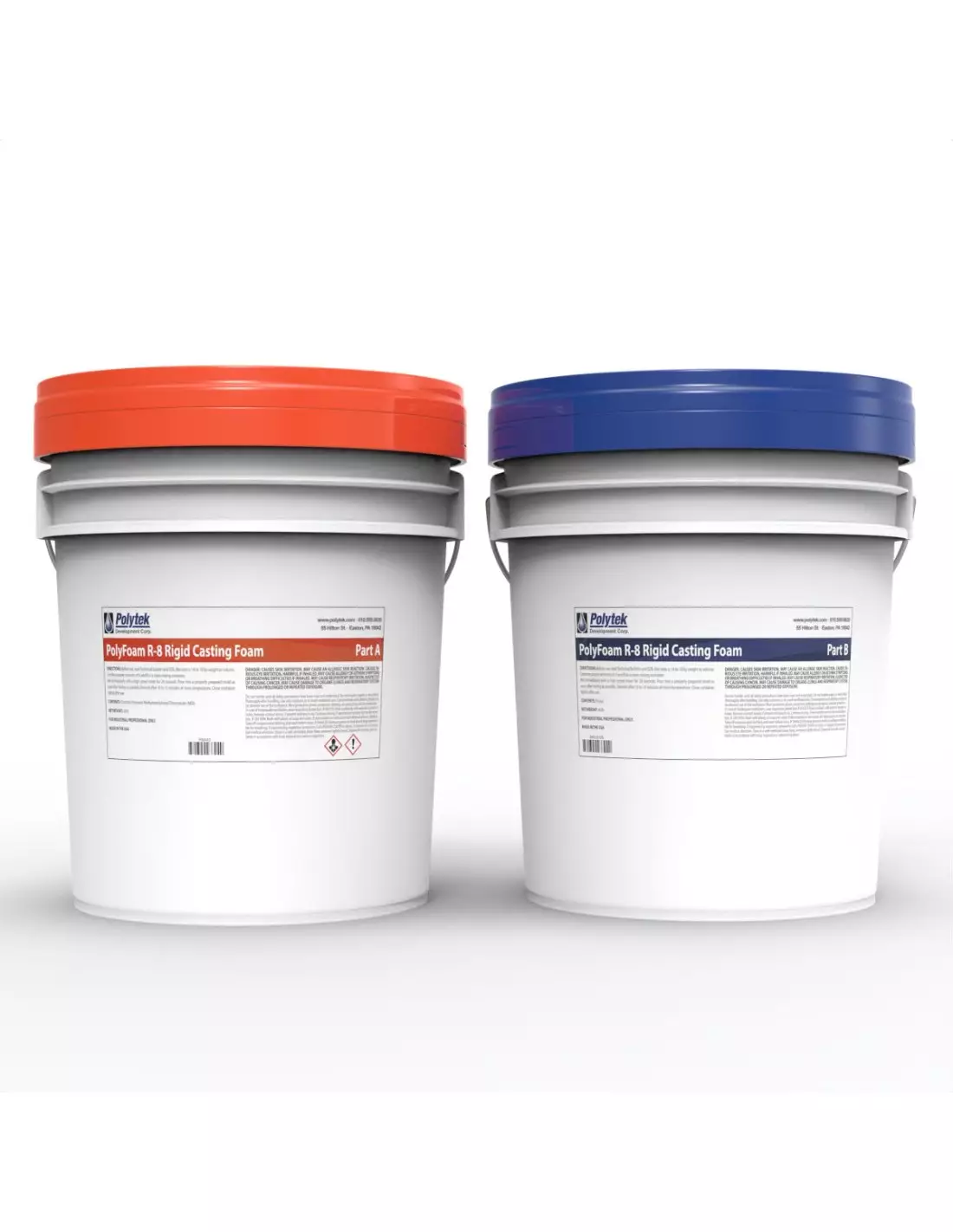
PolyFoam R-8 is a two-component rigid polyurethane foam (casting) with a free-rise density of 128 kg/m³. Its 1:1 mix ratio by weight and volume simplifies the process, and its ability to form skin in a closed mould makes it a solid option for producing parts with a defined surface finish. Virtually odourless and free from toluene diisocyanate, MOCA, heavy metals and HCFC.
Technical specifications
| Parameter |
Value |
| System |
Two-component (A+B) |
| Application |
Casting |
| Mix ratio by weight |
100A : 100B |
| Mix ratio by volume |
100A : 100B |
| Mixed viscosity |
1100 cP |
| Cream time |
~45 seconds |
| Working time |
2 min |
| Tack-free time |
~3 min |
| Cure / demould time |
10-15 min |
| Free-rise density |
128 kg/m³ |
| Moulded density |
128-320 kg/m³ (depending on confinement) |
| Colour |
Cream |
| Pigmentable |
Yes |
| Forms skin in closed mould |
Yes |
| Composition |
Free from TDI, MOCA, heavy metals and HCFC |
What it is used for
PolyFoam R-8 is designed for applications requiring a lightweight rigid foam with good surface detail. It is especially useful when the mould is closed and the foam must expand to fill the cavity and form a dense skin. Its most common uses include:
- Filling decorative pieces and sculptures
- Production of lightweight part series
- Duplicating masters and models
- Structural prototypes and mock-ups
- Lightweight support counter-moulds
- Prop pieces and special effects
- Decorative objects with surface detail
- Rigid cores for composites
How to use it
- Condition both components (A and B) to room temperature, ideally between 20-25 °C. Stir each component separately before mixing.
- Weigh or measure both parts in a 1:1 ratio by weight or volume. Accuracy in the ratio is key for correct curing and uniform density.
- Mix both components vigorously for 20-30 seconds, making sure to scrape the sides and bottom of the container thoroughly.
- Pour the mixture into the mould immediately. You have approximately 45 seconds before the cream phase begins and the foam starts to expand.
- Close the mould if you want to obtain a surface skin and a higher moulded density. For free rise, leave the mould open or semi-open.
- Wait for the tack-free time (~3 min) before handling the mould, and allow 10-15 minutes for complete curing before demoulding.
- If you wish to pigment the part, add PolyColor Dyes to component B before the final mix.
Warning: exothermic and hygroscopic product. Polyurethane reacts with ambient moisture and moisture in the mould, which can generate bubbles or alter the final density. Keep components tightly sealed and work in a dry environment. In large-volume castings, the reaction generates significant heat: do not exceed the manufacturer's recommended quantities in a single mix. Wear gloves and eye protection during handling.
Usage tips
Controlling final density
The density of 128 kg/m³ corresponds to free rise, i.e. without confinement. If you pour the mixture into a closed mould, the foam is compressed against the walls and density can reach up to 320 kg/m³. The more enclosed the mould, the denser and stronger the resulting part will be. Plan the volume to pour based on the expansion ratio you need.
Mould selection
PolyFoam R-8 is compatible with platinum silicone moulds and urethane rubber moulds. Always apply a release agent to rigid moulds (plaster, resin, wood) to prevent adhesion: this foam is self-adhesive and bonds strongly to porous or untreated surfaces. With flexible silicone moulds a release agent is usually not needed, although it is still recommended for long production runs.
Temperature and humidity
Always work above 18 °C. Below that temperature, working time increases and expansion may be incomplete or uneven. High humidity (above 70% RH) particularly affects component A (isocyanate) and can generate additional CO₂, causing unwanted bubbles. If the containers have been open for some time, check that component A has not crystallised or become cloudy.
Frequently asked questions
How much does this foam expand?
In free rise, PolyFoam R-8 has a density of 128 kg/m³. The expansion factor depends on the formulation, but under normal conditions the liquid mixture multiplies its volume approximately 8 to 10 times. If the mould is closed, expansion is restricted and density increases proportionally.
Can it be used in wood or plaster moulds?
Yes, but it is essential to apply a release agent before pouring the foam. PolyFoam R-8 is self-adhesive and bonds strongly to porous surfaces such as wood, plaster or cardboard. Without a release agent, the part will stick to the mould and it will be impossible to demould without damaging both.
Can it be pigmented before pouring?
Yes. Add PolyColor Dyes to component B before mixing with component A. Bear in mind that the resulting colour in the cured foam will be lighter than in the liquid mixture, as expansion reduces the pigment concentration per unit volume.
Is it suitable for thermal or acoustic insulation?
This is not its primary application. PolyFoam R-8 is formulated for modelling, decoration and prototyping applications. Thermal or acoustic insulation requires foams with specific conductivity or absorption characteristics that this product does not guarantee.
Can the cured part be sanded, painted or machined?
Yes. Once cured, the rigid foam can be sanded, carved, milled and painted without any problem. The outer skin (if formed in a closed mould) is denser and more resistant, which makes surface finishing easier. For acrylic or water-based paints, no primer is needed in most cases. For solvent-based paints, carry out a test on a small area first.
What happens if the two components are not mixed properly?
An incomplete mix results in uncured areas with a sticky texture or uneven density. It is important to mix for at least 20-30 seconds with movements that incorporate all the material from the sides and bottom. Since the working time is only 2 minutes, mixing must be fast but thorough.
Which type of mould gives the best results?
Platinum silicone moulds offer the best results: they require no release agent, allow effortless demoulding and faithfully reproduce surface detail. Urethane rubber moulds are also compatible. For rigid moulds (resin, plaster, wood), always use a release agent and make sure the mould is completely dry before pouring.
Is this foam hazardous for indoor use?
PolyFoam R-8 is formulated without TDI (toluene diisocyanate), MOCA, heavy metals or HCFC, making it significantly less aggressive than other polyurethane foams. Even so, it is recommended to work in ventilated spaces, wear nitrile gloves and eye protection. Avoid prolonged skin contact and inhalation of vapours during mixing and expansion.
How much product do I need?Calculate the exact amount before buying and avoid wasting material.
Go to the calculator →