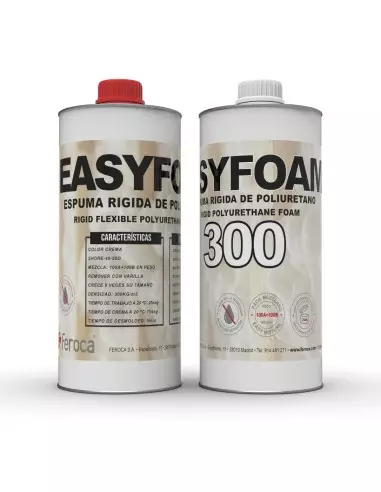
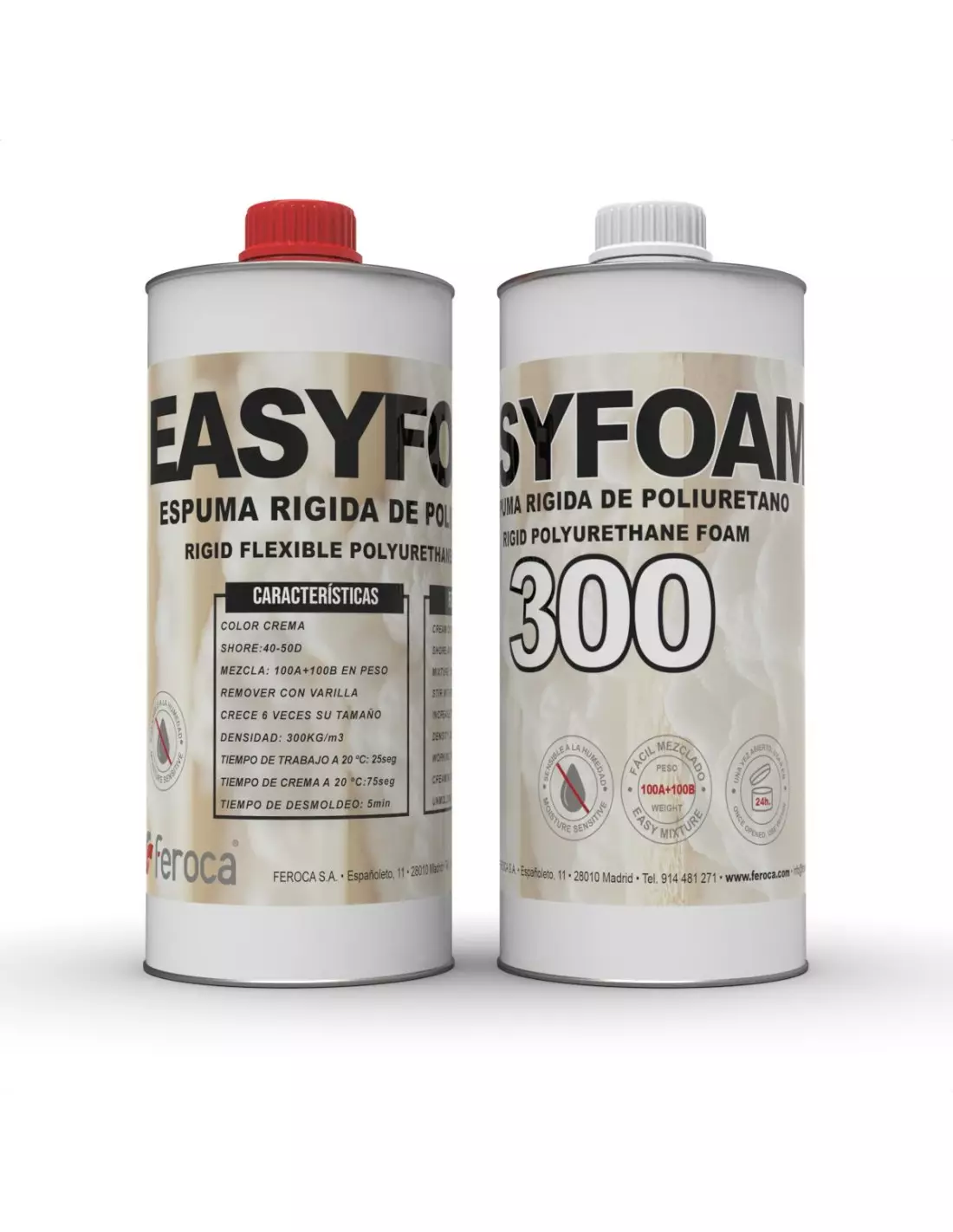
EASYFOAM 300 is a two-component rigid polyurethane foam that expands up to 6 times its initial volume, reaching a moulded density of 250–450 kg/m³ and a Shore Hardness of 40–50D. Its 1:1 mix ratio by weight makes it one of the easiest foams to use in the workshop, with excellent detail reproduction and a cream-coloured finish. It contains no CFCs or HCFCs and incorporates fire reaction improvement additives.
Technical specifications
| Parameter |
Value |
| Colour |
Cream |
| Mix ratio (by weight) |
100A : 100B (1:1) |
| Cream time |
22 seconds |
| Working time |
75 seconds |
| Demould time |
3 minutes |
| Expansion |
~6 times initial volume |
| Shore Hardness |
40–50D |
| Moulded density |
250–450 kg/m³ (average: 300 kg/m³) |
| CFCs / HCFCs |
None |
| Fire reaction |
With flame retardant additives |
What it's used for
EASYFOAM 300 is designed for producing lightweight, rigid parts with a high level of detail, in fields where the weight-to-hardness ratio is key. Its controlled expansion allows complex moulds to be filled or foam blocks to be created that can then be carved, sanded or painted.
- Decorative and artistic sculpture
- Special effects and props for film and television
- Cosplay: armour, helmets, weapons and lightweight rigid accessories
- Theatre and event scenography
- Scale modelling and architectural or terrain models
- Structural fill for hollow parts (surfboards, lightweight vessels)
- Fishing lures and floats
- Picture frames and decorative mouldings
- Advanced hobby and crafts
How to use it
- Prepare the mould or work area. If using a closed mould, apply a suitable polyurethane release agent to all contact surfaces.
- Bring components A and B to room temperature (18–25 °C). In cold conditions, the reaction slows down and expansion may be affected.
- Weigh the components at a ratio of 100A:100B by weight. Use a precision scale to ensure the correct reaction.
- Mix both components vigorously for 20–25 seconds, making sure to scrape the sides and bottom of the container thoroughly. You have a working time of 75 seconds before visible expansion begins.
- Pour the mixture into the mould or onto the work surface immediately. Remember that the foam will expand up to 6 times its volume, so calculate the initial amount carefully. For closed moulds, fill only 15–20% of the total volume.
- Keep the mould closed and clamped for at least 3 minutes until demoulding. The foam will exert internal pressure during expansion.
- After demoulding, allow to cure fully at room temperature before machining, sanding or painting (it is recommended to wait at least 30 minutes to reach final hardness).
- If you want to colour the foam in the mass, add PolyColor Dyes, pigments specifically designed for polyurethane, to component B before mixing.
Important notice — Two-component polyurethane
Component A (isocyanate) is moisture-sensitive: keep containers tightly closed when not in use and avoid working in environments with relative humidity above 70%. Exposure to water vapour generates CO₂ and may affect expansion or cause unwanted bubbles. Wear gloves, safety goggles and work in a well-ventilated area. Read the safety data sheet before using the product.
Usage tips
Control density by adjusting the mix quantity
The final density of the foam depends on the degree of confinement. Pouring the mixture into a closed mould with little room to expand will yield a denser, harder foam (close to 450 kg/m³). Allowing it to expand freely lowers the density to around 250 kg/m³, resulting in a lighter and more porous part. Experiment with different quantities to fine-tune the result for your application.
Machining and surface finishing
Once cured, EASYFOAM 300 can be cut with a band saw, milled, sanded and painted without difficulty. Its Shore Hardness of 40–50D allows it to be worked with standard workshop tools. For painting, use water-based or polyurethane paints and apply a primer first. Paints with aggressive solvent bases may attack the surface: always test on a scrap piece before applying to the final part. If you need a rigid resin for parts without expansion, consider Feropur PR55+E55.
Storage and shelf life
Store components in their original tightly sealed containers in a dry, cool place (between 15 and 25 °C), away from heat sources. Once opened, component A tends to absorb moisture from the air and may develop a skin at the container mouth: remove it before use. If the product has gelled or shows lumps, do not use it as the reaction will not be homogeneous. Typical shelf life is 12 months in sealed containers under proper storage conditions.
Frequently asked questions
How many times does this type of rigid polyurethane foam expand?
EASYFOAM 300 expands approximately 6 times its initial volume. This means that starting from 100 g of mixture (50 g of A + 50 g of B), you will obtain a foam block of around 600 cm³ in volume. Always plan the quantity based on the final volume you need to fill, not the volume of the mixture.
Can I use rigid polyurethane foam in a silicone mould?
Yes, EASYFOAM 300 is compatible with silicone moulds. For closed moulds, apply a release agent before pouring to ease demoulding and extend mould life. Keep in mind that expansion generates internal pressure, so the mould must be sufficiently rigid or clamped to maintain its shape.
Can polyurethane foam be mass-coloured?
Yes. To mass-colour EASYFOAM 300, mix PolyColor Dyes (special pigments for polyurethane) with component B before adding component A. Use small doses (1–3% by weight) as excessive pigment may slightly affect the reaction.
Can the rigid foam be drilled or screwed once cured?
EASYFOAM 300 can be drilled and cut without issue, but its structural load-bearing capacity is limited. It is not designed to support high loads via screws or anchors: it is a filling and modelling material, not a structural one. For applications requiring significant mechanical strength, combine it with a surface layer of rigid polyurethane resin such as Feropur PR55+E55.
What is the optimal working temperature for this type of foam?
The ideal working range is between 18 and 25 °C. Below 18 °C the reaction slows down, cream time and working time increase, and expansion may be less than expected. Above 30 °C the reaction accelerates and working time is significantly reduced. Both components must be at the same temperature before mixing.
Can rigid polyurethane foam be used for thermal insulation?
EASYFOAM 300 is not formulated as a thermal insulator. It is designed for producing lightweight, rigid parts with high detail for artistic, modelling and special effects applications. If you need insulation, there are specific products available for that purpose.
Can I mix this foam with the B component of other polyurethane resins?
No. Each polyurethane system is formulated with its own A and B components to achieve the specified properties. Mixing components from different systems may result in incomplete reactions, unpredictable properties or defective materials. Always use the A and B components from the same product.
Is there a flexible version of this polyurethane foam?
Yes. If you need a flexible foam instead of a rigid one, Feroca distributes EASYFLEX 60, a two-component flexible polyurethane foam suitable for applications requiring elasticity and compressibility.
How much product do I need?Calculate the exact amount before buying and avoid wasting material.
Go to the calculator →