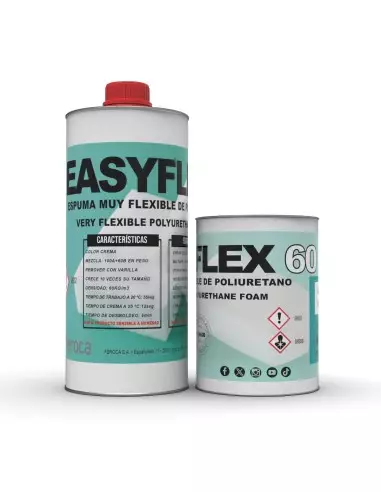
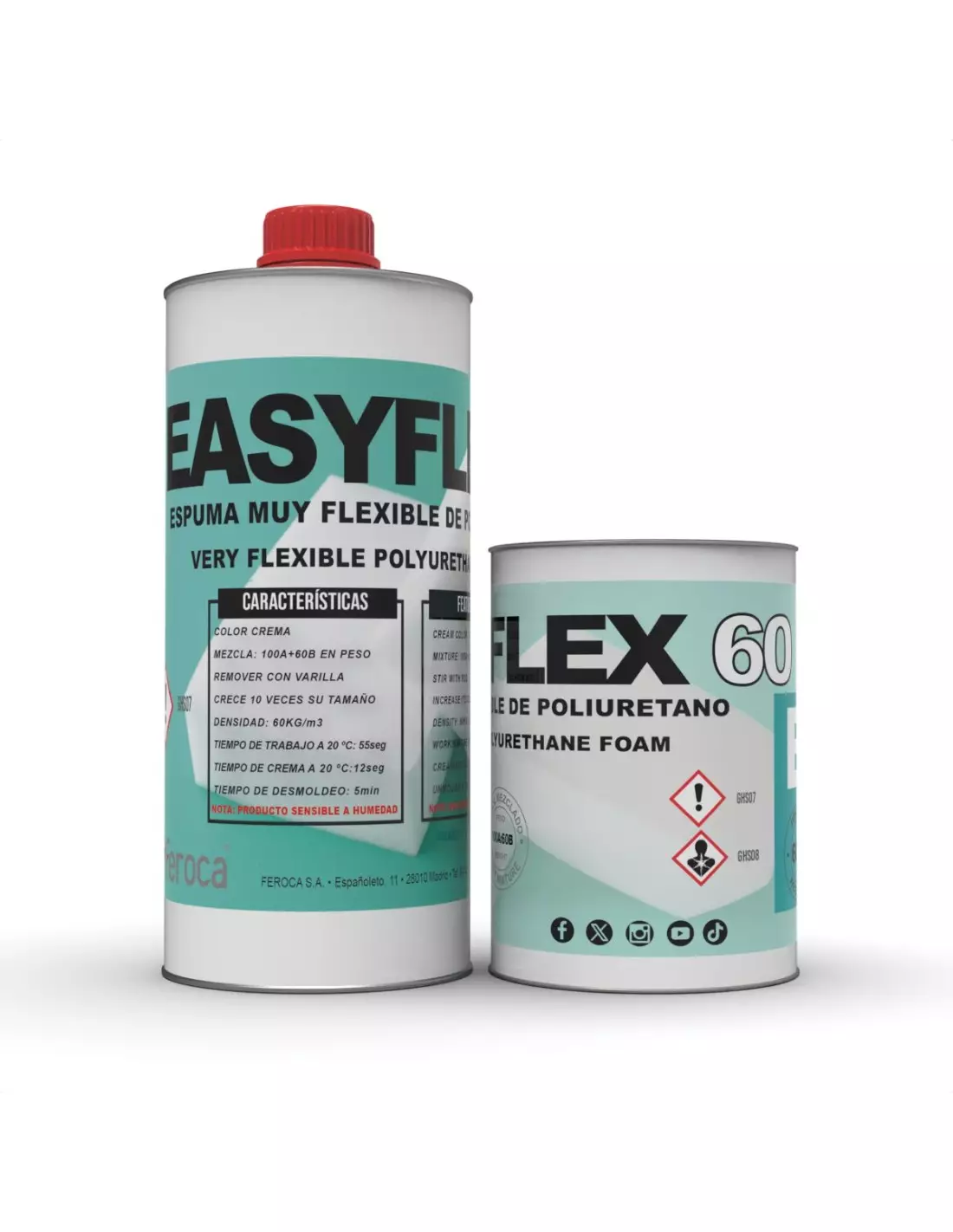
EASYFLEX 60 is a two-component flexible polyurethane foam that expands between 10 and 12 times its original volume, reaching a moulded density of 60 kg/m³. Its combination of elasticity, comfort and ease of use makes it the preferred choice for filling articulated figures, props and any soft part that needs to hold its shape without rigidity.
Technical specifications
| Parameter |
Value |
| Mix ratio (by weight) |
100A : 60B |
| Colour |
Cream |
| Working time |
55 seconds |
| Cream time |
12 seconds |
| Cure / demould time |
5 minutes |
| Expansion |
10–12 times the initial volume |
| Moulded density |
60 kg/m³ (55–65 kg/m³) |
| Tear resistance |
400 ± 50 N/m |
| Number of components |
2 (A + B) |
What it's used for
EASYFLEX 60 is designed for applications where a soft, lightweight and elastic fill is needed. Its medium density and high expansion factor make it highly versatile in both special effects and industrial settings:
- Filling latex puppets and figures for animation and theatre
- Soft props for film, television and stage design
- Animatronics: filling heads, bodies and articulated limbs
- Stop-motion figures requiring a flexible and lightweight body
- Seat, saddle and headrest prototypes where comfort is a priority
- Filling decorative and set-dressing pieces
- Industrial applications in furniture and automotive where controlled elasticity is required
How to use it
- Prepare the mould: make sure it is clean, dry and properly sealed. Apply a release agent if the mould is porous or if you plan to demould before the foam has fully cured.
- Weigh the components: use a precision scale. The ratio is 100 parts of component A to 60 parts of component B, always by weight.
- Mix quickly: cream time is only 12 seconds and total working time is 55 seconds. Mix vigorously but thoroughly, scraping the sides of the container well.
- Pour into the mould: do so immediately, as soon as the mix begins to cream (change to a creamy appearance). Pour at the lowest point of the mould and let the foam rise on its own.
- Close the mould: if working in a closed mould, calculate the volume needed so the foam fills the cavity with a slight overpressure. Bear in mind that it expands 10 to 12 times.
- Wait for demoulding: after 5 minutes the part can already be demoulded. Full cure and property stabilisation is reached within a few hours at room temperature.
- Demould carefully: flexible foam that is still warm is more fragile. Handle it gently during the first few minutes after demoulding.
Warning: EASYFLEX 60 is a polyurethane foam with a very short working time (55 seconds). Ambient humidity and temperature directly affect expansion and final density. Always work in a dry environment (relative humidity below 60%) and at a temperature between 20 and 25 °C. Avoid contact with water during mixing: any trace of moisture in the mould or components will cause irregular bubbles and may ruin the part. Read the safety data sheet before using the product.
Usage tips
Calculate the volume carefully before pouring
EASYFLEX 60 multiplies its volume 10 to 12 times. If you overfill a closed mould, the excess pressure can deform it or prevent proper curing. A good practice is to calculate the cavity volume, divide it by 10, and use that amount of mix as a starting point. Adjust through successive tests until you achieve the density and fill you need.
Temperature and humidity: two critical variables
At higher ambient temperatures, the foam expands faster and may reduce final density. In winter or in a cold workshop, gently pre-warm the components (never above 30 °C) to ease mixing and maintain expected behaviour. If working in a humid environment, keep containers tightly closed between uses: isocyanates (component B) react with moisture in the air and degrade over time.
Pigmentation and customisation
If you need a specific colour in the foam, you can add PolyColor Dyes to component A before mixing with component B. These are pigments formulated specifically for polyurethanes and do not affect curing. Use small amounts (1–3% by weight) to avoid altering the reaction. You can also incorporate pigmento empastado if you are looking for more opaque or pastel shades.
Frequently asked questions
How many times does this flexible foam expand?
EASYFLEX 60 expands 10 to 12 times its initial volume. This means that with 100 g of mix you can fill a volume of approximately 1.5 to 1.8 litres, depending on the temperature and humidity conditions in your workspace.
Can I use this foam in a silicone mould?
Yes, silicone moulds are highly compatible with EASYFLEX 60. The foam does not adhere to silicone, which makes demoulding easy. Make sure the mould is completely dry before pouring the mix, as any trace of moisture can generate unwanted bubbles.
What happens if I take too long mixing?
The working time of EASYFLEX 60 is only 55 seconds. If you take longer to pour, the foam will start to expand inside the mixing container and will not fill the mould correctly. The result will be a part with irregular or incomplete density. Prepare everything before opening and measuring the components so you don't waste time.
Can the foam be painted or lacquered once cured?
Yes, cured flexible foam accepts paint with products compatible with polyurethane. Avoid aggressive solvents (acetone, MEK) that can degrade the cell structure. For special effects finishes, latex painted directly onto the foam gives excellent results on figures and puppets.
How long does it take to fully cure?
Demoulding is possible after 5 minutes, but the foam continues to develop mechanical properties over the following hours. For work that will undergo heavy handling (animatronic joints, frequently used prop fills), wait at least 24 hours before subjecting it to stress.
What is the difference between a flexible foam and a rigid foam?
Flexible foams like EASYFLEX 60 have an open-cell structure that allows elastic deformation: they compress and recover their shape. Rigid foams, such as EASYFOAM 300, have a closed-cell structure and do not deform once cured. The choice depends on whether you need comfort and movement (flexible) or structure and support (rigid).
Can I combine this foam with polyurethane resin to make parts with a hard exterior and soft core?
Yes, this is a common technique in special effects and prop making. A layer of rigid resin such as Feropur PR55+E55 is first applied to the mould to create the exterior, and once gelled the interior is filled with EASYFLEX 60. The result is a part with a rigid shell and a flexible, lightweight core.
Is it suitable for use in contact with skin?
No. EASYFLEX 60 is not formulated or certified for direct and prolonged contact with skin. For character or prosthetic applications in contact with the body, consult materials specifically approved for that use. Always read the product's safety data sheet before handling it.
How much product do I need?Calculate the exact amount before buying and avoid wasting material.
Go to the calculator →