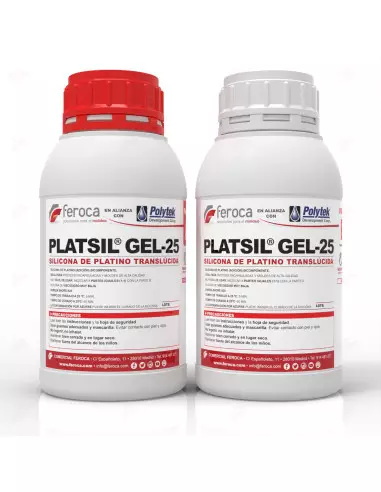
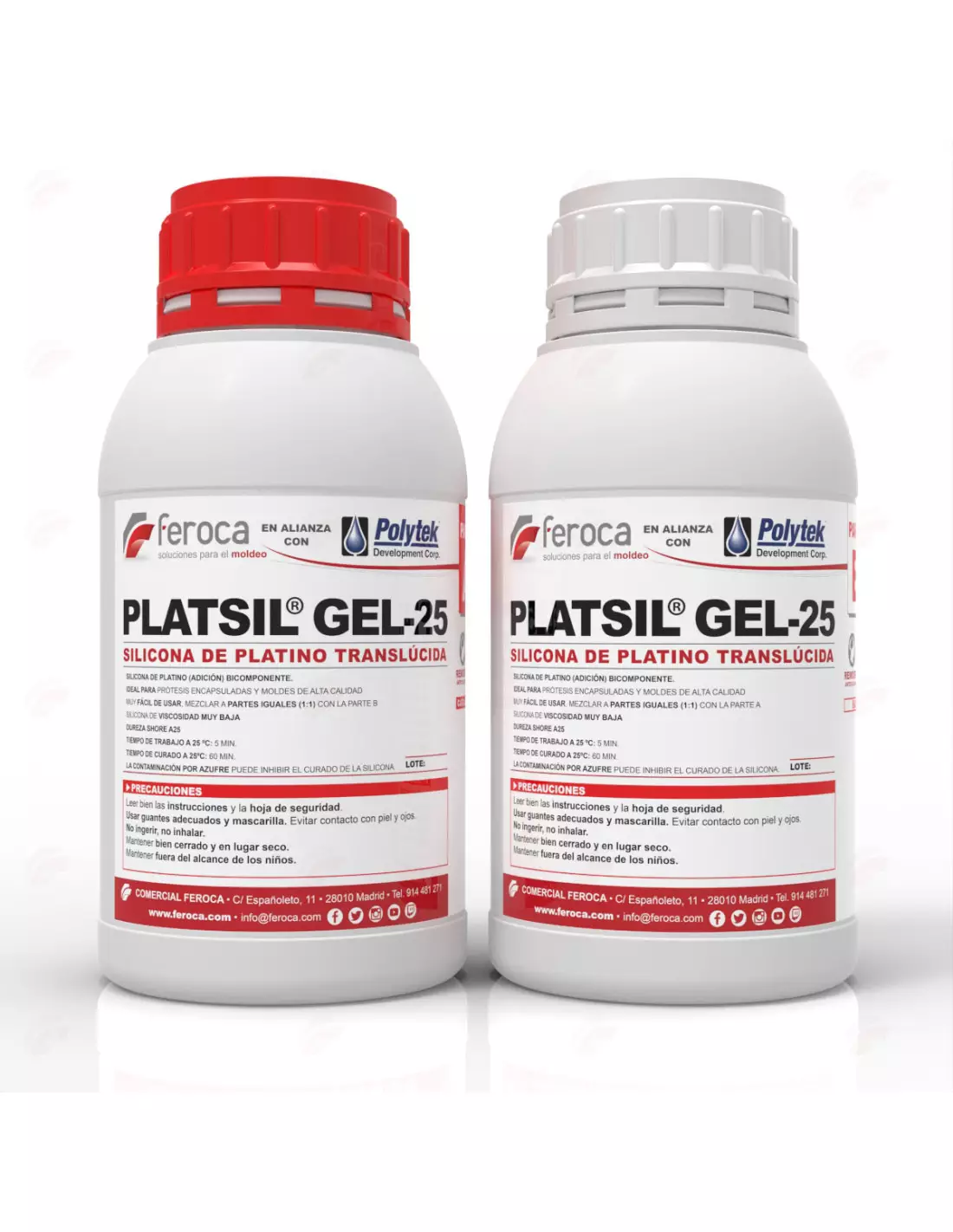
PlatSil Gel-25 is a two-component platinum (addition) silicone, mixed in equal parts, translucent and with a Shore A25 hardness. It cures in approximately one hour into a reliable, flexible, high-quality rubber suitable for both mold making and prosthetic and Life Cast applications. Its versatility is greatly expanded when combined with PlatSil range additives: it can be thickened, retarded, softened with deadener or hardened depending on the project.
Technical specifications
| Parameter |
Value |
| Type |
Platinum silicone (addition) |
| Color |
Translucent |
| Shore Hardness |
A25 |
| Mix ratio by weight |
100A : 100B |
| Mix ratio by volume |
100A : 100B |
| Working time |
5 min |
| Cure time |
1 hour |
What it is used for
PlatSil Gel-25 is one of the reference silicones in special effects, prosthetics and model reproduction thanks to its balance between hardness, flexibility and ease of processing. It is used in professional film, television and theatre environments, as well as in special effects workshops and prosthetics artists:
- Flexible mold making for resins, foams and plaster
- Encapsulated prosthetics for special effects (with deadener to achieve the right texture)
- Life-cast of the human body and skin replicas
- Reproduction of parts with complex geometry or sharp undercuts
- Precision molds combined with PlatSil Hardener Parte H (up to Shore A40)
- Reborn babies and hyperrealistic figures
- Prosthetic effects for theatre and character makeup
How to use it
- Verify that the model or surface to be molded is compatible with platinum silicones (no sulfur, latex, tin or recently cured epoxy). See the inhibition warning below.
- Apply release agent spray on the model if necessary, especially if you are going to cast silicone over silicone.
- Mix parts A and B in a 1:1 ratio by weight or volume, stirring carefully for 2-3 minutes to avoid incorporating bubbles.
- If you need to thicken the mixture for brush application, add PlatThix before mixing both parts. If you want to add color, incorporate silicone pigments or Key-Pigments during mixing.
- For encapsulated prosthetic applications, add Smith's Prosthetics Deadener or PlatSil Deadener LV at a ratio of 180-200% of the total silicone (1A : 1B : 180-200% D).
- Pour or brush onto the model. Working time is approximately 5 minutes: work quickly and without interruption.
- Allow to cure at room temperature for 1 hour before demolding.
- Carefully remove the mold and check that the cure is complete (uniform translucent appearance, no tacky areas).
Warning: inhibition riskPlatSil Gel-25 is a platinum (addition) silicone. The platinum catalyst is deactivated upon contact with certain substances, preventing full or partial curing. The most common inhibiting materials are:
- Tin silicones (condensation) — including already cured molds
- Natural latex
- Plasticines and clays containing sulfur
- Petroleum jelly and some lubricants
- Polyester and epoxy resins recently cast or not fully cured
- Urethane rubbers
- Some metals and unsealed surfaces
- Vinyl
If you have doubts about the compatibility of your model, always perform a small cure test before proceeding with the full piece. When working over tin silicone, it is not possible to use platinum silicone directly: they will not cure together.
Usage tips
Expand the hardness range with PlatSil additives
PlatSil Gel-25 is not a fixed-hardness silicone. With PlatSil Deadener LV or Smith's Deadener you can achieve much softer results, ideal for prosthetics that need to blend with the skin. At the other extreme, by mixing with PlatSil Hardener Parte H you can reach Shore A40 hardness, useful for molds requiring greater dimensional precision. All from the same base product.
Work fast: working time is short
With only 5 minutes of working time, it is essential to have everything ready before mixing: model prepared, tools at hand and proportions already weighed. If you need more handling time, use PlatSil Retarder 71/73 R following the manufacturer's instructions (do not exceed the recommended dose to avoid compromising the cure). If your project requires brush application in layers, thixotropize the mixture with PlatThix: the thickener does not alter the cure time, only the viscosity.
Pigmentation and hyperrealistic finish
The natural translucency of PlatSil Gel-25 is an advantage in prosthetics and special effects, as it facilitates the illusion of skin depth. To pigment, use silicone-specific pigments or Key-Pigments for FX, which are compatible with platinum silicones. Conventional pigments (acrylic, water-based) are not compatible and may cause inhibition or uneven results. If the prosthetic is encapsulated, remember that the encapsulant is essential for blending the edges with the skin before makeup application.
Frequently asked questions
What materials can inhibit the cure of a platinum silicone?
Platinum silicones like PlatSil Gel-25 are sensitive to several contaminants that prevent or hinder curing: tin silicones (condensation), natural latex, clays and plasticines containing sulfur, petroleum jelly, uncured polyester and epoxy resins, urethane rubbers, vinyl and some metals. If in doubt, always perform a small test before working with the final piece.
Can I use tin silicone for the mold and platinum silicone for the final piece?
No. Platinum silicone is inhibited upon contact with tin silicones, even cured ones. They will not cure correctly in direct contact. If you want to make molds for casting platinum silicone, the mold must also be made of platinum silicone, or you must use a barrier sealant that has been confirmed as compatible.
What deadener ratio is used for encapsulated prosthetics?
For encapsulated prosthetic applications it is recommended to work with a ratio of 180-200% of deadener relative to the total silicone. That is: 1 part A + 1 part B + 180-200% deadener (PlatSil Deadener LV or Smith's Prosthetics Deadener). This allows you to obtain a very soft silicone that integrates naturally with the skin.
Does the thixotropic agent change the cure time?
No. The thixotropic agent (PlatThix) only modifies the viscosity of the mixture so it can be brushed without dripping. The working time and cure time of PlatSil Gel-25 remain the same: 5 minutes working time and 1 hour cure time.
Is it necessary to use an encapsulant for silicone prosthetics?
Yes, it is highly recommended. The encapsulant allows the edges of the prosthetic to be blended onto the skin, which is essential for a realistic finish before the makeup process. Without an encapsulant, the edges are visible and difficult to integrate. Feroca carries encapsulants compatible with platinum silicones such as PlatSil Gel-25.
Can I increase or reduce the final hardness?
Yes. PlatSil Gel-25 accepts two additives that modify hardness: PlatSil Deadener LV (or Smith's Deadener) to achieve softer results, down to values close to Shore OO, ideal for soft prosthetics; and PlatSil Hardener Parte H to increase hardness up to Shore A40, suitable for molds requiring greater dimensional rigidity.
Can I use regular pigments to color the silicone?
No. Acrylic or water-based pigments are not compatible with platinum silicones and may cause inhibition or uneven results. You must use silicone-specific pigments, such as the Silicone Pigments or the Key-Pigments for FX distributed by Feroca.
How is a Life-Cast done with platinum silicone?
For a professional Life Cast it is recommended to use a silicone specifically designed for low cure heat and skin contact, such as KEY-FORM. PlatSil Gel-25 can be used for Life-Cast on specific areas, but it is essential to verify that there are no inhibiting contaminants on the skin (creams, sulfur-containing oils, etc.) and to always apply a suitable barrier agent for dermal contact.
How much product do I need?Calculate the exact amount before buying and avoid wasting material.
Go to the calculator →