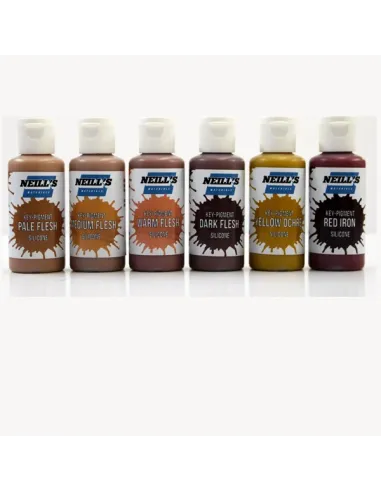
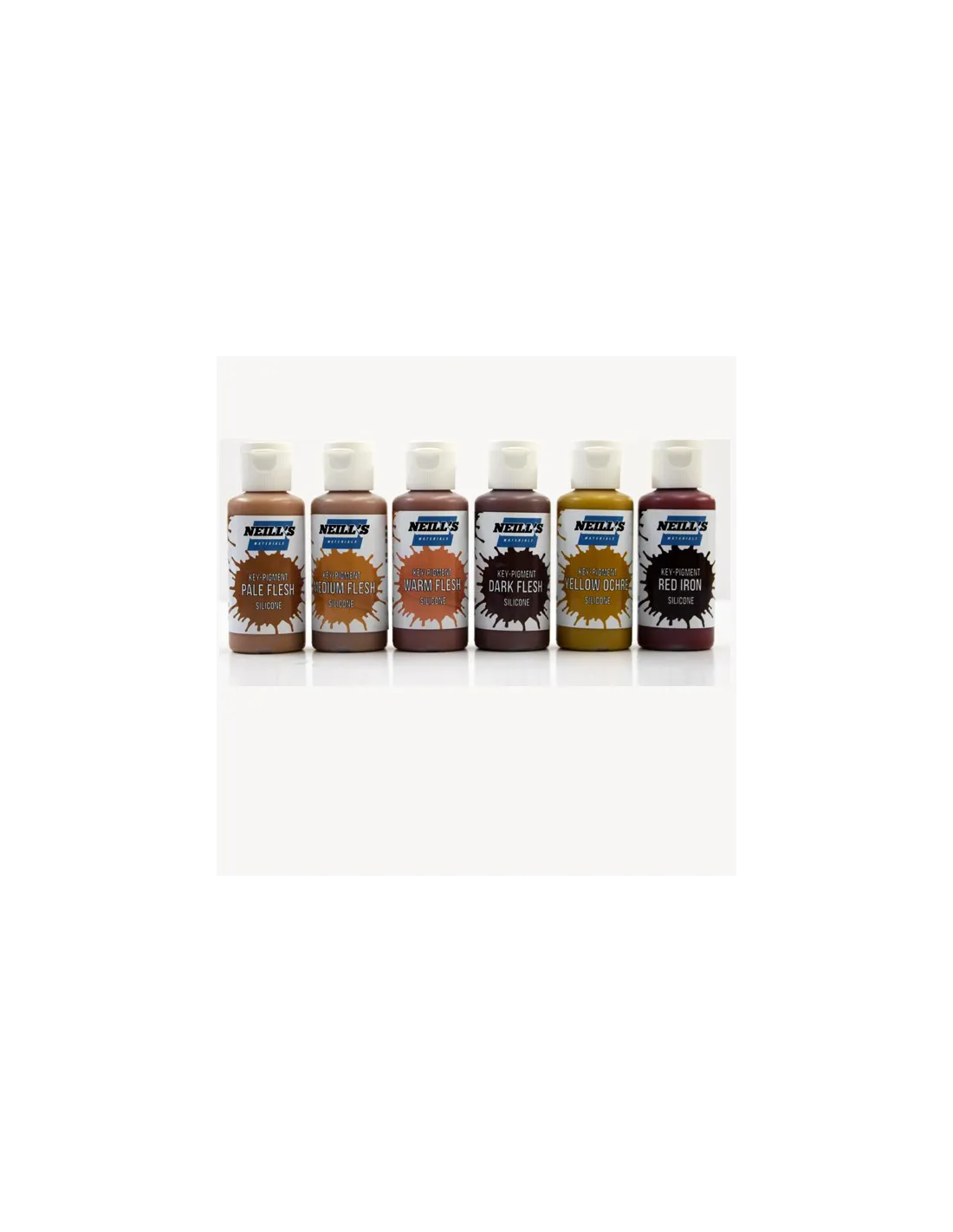
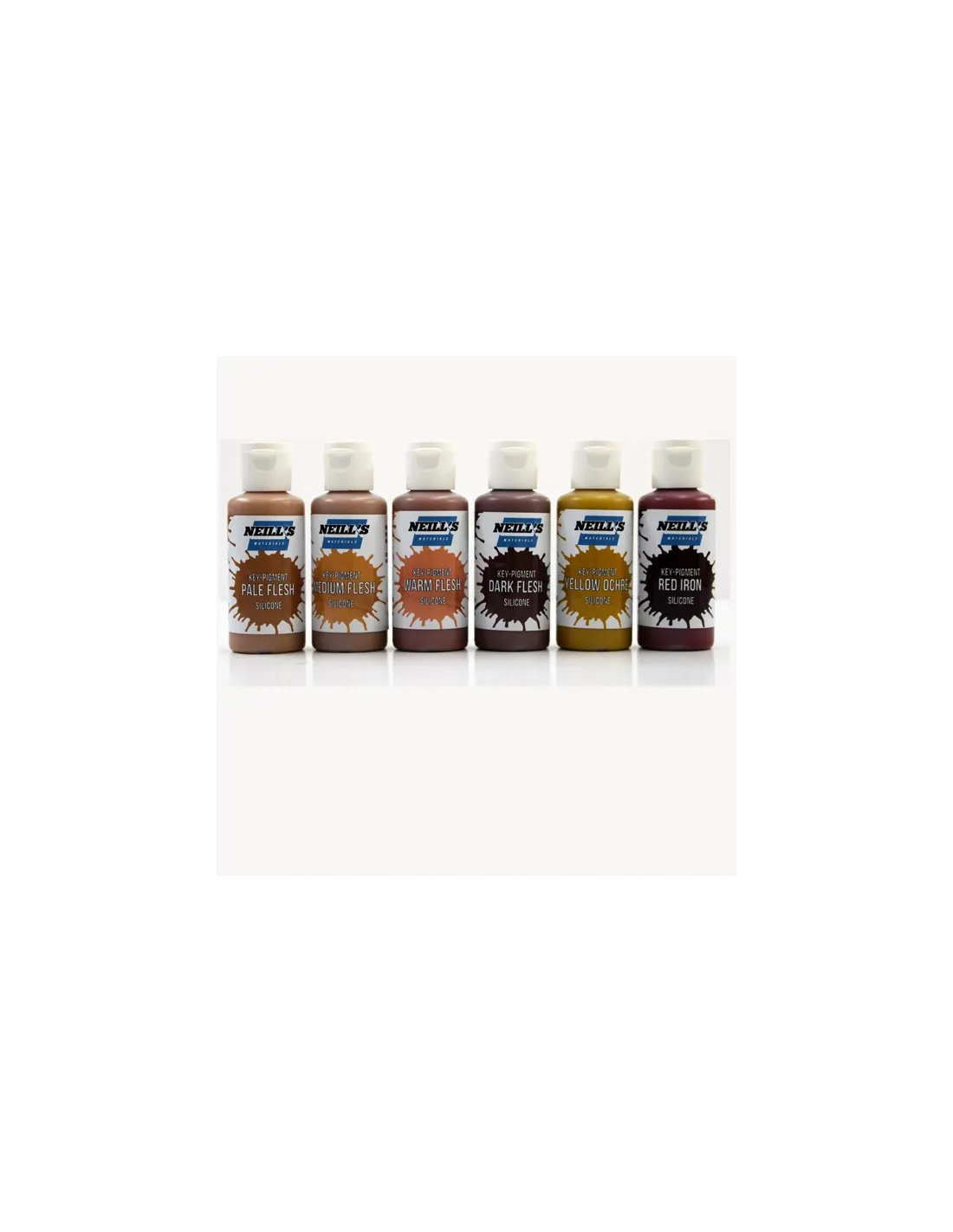
Key-Pigments are highly concentrated silicone pigments, developed by prosthetics artist Neill Gorton (Millennium FX) from years of real work on special effects productions. They are formulated to mix directly with platinum siliconesand deliver a credible, reproducible, batch-consistent skin tone range. If you work with prosthetics, encapsulated pieces or hyperrealistic work, this is the colour system that saves you time and guarantees continuity.
Technical specifications
| Feature |
Detail |
| Format |
Individual 50 g container |
| Pigment type |
Silicone pigment, compatible with platinum (addition) silicones |
| Concentration |
High concentration — small amounts colour large volumes |
| Range |
4 base skin tones + 2 adjusters (red iron oxide and yellow ochre) |
| Developer |
Neill Gorton / Millennium FX |
| Main application |
FX prosthetics, encapsulated pieces, hyperrealistic work |
What they are used for
Key-Pigments are designed to colour platinum silicones in bulk before curing, especially in applications requiring natural, reproducible skin tones. They are the foundation of the Millennium FX colour system and are used both in film and television productions and in independent special effects and realistic art studios.
- Intrinsic colouring of silicone prosthetics for special effects
- Foam encapsulations with bulk-coloured silicone skin
- Hyperrealistic figures and reborn pieces requiring precise flesh tone
- Production runs with colour continuity between batches
- Tone adjustment on translucent silicones to simulate skin with optical depth
- Custom blends starting from the four base tones + the two adjusters
How to use
- Select the base tone closest to the desired result. The four base colours cover the majority of human skin phototypes.
- Weigh the amount of silicone you are going to use. Always work by weight to ensure batch reproducibility.
- Add the Key-Pigment directly to part A (or the higher-volume component) of your FX prosthetics silicone before mixing the two parts. Start with a small amount: the high concentration allows you to reach the desired tone with very little pigment.
- Mix thoroughly until you obtain a homogeneous colour, with no streaks or unpigmented areas.
- If the tone is not quite right, add small amounts of the red adjuster (iron oxide) for warmer or pinker tones, or the yellow adjuster (ochre) for more golden or olive tones.
- Once the desired tone is achieved, add part B and mix according to the instructions for the silicone being used.
- Record the exact pigment proportions used so you can reproduce the colour batch in the future.
Important — Cure inhibition in platinum silicones: Key-Pigments are formulated for platinum (addition) silicones. These silicones are sensitive to inhibition through contact with materials containing sulphur, tin, amines or certain resins. Do not allow the pigmented silicone to come into contact with sulphur-containing plasticines, uncured cyanoacrylate adhesives, latex gloves or surfaces contaminated with these materials. When in doubt, always carry out a small cure test before executing the full piece.
Usage tips
Four-base-tone colour system
The four base tones are not conventional primary colours: they are starting points already optimised for the majority of human skin phototypes. In practice, nine out of ten prosthetics can be executed directly with one of these tones without modification. Before adding the adjusters, evaluate the colour on a white surface under daylight or a light source that emulates the final use environment.
Batch reproducibility
The greatest value of this system is not just the colour, but the consistency. Keep a precise record of every mix: grams of pigment per 100 g of silicone. Since Key-Pigments are highly concentrated, differences of tenths of a gram can noticeably shift the tone. Use a precision scale with at least one decimal place.
Layered pigmentation with translucent silicones
For maximum hyperrealism results, combine Key-Pigments with translucent silicones such as EASYPLAT MOLD-40 or EasyGel FX HR20. Apply layers with different pigment concentrations to simulate the optical depth of real skin: more pigmented in the inner layers, more translucent in the outer ones.
Frequently asked questions
What type of silicones are these pigments compatible with?
Key-Pigments are formulated for platinum (addition) silicones. They are compatible with the full range of Feroca platinum silicones, including EasyGel FX00, EasyGel FX HR20, EASYPLAT 00-30 and other platinum silicones in the catalogue. They are not suitable for tin (condensation) silicones.
How much pigment needs to be added to obtain a skin tone?
Being highly concentrated, the amounts needed are very small. In general, between 0.5% and 2% by weight of the total silicone is usually enough to obtain an opaque, natural skin tone. For more translucent layers, percentages below 0.5% yield interesting results. Always record the exact proportion so you can repeat the batch.
Can the pigment affect the silicone's cure time?
No. Key-Pigments are neutral silicone pigments that do not interfere with the platinum catalyst or modify the working time or cure time of the base silicone. Curing occurs within the times indicated by the manufacturer of the silicone used.
Can the different tones be mixed together?
Yes. Key-Pigments are designed precisely to be mixed. The system works like a palette: the four base tones cover the majority of cases, and the two adjusters (red and yellow) allow any of them to be shifted towards pinker, warmer or more golden tones. Combinations are open and predictable, as long as you work by weight and record the proportions.
Can they be used to colour mould silicones as well as prosthetics?
Yes, they are technically compatible with any platinum silicone, including mould silicones. However, their range is optimised for skin tones, so their most natural use is in FX prosthetics, hyperrealistic figures and reborn pieces. For colouring moulds in other colours, a broader range of silicone pigments is available in the Feroca catalogue.
Does the pigment affect the mechanical properties of the silicone?
At typical use concentrations (below 2–3% by weight), the pigment does not significantly modify the hardness, elongation or tear resistance of the silicone. At very high concentrations there may be a slight variation, but this falls outside the normal use range.
At what point in the mixing process should the pigment be added?
The most practical approach is to incorporate the pigment into part A before adding the catalyst (part B). This gives you time to evaluate the bulk tone and adjust it before curing has started. Once the desired colour is achieved, add part B and mix as normal.
Does the pigment hold up to subsequent extrinsic painting?
Yes. Intrinsic pigmentation with Key-Pigments provides a solid base colour that facilitates subsequent extrinsic painting, since the starting tone is already close to the final one. This reduces the number of extrinsic paint layers needed and improves the final result when the piece is deformed or thins at the edges.
How much product do I need?Calculate the exact amount before buying and avoid wasting material.
Go to the calculator →