Shopping Cart


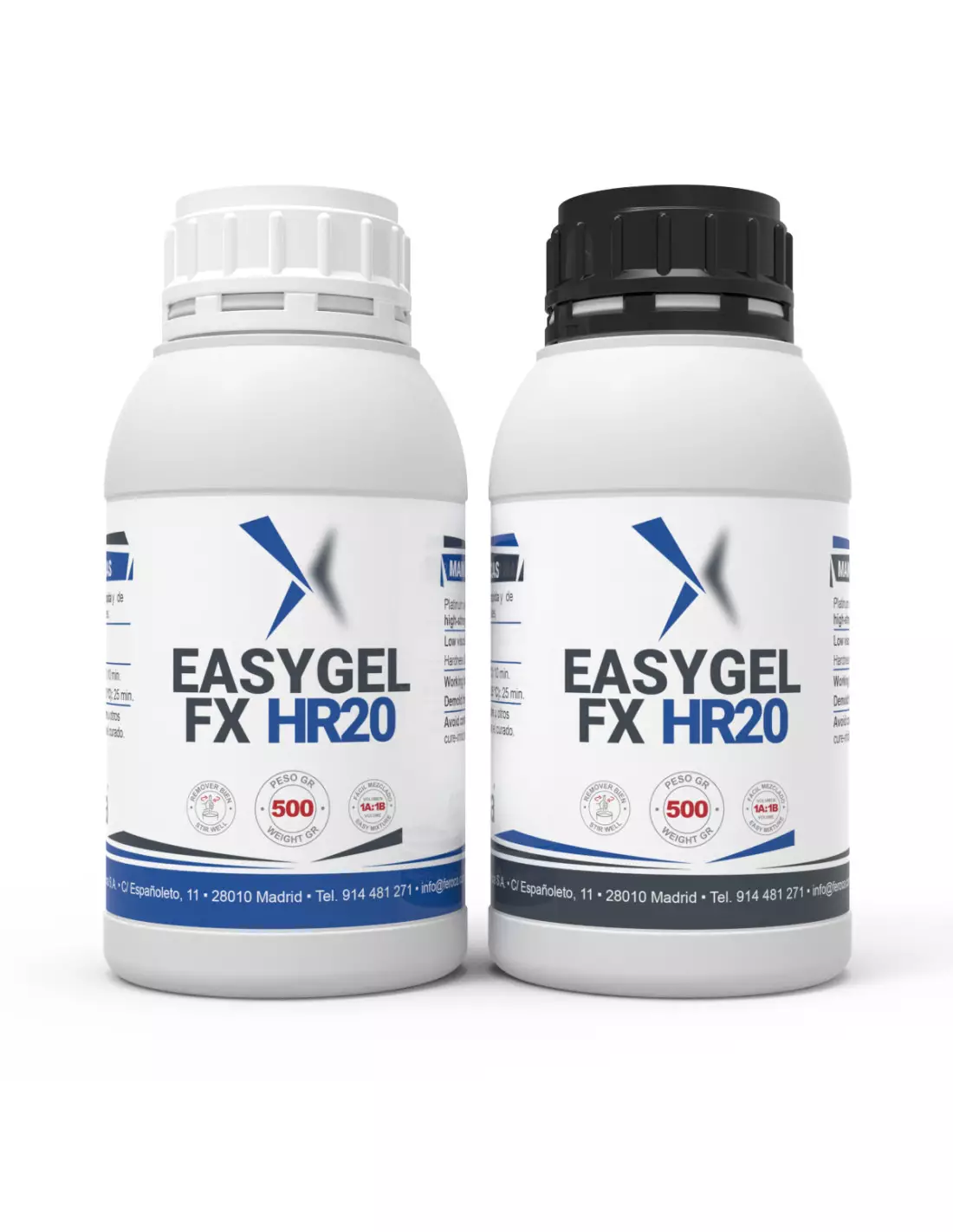
EasyGel FX HR20 - Fast Curing and High Strength -
201353701
€27.00
32,67 € Tax incl.
32,67 € Tax incl.
Platinum silicone Shore A20, 1:1 mix ratio, cure in 25 min and 10 min working time. High tear resistance for FX moulds and serial production.
EasyGel FX HR20 is a two-component platinum (addition) silicone with Shore A20 hardness formulated for production environments where time is a critical factor. With only 10 minutes of working time and full demould in 25 minutes, it combines ultra-fast curing, high tear resistance and minimal shrinkage to deliver faithful reproductions even in geometries with fine detail. Its 1:1 mix ratio by weight and volume simplifies the process and eliminates weighing errors in production.
Technical specifications
| Parameter | Value |
|---|---|
| Type | Platinum (addition) silicone, two-component |
| Colour | Translucent |
| Shore Hardness | A20 |
| Mix ratio (weight) | 100A : 100B |
| Mix ratio (volume) | 100A : 100B |
| Working time at 25 °C | 10 min |
| Cure time at 25 °C | 25 min |
What it is used for
EasyGel FX HR20 is designed for mould-making professionals, special effects artists and serial production users who need a fast, durable silicone with excellent detail reproduction. Its Shore A20 provides the flexibility needed to demould parts with undercuts without compromising copy fidelity, and its translucency makes it easy to spot bubbles and monitor mould fill at a glance.
- Serial production moulds with short demoulding cycles
- Special effects (FX) for film, television and theatre: prosthetics, character make-up and props
- Moulding of sculptures and models with fine texture or complex relief
- Reproduction of parts with pronounced undercut geometries
- Mould making for resins, waxes, plasters and low-temperature materials
- Rapid prototyping where cycle time is critical
- Duplication of originals in character make-up and artistic FX workshops
How to use it
- Prepare the original: make sure the model surface is clean, dry and free of contaminants. Apply release agent if the material requires it. Confirm that the original contains no sulphur, latex or tin (see warning).
- Weigh the parts: mix part A and part B in a 1:1 ratio by weight or by volume. Use a precision scale or graduated containers to ensure the exact ratio.
- Mix: stir slowly and evenly for at least 2 minutes, scraping the sides and bottom of the container thoroughly. Avoid introducing air. If you need to increase viscosity for vertical or inclined surface applications, add Thixo Additive at the recommended ratio.
- Degas (optional but recommended): if you have a vacuum chamber, degas the mixture for 1–2 minutes before pouring to eliminate microbubbles.
- Pour or apply: you have 10 minutes of working time. Pour in a thin stream from the lowest point of the mould or apply in layers if brush-coating. If you wish to pigment the silicone, incorporate Key-Pigments before pouring.
- Allow to cure: the mould will be ready to demould after 25 minutes at 25 °C. Do not handle the piece before curing is complete to avoid distortion.
- Demould: carefully remove the piece taking advantage of the flexibility of the Shore A20. The mould is then ready for the next production cycle.
Warning — Platinum silicone inhibition: EasyGel FX HR20 is a platinum (addition) silicone sensitive to inhibition through contact with certain materials. If the platinum catalyst comes into contact with these substances, the silicone will not cure correctly or will remain tacky at the contact surface. Materials that may inhibit curing:
- Clays and plasticines containing sulphur (most conventional modelling plasticines)
- Tin (condensation) silicones and moulds made with them
- Latex and natural rubber
- Urethane rubbers
- Freshly catalysed polyester and epoxy resins
- Petroleum jelly and some tin-based release agents
- Vinyl and flexible PVC
- Certain metals and unsealed surfaces
Usage tips
Control temperature to adjust working times
The 10-minute working time applies at 25 °C. At higher temperatures curing accelerates and handling time decreases noticeably; at lower temperatures it extends. If you are working in summer or in a warm workshop, pre-cool the components before mixing. If you need more handling time for complex projects, work below 20 °C or divide the pour into several stages.
Inhibition test before each new original
Before making the final mould on a new model, mix a small amount of EasyGel FX HR20 and apply it to a discreet area of the original. If after 30 minutes the silicone is still tacky or soft at the contact point, the material is inhibiting the cure. In that case, seal the surface with acrylic spray lacquer or water-based varnish, allow to dry completely and repeat the test. Remember that you cannot use tin silicone as a base material or as a containment mould if you are going to pour platinum over it.
Optimise performance in serial production
The 25-minute cycle allows multiple castings in a single working day. To maintain copy quality, clean the mould between castings and apply release agent according to the material being reproduced. If the mould will work with deep undercut geometries, consider reinforcing it with a rigid counter-mould to avoid accumulated distortion after many cycles. For FX character work where you need to blend prosthetic edges into skin, consult the use of a specific encapsulant.
Frequently asked questions
What materials can prevent a platinum silicone from curing properly?
Platinum silicones like EasyGel FX HR20 are sensitive to inhibition through contact with sulphur, latex, tin (condensation) silicones, urethane rubbers, freshly catalysed polyester and epoxy resins, petroleum jelly and vinyl. If any of these materials is in contact with the silicone during curing, the result will be a tacky surface or incomplete cure. Always seal the original with acrylic lacquer and carry out a compatibility test before the final pour.
Can I use conventional plasticine to make the mould box or the original?
It depends on the plasticine. Most modelling plasticines contain sulphur, which inhibits the curing of EasyGel FX HR20. Use only sulphur-free plasticines certified as compatible with platinum silicones. If in doubt, carry out a cure test on a sample before proceeding.
Can this silicone be mixed with tin silicones or used to repair a tin mould?
No. Platinum silicone does not cure over tin silicone — it is inhibited. They are not compatible in direct contact. If you need to work with condensation silicones, see the EASYL 3520 or Silastic 3481 ranges.
How many copies can a mould withstand before degrading?
The service life of an EasyGel FX HR20 mould depends on the material being reproduced, the use of release agent and storage conditions. Under correct conditions and with adequate release agent, platinum silicone moulds typically withstand between 20 and 50 castings with resins or plasters, and more with less aggressive materials such as waxes. The high tear resistance of this silicone extends mould life in undercut geometries.
How do I add colour to the silicone before pouring?
Incorporate Key-Pigments, pigments specifically formulated for platinum silicones, before the final mix or during mixing. Do not use conventional paint pigments or acrylic dyes, as these may contain inhibitors. The natural translucency of EasyGel FX HR20 makes it easy to achieve uniform tones with small amounts of pigment.
Can it be applied vertically or on inclined surfaces without sagging?
By default, EasyGel FX HR20 has the viscosity of a pourable liquid silicone. For vertical applications, layered work or complex surfaces where a mould box is not practical, add Thixo Additive to the mix to increase thixotropy and prevent sagging. The thixotropic additive does not affect cure time.
Is it suitable for direct skin impression (Life Cast)?
EasyGel FX HR20 is not specifically formulated for Life Cast. For direct skin impressions it is recommended to use KEY-FORM, a platinum silicone designed and tested for skin contact. EasyGel FX HR20 is aimed at production moulds and FX applications where the silicone does not come into prolonged contact with the end user's skin.
Can I accelerate or retard the cure?
Curing can be accelerated by increasing ambient temperature or using a gentle curing oven (40–50 °C). To retard it, work at a lower temperature or pre-cool the components. Some platinum products accept specific retarders, but excessive use can compromise the cure; consult Feroca before adding any additive not specified for this reference.
- Color
- Translucent
- Working Time
- 10min
- Curing Time
- 25min
- Shore Hardness
- A20
- Volume Mixing Ratio
- 100A:100B
- Mixed Weight Ratio
- 100A:100B
No reviews
Tap to zoom