Shopping Cart


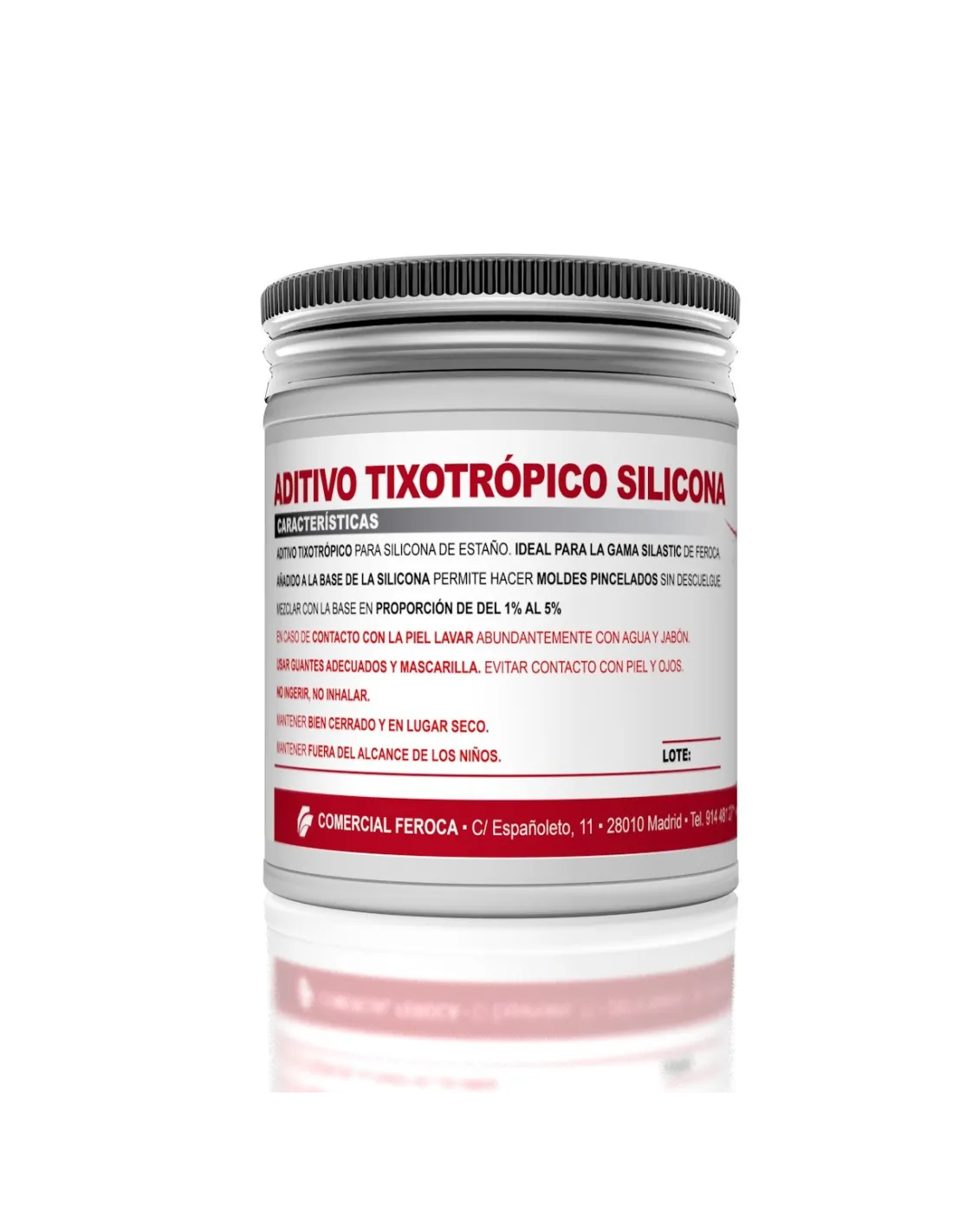
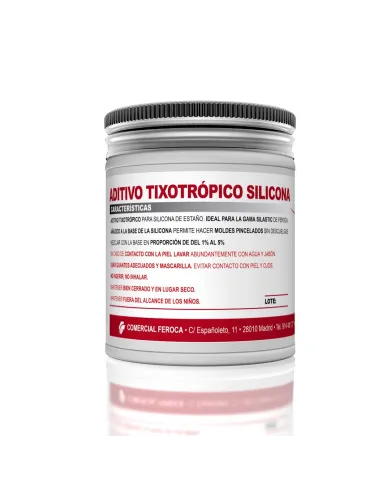
Thixo Additive Thixotropic Additive for Silicones
204000050
€10.50
12,71 € Tax incl.
12,71 € Tax incl.
Thixotropic additive for tin and platinum silicones. Eliminates sagging on vertical surfaces. Dosage from 1% to 5% by weight of the base.
Thixo Additive is a thixotropic additive designed to modify the viscosity of tin and platinum silicones without altering their cure time. Added to the silicone base in small proportions, it converts any pourable silicone into a non-sagging paste, allowing you to apply even layers over vertical, inclined or complex-geometry surfaces directly with a brush.
Technical specifications
| Property | Value |
|---|---|
| Product type | Thixotropic additive for silicones |
| Compatibility | Tin (condensation) silicones and platinum (addition) silicones |
| Usage ratio | 1% to 5% by weight of the silicone base |
| Effect on cure time | None — does not alter curing |
| Application method | Brush, spatula |
| Supply | As a complement to Feroca silicone kits |
What it's used for
Thixo Additive is intended for any situation where you need to apply silicone without it running before it starts to gel. It is the standard solution in brush-on mold and skin mold techniques, where the mold is built up layer by layer over the original piece.
- Brush-on molds over vertical pieces or pieces with undercuts where pourable silicone would not hold the initial layer.
- Blanket molds over large-format sculptures.
- First detail layer in dual-density molds (soft layer + reinforcement).
- Applications on ceiling surfaces or soffits.
- FX special effects and prosthetics where silicone is brushed directly onto the positive.
- Silicone coatings over rigid structures with inclined faces.
How to use it
- Prepare the silicone base you are going to use (for example, EASYPLAT 00-30 or any other compatible Feroca silicone).
- Weigh the base before adding the catalyst. Calculate the amount of Thixo Additive: between 1% and 5% of the base weight. Start with 2–3% and adjust to achieve the desired viscosity.
- Incorporate the Thixo Additive directly into the base and mix thoroughly with a spatula until you obtain a homogeneous paste with no lumps.
- Add the catalyst at the ratio indicated by the silicone you are using and mix again carefully to avoid incorporating bubbles.
- Apply the mixture with a brush or spatula over the original piece. The paste consistency will prevent sagging even on vertical walls.
- Allow to cure for the time indicated by the base silicone. Thixo Additive does not modify that time.
- Repeat the application in successive layers until the desired wall thickness for the mold is reached.
Warning — Cure inhibition in platinum silicones: If you use Thixo Additive with platinum (addition) silicones, bear in mind that this type of silicone is sensitive to inhibition by contact with certain materials: sulphur-containing clays, latex, incompletely cured epoxy resins, cyanoacrylate adhesives and certain metals. If the silicone remains tacky or does not cure correctly, check the model and tools. Always perform a compatibility test before proceeding with the full piece.
Usage tips
Get the dosage right
At 1–2% the thixotropic effect is mild: the silicone thickens but remains easy to apply with a brush. At 4–5% you get a very dense paste, ideal for ceiling surfaces or strongly pronounced areas. Do not exceed 5% as this can negatively affect the final mechanical properties of the mold.
Mix without bubbles
When incorporating the additive into the base, mix with slow, circular movements, scraping the container walls thoroughly. Vigorous mixing introduces bubbles that then become trapped in the detail layer. If you have access to a vacuum chamber, degas the mixture before adding the catalyst. With silicones such as EASYPLAT MOLD-40 or EasyPlat ACQUA, the transparency of the material will allow you to see and remove bubbles easily.
Build the mold in layers
In brush-on molds, the standard technique is to apply a thin first layer with Thixo Additive (detail layer) and let it cure. You can then add reinforcement layers with the same silicone without additive, or with a harder silicone. For hyperrealism work or FX prosthetics, this technique works very well combined with EasyGel FX00 or EasyGel FX HR20.
Frequently asked questions
Does a thixotropic additive change the cure time of the silicone?
No. Thixo Additive only modifies the viscosity of the silicone. The cure time is exactly the same as indicated by the base silicone, whether you are working with tin or platinum silicones.
Can it be used with any silicone?
Yes, Thixo Additive is compatible with condensation (tin) silicones and addition (platinum) silicones. It works with the entire Feroca mold silicone range.
How much additive needs to be added to prevent sagging?
The recommended dosage is between 1% and 5% of the silicone base weight. For slightly inclined surfaces, 2% is usually sufficient. For vertical walls or ceilings, increase to 4–5%. Do not exceed that limit to avoid compromising the mechanical properties of the final mold.
Is it mixed with the base or with the already catalysed mixture?
Always with the base, before adding the catalyst. This gives you more time to integrate the additive properly before the curing reaction has started.
Does it affect the final hardness of the mold?
At normal proportions (up to 5%) the impact on final hardness is minimal. Higher dosages may slightly soften the mold, so it is recommended not to exceed that threshold.
Can it be used in special effects molds and prosthetics?
Yes. It is a standard technique in FX workshops and prosthetics manufacturing. The thixotropic mixture is brushed onto the positive to build the detail layer of the mold. Combined with silicones such as EasyGel FX00 or EasyGel FX HR20 from Feroca, it allows high-definition molds to be obtained over complex geometries.
What tools are used to apply the mixture?
The most common option is a synthetic or silicone bristle brush. You can also use a flexible spatula for larger areas. Avoid natural bristle brushes that may shed hairs and leave them trapped in the detail layer.
How many layers need to be applied for a complete brush-on mold?
It depends on the size and complexity of the piece, but the usual practice is to apply between 3 and 6 layers, allowing each one to cure before the next. The first layer with Thixo Additive ensures detail registration; subsequent layers can be done with silicone without additive or with a lower dosage to gain fluidity and cover more quickly.
Video tutorial
Simbiox Sculpting Armature and Rotomolding
No reviews
Tap to zoom