Shopping Cart


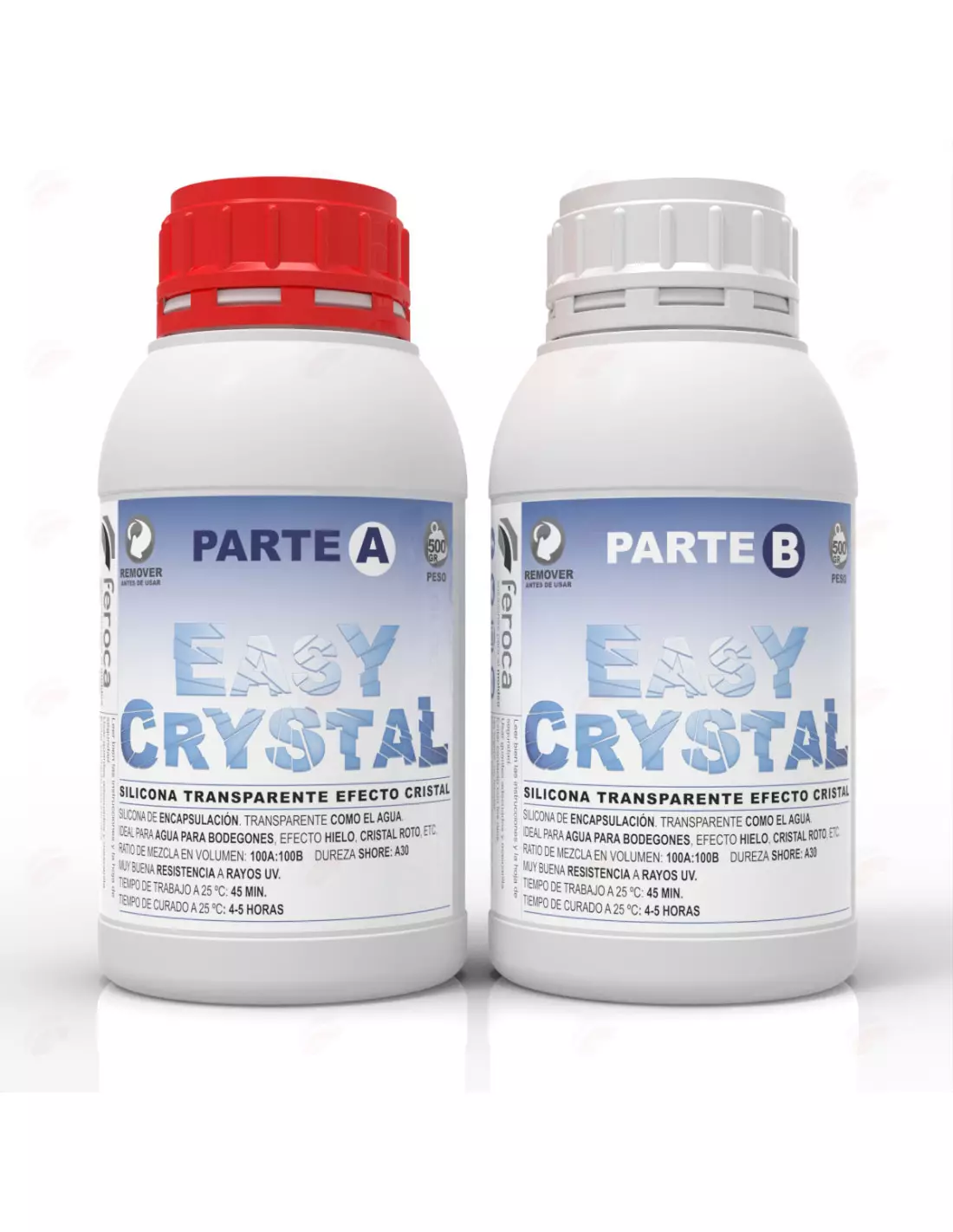
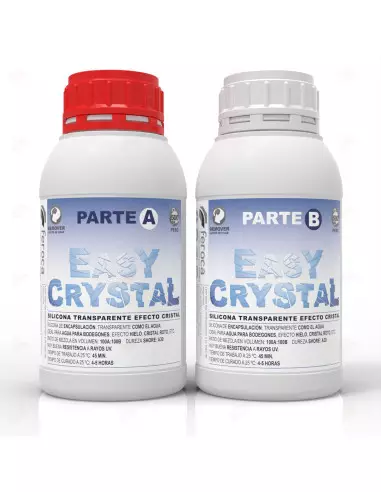
Easy Crystal -Water/Ice/Crystal Effect Silicone-
201356001
€21.00
25,41 € Tax incl.
25,41 € Tax incl.
Transparent Shore A25 platinum silicone for simulating water, ice and glass. 1:1 mix by volume, 45 min working time, cures in 4-5 h.
Easy Crystal is a fully transparent two-component platinum silicone, specifically formulated to simulate static water, ice, broken glass or diamonds with high-quality optical results. Its low viscosity allows bubble-free pouring, the 1:1 mixing ratio by volume simplifies the process, and its room-temperature cure without heat or fumes makes it one of the most versatile options for decorative, display and special effects applications.
Technical specifications
| Parameter | Value |
|---|---|
| Type | Two-component platinum (addition) silicone |
| Colour | Transparent |
| Shore Hardness | A25 |
| Mix ratio (volume) | 100A : 100B |
| Working time at 25 °C | 45 min |
| Cure time at 25 °C | 4-5 hours |
What it is used for
Easy Crystal is designed for any application where you need to simulate static water, ice or glass with a flexible, transparent and easy-to-handle material. Its semi-rigid cure and optical appearance make it especially versatile in decorative, exhibition and visual effects environments:
- Artificial water for floral arrangements and shop windows: encapsulate flowers, branches or artificial stems creating the effect of a vase with real water.
- Object encapsulation for display: figures, insects, minerals or other elements for exhibition in museums, shop windows or trade fairs.
- Water effects in scale models and dioramas: ponds, rivers, puddles or aquatic surfaces for modelling and scenography.
- Imitation of ice, broken glass or diamonds in props and sets for film and television.
- Special effects in theatre, product photography and advertising.
- Creation of jewellery, pendants and decorative pieces with objects encapsulated inside.
- Filling decorative fountains, plant pots and table centrepieces for events.
How to use it
- Prepare the mould or container: make sure the vessel into which you are going to pour the silicone is clean, dry and free of contaminants such as latex, sulphur or uncured epoxy. If you are encapsulating objects, place them in position before pouring.
- Measure the parts: mix part A and part B in a 1:1 ratio by volume. Use two graduated containers for greater accuracy.
- Mix slowly: combine both parts by stirring slowly with a spatula for at least 2-3 minutes, scraping the sides and bottom of the container thoroughly. Avoid vigorous movements that would incorporate air.
- Apply vacuum if you have a chamber: a 1-2 minute cycle in a vacuum chamber removes any microbubbles before pouring. If you do not have a chamber, work at a moderate room temperature and pour from a height in a thin stream.
- Pour carefully: fill the mould or container in a continuous thin stream from a low point to progressively displace air upwards. If you need to thixotropise the mix for vertical applications, add a small amount of Thixo Additive.
- Leave to cure without moving: the working time is 45 minutes. Leave to rest at room temperature (25 °C) for 4-5 hours without moving or vibrating the assembly.
- Demould: once curing is complete, demould carefully. The piece will be flexible, transparent and ready to use.
Warning: platinum silicone inhibition
Easy Crystal is a platinum (addition) silicone sensitive to inhibition through contact with certain materials. Any contaminant can prevent curing, leaving the silicone tacky or uncured. Avoid contact with:
Easy Crystal is a platinum (addition) silicone sensitive to inhibition through contact with certain materials. Any contaminant can prevent curing, leaving the silicone tacky or uncured. Avoid contact with:
- Clays and modelling compounds containing sulphur (most conventional modelling clays)
- Latex in any form (latex gloves, latex moulds)
- Cured or uncured tin silicone (condensation)
- Freshly poured or incompletely cured polyester or epoxy resins
- Urethane rubbers
- Vaseline and some tin-based release agents
Usage tips
Maximum transparency: control the temperature
Ambient temperature directly affects the optical clarity of the result. Work between 20 and 25 °C. Above 30 °C the cure accelerates and slight cloudiness may appear. Below 18 °C the cure slows down considerably and the mix tends to trap air more easily. If the workshop is cold, warm the components slightly (no more than 30 °C) before mixing.
How to avoid bubbles
Easy Crystal's low viscosity already helps air escape naturally, but if you want maximum clarity you can combine several techniques: mix slowly with a spatula rather than a mixer, pour in a thin stream from height, and if you have a vacuum chamber apply a brief cycle immediately after mixing. For very large pieces, a positive pressure cycle (pressure chamber) during curing eliminates even the smallest residual bubbles.
Pigmentation and special effects
Easy Crystal accepts Key-Pigments specifically for silicone in very small quantities if you want to achieve effects of murky water, sea water, coloured glass or tinted ice. Always add the pigment to part A before incorporating part B and mix thoroughly for a homogeneous dispersion. With very small amounts (1-3 drops per 100 g) you will maintain translucency while controlling the hue.
Frequently asked questions
What materials can inhibit the cure of a platinum silicone?
Platinum silicones such as Easy Crystal are sensitive to inhibition through contact with sulphur (present in many modelling clays), latex, cured or uncured tin silicone, uncured polyester and epoxy resins, urethane rubbers and vaseline. If the silicone remains tacky or fails to cure in any area, contamination is the most likely cause. Clean the mould or container with isopropyl alcohol and make sure all materials in contact are compatible before repeating the pour.
Can it be completely transparent and bubble-free?
Yes. Easy Crystal is formulated with low viscosity precisely to minimise air entrapment. By mixing slowly, pouring in a thin stream and working at a controlled temperature (20-25 °C) you achieve pieces with very high optical transparency. If you have a vacuum chamber, a short cycle after mixing guarantees virtually bubble-free results even in large-volume pieces.
Can it be used in contact with real water or outdoors?
Easy Crystal is designed to simulate static water, not for use in installations with running water. For indoor or occasional outdoor decorative applications (shop windows, table centrepieces, display stands) it works perfectly. It has UV resistance, so it does not yellow with light exposure. For outdoor applications with continuous rain or humidity, consult the Feroca technical team.
What type of mould or container should I use?
You can use silicone, plastic (PP, PE, PETG), glass or metal moulds. Avoid unsealed polyurethane moulds, moulds with latex residue or any material containing sulphur. Glass or rigid plastic containers are ideal for creating the vase-with-water effect. If you use a silicone mould to shape the piece, make sure it is cured platinum silicone, never tin silicone.
Can I accelerate the cure with heat?
Yes, heat accelerates the cure of Easy Crystal. At 40-50 °C in a domestic or curing oven you can significantly reduce the time. However, only apply heat after the piece has partially gelled at room temperature (approximately 30-45 minutes) to avoid bubble formation due to thermal expansion. Temperatures above 60 °C are unnecessary and may affect transparency.
Can it be pigmented to imitate sea water, coloured glass or blue ice?
Yes. Easy Crystal accepts Key-Pigments for silicone in very small quantities. With 1-3 drops per 100 g of mix you obtain translucent tones that imitate tinted water, coloured glass or bluish ice. Always add the pigment to part A, mix well, then incorporate part B.
Can any object be encapsulated inside?
You can encapsulate most solid objects: artificial or dried natural flowers, minerals, figures, preserved insects, metals, treated wood or stable plastics. Avoid objects containing sulphur, latex or materials that could contaminate the mix. Wet objects or those with oils can cause cloudiness or poor adhesion. Make sure everything is clean and completely dry before pouring.
How long does demoulding take and when is the final hardness reached?
At 25 °C, Easy Crystal is ready to demould in 4-5 hours. The final hardness (Shore A25) is typically reached at 24 hours. If you have accelerated the cure with heat, the material reaches its final mechanical properties sooner. Always wait for full cure before subjecting the piece to intensive handling or final installation.
- Color
- Transparent
- Working Time
- 45min
- Curing Time
- 4-5horas
- Shore Hardness
- A25
- Volume Mixing Ratio
- 100A:100B
No reviews
Tap to zoom