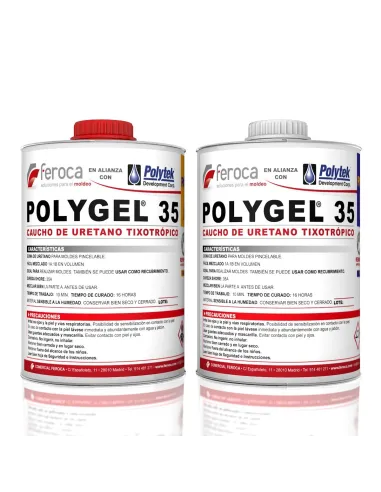
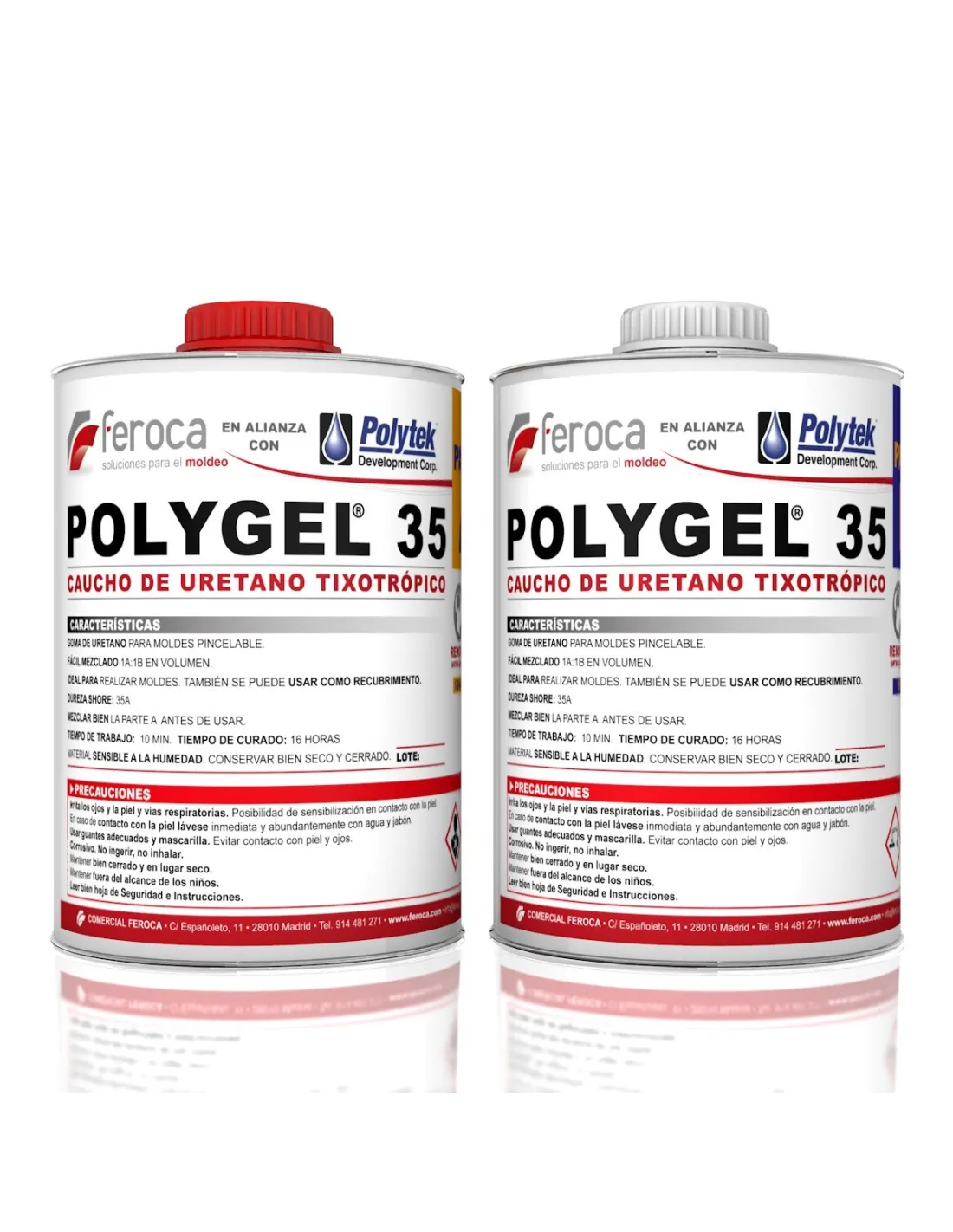
Polygel® 35 is a thixotropic polyurethane rubber designed to be brush-applied onto vertical or relief surfaces without sagging. With a Shore A35 hardness and 620% elongation, it is the ideal choice when you need a flexible, durable mold with virtually no shrinkage, or when you want to add flexibility to a surface as a coating.
Technical specifications
| Parameter |
Value |
| Mix ratio (by weight) | 100A : 100B |
| Mix ratio (by volume) | 100A : 100B |
| Pot life | 10 minutes |
| Cure time | 16 hours |
| Shore Hardness | A35 |
| Color | Blue |
| Mix viscosity | Thixotropic |
| Elongation | 620% |
| Shrinkage | Negligible |
What it is used for
Polygel® 35 is designed for any situation where you need to build a flexible mold directly on the model by brush, without the need to contain the material with a mold box. Its thixotropic nature keeps it in place even on complex geometries and vertical surfaces. It also works as a flexible coating to protect or add elasticity to a part.
- Skin molds for casting plaster, rigid polyurethane resins, epoxy or polyester resins
- Molds for casting wax, cement or low-pressure materials
- Reproduction of textures and relief surfaces in sculpture and special effects
- Skin molds with a plaster, fiberglass or rigid filler shell for large pieces
- Flexible coating for parts that require added elasticity and surface resistance
- Rapid prototyping where a lightweight, manageable mold is needed
How to use it
- Prepare the model: make sure the surface is clean, dry and free of dust. If the model material is porous, apply a sealer coat before proceeding.
- Apply release agent: coat the model with a suitable release agent. Unlike silicone, Polygel® 35 bonds to the cast material, so this step is essential in almost all cases.
- Mix the components: combine parts A and B in equal amounts by weight or by volume (1:1). You can measure by volume directly, without a scale. Mix thoroughly for at least 2 minutes, scraping the sides of the container well.
- Add color if needed: if you want to identify layers or simply color the rubber, add PolyColor Dyes before applying. You have a 10-minute pot life.
- Apply the first coat: using a brush, spread a thin layer over the entire model. This first detail coat is the most important: make sure no bubbles are trapped in angles and textured areas.
- Add successive coats: before the previous coat has fully cured (while it is still slightly tacky), apply additional coats until the desired thickness is reached. Generally, 4 to 6 mm is sufficient for most applications.
- Allow to cure: once the required thickness has been reached, allow the assembly to cure for 16 hours at room temperature.
- Build the shell mold: after curing, reinforce the exterior with plaster, fiberglass or rigid filler so the mold retains its shape during casting.
- Demold: carefully remove the assembly from the original model. The mold is now ready to use.
Important — Release agent required: polyurethane rubbers such as Polygel® 35 adhere to most cast materials. Unlike silicone, applying a release agent before casting plaster, resins or other materials is absolutely essential. Without a release agent, the mold may bond permanently to the part. Additionally, polyurethane is sensitive to moisture during curing: work in a dry environment and seal containers tightly after each use to prevent component B from absorbing moisture from the air and deteriorating.
Tips and advice
Working temperature and cure
Polygel® 35 cures at room temperature, but ambient temperature directly affects pot life and cure time. Below 18 °C, cure time increases considerably and the mix may become more viscous, making brush application more difficult. Above 30 °C, pot life is reduced. Ideal working conditions are between 20 and 25 °C. Do not exceed 60 °C during use of the cured mold, as the rubber may lose mechanical properties above that temperature.
Managing coats for a uniform mold
The key to a good skin mold is consistent thickness. Always apply thin, even coats rather than a single thick one: this minimizes bubbles and ensures the rubber faithfully captures detail. To ease application in hard-to-reach areas, you can slightly thicken the mix with thixotropic fillers compatible with polyurethanes, although in most cases the natural thixotropy of Polygel® 35 is sufficient. If you need a stiffer or harder mold, consider Poly 74-45, which offers a higher Shore A rating.
Storage and shelf life
Component B (isocyanate) is particularly sensitive to ambient moisture. Once opened, seal the container tightly after each use and, if possible, protect it with an inert gas atmosphere (nitrogen or argon). If component B shows lumps or has noticeably increased in viscosity, it has likely absorbed moisture and its performance will be compromised. Store both components in a cool, dry place away from direct sunlight.
Frequently asked questions
Do I need a scale to mix this polyurethane rubber?
No. Polygel® 35 is mixed in a 1:1 ratio both by weight and by volume, so you can measure the components with graduated cups or any container of known volume without a scale. That said, if you have a scale available, use it: accuracy always improves the final result.
Is it necessary to use a release agent with polyurethane molds?
Yes, almost always. Unlike silicone, polyurethane rubbers such as Polygel® 35 tend to bond to the cast material. Before casting plaster, resins or other materials into the mold, always apply a suitable release agent. Failing to do so can result in a permanent bond between the mold and the part.
Can I cast polyurethane resin inside a polyurethane mold?
Yes, but applying a good release agent before casting is essential. Polyurethane can bond to itself, especially if both surfaces are fresh or if the release agent does not cover the entire cavity. Make sure the release agent layer is uniform and complete, paying particular attention to angles and detailed areas.
What is the maximum temperature polyurethane rubber molds can withstand?
Polyurethane rubbers, including Polygel® 35, should not exceed 60 °C during use. Above that temperature, the material may lose dimensional stability and mechanical properties, compromising mold accuracy. For applications requiring resistance to higher temperatures, consider using high-temperature silicones.
Can I pigment this polyurethane rubber?
Yes. PolyColor Dyes are pigments specially formulated for use in polyurethane resins and rubbers, and are fully compatible with Polygel® 35. Add them to the mix before applying, always within the 10-minute pot life.
Can I use polyurethane rubber on plasticine or clay models?
It depends on the composition of the plasticine or clay. Some plasticines contain oils or components that can migrate into the rubber and affect curing or cause unexpected adhesion. The safest approach is to always apply a sealer or release agent coat over the model before applying Polygel® 35. If the model is made from dry or oven-cured clay, make sure it is completely dry and free of surface moisture.
What is the purpose of a shell mold with a skin mold?
The shell mold is a rigid casing built over the exterior of the rubber mold once it has cured. Its purpose is to prevent the flexible mold from deforming or losing its shape when material is cast inside it. It can be made from plaster, polyester filler, fiberglass or any rigid material. Without a shell mold, the Polygel® 35 mold may deform under the weight or pressure of the cast material, especially with larger pieces.
Is it possible to repair a polyurethane mold if it tears or is cut?
In general, repairing polyurethane molds is difficult because conventional adhesives do not bond well to cured polyurethane rubber. For small cracks or cuts, a repair can be attempted by applying fresh Polygel® 35 to the affected area, although the bond is not always perfect. For more significant damage, the best course of action is to make a new mold.
How much product do I need?Calculate the exact amount before buying and avoid wasting material.
Go to the calculator →