
Shopping Cart

Polyurethane rubbers for concrete molds
Hardness is the main selection criterion: a rubber that's too soft deforms under the weight of the concrete and loses surface detail; one that's too rigid makes demolding difficult on geometries with undercuts. For most decorative concrete applications, the Shore A60–85 range is ideal. Within that range you can choose between pourable formulations, which fill the counter-mold in a single pour, and brushable formulations, which build up the mold layer by layer on large-format pieces.
Shore A60–85 rubbers: the recommended range for concrete
These rubbers offer the abrasion and compression resistance that concrete demands. Their low viscosity makes pouring easy and ensures faithful reproduction of rough textures like stone, wood or slate.
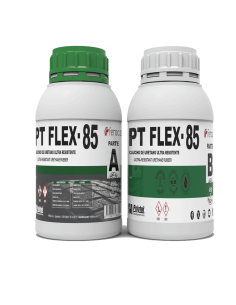 PT Flex 85
Shore A85, maximum abrasion resistance. The best choice for concrete.
PT Flex 85
Shore A85, maximum abrasion resistance. The best choice for concrete.
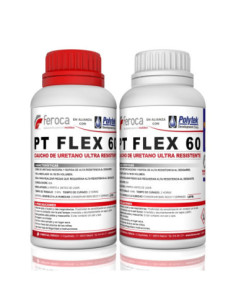 PT Flex 60
Shore A60, high resistance, slightly more flexible for complex demolding.
PT Flex 60
Shore A60, high resistance, slightly more flexible for complex demolding.
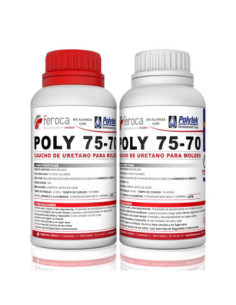 Poly 75-70
Shore A70, 1:1 mix ratio, good balance between hardness and flexibility.
Poly 75-70
Shore A70, 1:1 mix ratio, good balance between hardness and flexibility.
Brushable rubber for large-format molds
When the piece to be molded is large or has a vertical geometry, the layer-by-layer brushing technique lets you build up the mold with full control over thickness and avoid wasting material. Polygel 35 is thixotropic and non-sagging, making it practical to work on vertical surfaces such as panels, pilasters or textured partition walls.
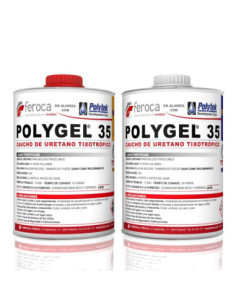 Polygel® 35
Thixotropic brushable, Shore A35. Ideal for large-format vertical surfaces.
Polygel® 35
Thixotropic brushable, Shore A35. Ideal for large-format vertical surfaces.
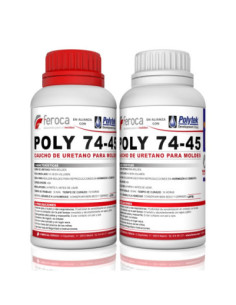 Poly 74-45
Shore A45, 1:1 mix ratio, good flow for pouring into large counter-molds.
Poly 74-45
Shore A45, 1:1 mix ratio, good flow for pouring into large counter-molds.
Note on hardness: for series production with vibrated or self-compacting concrete, PT Flex 85 is the preferred choice due to its tear resistance (190 pli) and abrasion resistance. For short runs or pieces with high relief and multiple undercuts, PT Flex 60 or Poly 75-70 offer greater demolding flexibility without sacrificing mold life.
Release agents for concrete molds
Release agent is the step that's most underestimated and most costly when skipped: concrete without release agent bonds permanently to polyurethane rubber and destroys the mold. You must apply it on every pour, even on already broken-in molds. For concrete there are three formats depending on your working method:
Release agents specifically for concrete and formwork
Sika Desencofrante D is the reference release agent for concrete: specially formulated for formwork, it creates a barrier between the concrete and the mold, is water-soluble and noticeably extends mold life.
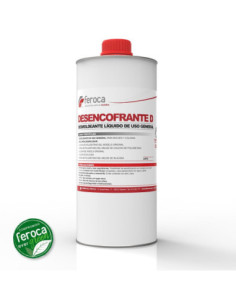 SIKA Desencofrante D
Specific oil for concrete and formwork. Water-soluble.
SIKA Desencofrante D
Specific oil for concrete and formwork. Water-soluble.
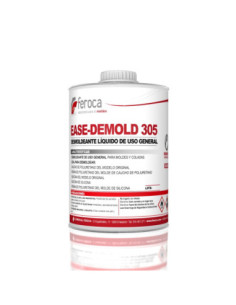 Ease-Demold 305
Universal liquid release agent, effective on polyurethane rubber and concrete.
Ease-Demold 305
Universal liquid release agent, effective on polyurethane rubber and concrete.
Spray release agents for fast application
Sprays are the most efficient option when you're working in series: one even pass at 20–30 cm covers the entire mold surface in seconds. Choose a wax or petroleum jelly spray for polyurethane rubbers; avoid silicone sprays if you plan to paint or seal the concrete piece afterwards.
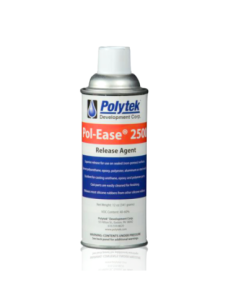 Pol-Ease 2500
Wax-based aerosol, compatible with polyurethanes. Fast application in series.
Pol-Ease 2500
Wax-based aerosol, compatible with polyurethanes. Fast application in series.
 ACMOS 82-2405
Wax spray, silicone-free and CFC-free, compatible with resins and concrete.
ACMOS 82-2405
Wax spray, silicone-free and CFC-free, compatible with resins and concrete.
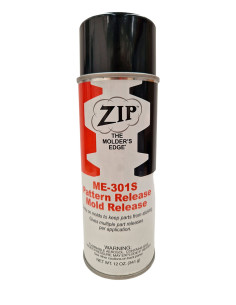 Stoner ME 301S
Petroleum jelly in spray, ideal for urethane rubbers and silicones.
Stoner ME 301S
Petroleum jelly in spray, ideal for urethane rubbers and silicones.
How to make a rubber mold for decorative concrete
The process varies depending on the size and complexity of the original piece, but the general sequence is always the same. Follow these steps to get a durable mold with good detail:
| Step | Action | Recommended product |
|---|---|---|
| 1 | Prepare and clean the original. Seal porous surfaces with lacquer or sealer. | — |
| 2 | Apply release agent to the original to prevent the rubber from bonding. | Ease-Demold 305 / Pol-Ease 2500 |
| 3 | Mix the polyurethane rubber at a 1:1 ratio and pour over the original or apply by brush. | PT Flex 85 / PT Flex 60 / Polygel® 35 |
| 4 | Allow to cure at room temperature (minimum 2 hours before demolding the original). | — |
| 5 | Build or place a rigid support shell (plaster, wood or resin). | — |
| 6 | Apply release agent inside the mold before every concrete pour. | SIKA Desencofrante D / Pol-Ease 2500 |
| 7 | Pour the concrete, vibrate if necessary and wait for the setting time. | — |
| 8 | Demold carefully, clean the mold and repeat from step 6. | — |
Frequently asked questions about concrete molds
What Shore hardness do I need for decorative concrete molds?
For concrete, a Shore A60–85 range is recommended. Softer rubbers (Shore A20–40) deform under the weight of the concrete and lose surface detail. PT Flex 85 is the preferred choice for series production; PT Flex 60 or Poly 75-70 are suitable for short runs or pieces with geometries that require a bit more flexibility during demolding.
Why is release agent required on every pour?
Concrete has a very high pH and contains compounds that react chemically with the surface of polyurethane rubber if no separation barrier is present. Without release agent, the piece bonds permanently to the mold and destroys it. With release agent applied on every pour, the mold can last tens or even hundreds of uses depending on the type of concrete and how carefully it's handled.
Can I use silicone instead of polyurethane rubber for concrete molds?
Silicone has better chemical resistance to the pH of concrete, but its low hardness (Shore A13–30 for typical condensation silicones) makes it poorly suited for heavy concrete pours, which deform it. Also, the cost per mold is significantly higher. High-hardness polyurethane rubber is the industry standard for decorative concrete precisely because it combines rigidity, abrasion resistance and reasonable cost.
How many pours can a PT Flex 85 mold handle?
With proper maintenance — release agent on every pour, cleaning with water after demolding and storage without tensile stress — a PT Flex 85 mold can handle between 50 and 150 pours depending on the type of concrete (vibrated, self-compacting, GFRC) and the geometry of the piece. Molds with very pronounced relief or sharp edges tend to wear faster in those areas.
What's the difference between PT Flex 60 and PT Flex 85?
Both are polyurethane rubbers from the same family, with a 1:1 mix ratio and a 5-minute working time. The difference is the final hardness: PT Flex 60 cures to Shore A60 and is somewhat more flexible, which makes demolding easier on pieces with undercuts or pronounced relief. PT Flex 85 cures to Shore A85 and offers greater tear resistance (190 pli vs. 70 pli) and abrasion resistance, making it more durable for intensive production.
Do I need a rigid shell for the rubber mold?
Yes, in most cases. Polyurethane rubber, even at Shore A85, is flexible and without support it would deform under the weight of the concrete. The shell (also called a mother mold or jacket) can be made of plaster, wood, polyester resin or even lightweight concrete. Its function is to maintain the mold's geometry during the pour. For small flat pieces it's sometimes not necessary, but for any piece larger than 20–30 cm it's always recommended.