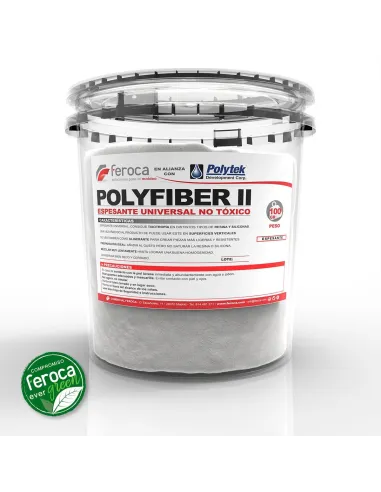
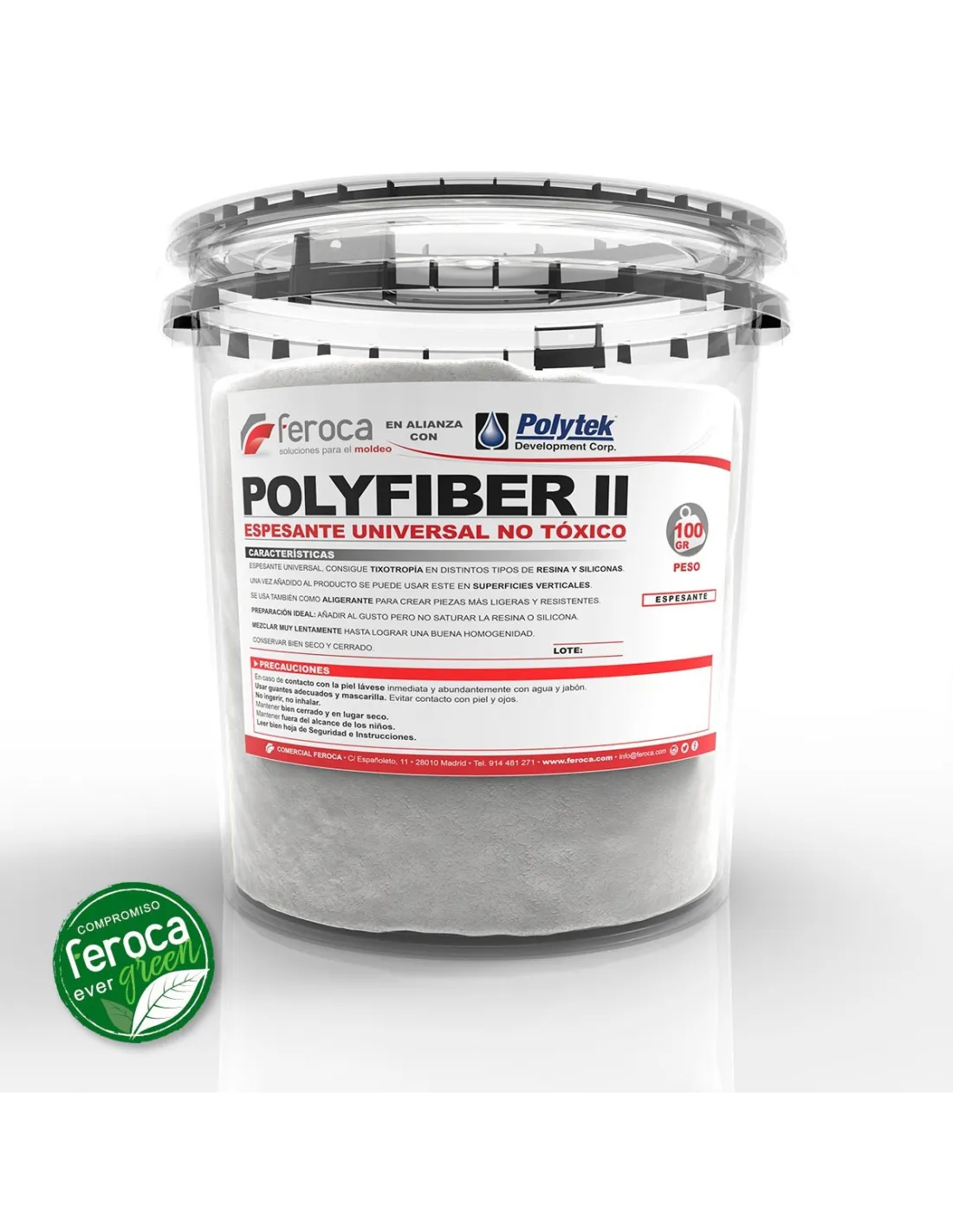
PolyFiber II is a universal fiber thickener that transforms any resin or silicone into a thixotropic mix, ready to apply on vertical surfaces without sagging. Non-toxic, it also acts as a lightening agent, reducing the final weight of the part without compromising its strength.
Technical specifications
| Property | Value |
|---|
| Type | Fiber thickener / lightening agent |
| Compatibility | Polyester, polyurethane, epoxy resins and silicones |
| Toxicity | Non-toxic |
| Effect | Thixotropy + weight reduction |
| Presentation | Bulk dry fiber / powder |
| Storage | Dry place, hermetically sealed |
What it is used for
PolyFiber II is incorporated directly into the base resin or silicone before curing to modify its rheology. It is essential when you need the material to stay where you apply it, or when you want to reduce the weight of the laminate without losing structural rigidity.
- Applications on vertical or angled surfaces where liquid resin would sag
- Lightweight laminates in fiberglass or carbon composites
- Fillers and putties based on polyester resins
- Encapsulations and castings of polyurethane resins in moulds with hard-to-retain areas
- Hand-applied silicones on irregular-surface moulds
- Special effects parts and prosthetics where final weight matters
- Manufacture of repair pastes and putties in the workshop
How to use it
- Prepare the base resin or silicone following the instructions for the corresponding product (mix components A+B if applicable, but without catalyst yet in systems that allow it).
- Add PolyFiber II gradually, in small amounts, stirring between each addition.
- Mix very slowly using folding motions to avoid introducing air and achieve a homogeneous dispersion.
- Keep adding fiber until you reach the desired consistency — paste, gel or thick cream — without saturating the mix.
- If the system requires a catalyst (as with tin silicones), add it now and mix gently again.
- Apply the thixotropic mixture with a spatula, brush or gun depending on the application.
- Follow the curing times of the base product; PolyFiber II does not modify them.
Usage tips
Dosage: less is more at first
There is no single universal fixed ratio because each resin or silicone has its own starting viscosity. Begin with a small amount, check the consistency and add more if needed. Once the mix is saturated with fiber, it cannot be reversed: you would have to discard the batch. For lightweight laminating applications, 2–5% by weight is usually sufficient; for dense pastes you can go up to 10–15%.
Mixing speed and temperature
Always mix at low speed or by hand. Fast mechanical agitation breaks the fibers, reduces the thickening effect and can introduce bubbles that are hard to eliminate. If you work in a cold environment (below 18 °C), the base resin already has higher viscosity and you will need less PolyFiber II to achieve the desired thixotropy. In summer or with very fluid resins, the dosage will be somewhat higher.
Storage and moisture
The fiber must be kept completely dry. Ambient humidity causes it to clump and makes dispersion difficult. Seal the container tightly after each use and store it in a dry, cool place. If the product has absorbed moisture and forms lumps, do not use it: dispersion will be uneven and the result unpredictable. Also consider using it alongside a liquid thixotropic additive if you need greater controlled fluidity in silicones.
Frequently asked questions
Does adding this thickener affect the curing time of the resin?
No. PolyFiber II is inert with respect to the chemical curing reaction. The gel time and demoulding time are exactly the same as indicated by the manufacturer of the base resin or silicone. It only modifies the rheology (viscosity and thixotropy) of the mix, not the kinetics of the reaction.
Is it compatible with any type of resin?
Yes, PolyFiber II is compatible with most workshop resins: polyester such as Ferpol 100 BSX15 DCPD, polyurethane such as Feropur PR55+E55, epoxy, and also condensation silicones such as Easyl 3520. When in doubt with a new system, always run a small-scale test before applying at full scale.
What is the difference between a fiber thickener and a liquid thixotropic additive?
A fiber thickener like PolyFiber II works primarily through a mechanical effect — the fibers interlock within the resin forming a network — and also reduces the weight of the final part by introducing volume without significant mass. A liquid thixotropic additive works through chemical rheological modification and typically integrates more easily without affecting the surface finish. For high-quality finishes, the liquid additive gives smoother surfaces; for structural laminates or lightweight parts, PolyFiber II is the most suitable option.
Can it be used on vertical surfaces without sagging?
Yes, that is precisely one of its main uses. Once incorporated at the correct ratio, the resulting mixture is thixotropic: it flows when applied with a spatula or brush but regains consistency at rest, staying in place on inclined or vertical surfaces while it cures.
How much thickener should be added to obtain a dense paste?
There is no fixed universal ratio. It depends on the initial viscosity of the base resin or silicone and the desired result. As a general guide: for a light gel effect, between 2 and 5% by weight; for a dense putty-like paste, up to 10–15%. Always add progressively and check the consistency before adding more.
Does it affect the final mechanical properties of the part?
In moderate proportions, PolyFiber II can even slightly improve the tensile strength of composite parts by acting as a fibrous reinforcement filler. At high doses, it may slightly reduce compressive strength. For critical structural applications, carry out mechanical tests with the specific system you intend to use.
Is there any health risk from the fibers?
PolyFiber II is classified as non-toxic. Even so, when handling the dry powder it is advisable to wear a fine dust mask and work in a ventilated environment to avoid inhaling airborne particles. Always consult the safety data sheet before use in continuous production environments.
Is a release agent necessary when working with thickened mixes?
Yes. PolyFiber II does not modify the adhesion properties of the base resin, so if it requires a release agent, the thickened mix will too. For silicone moulds you can use Ferosil V 32. Always apply the appropriate release agent to the mould before pouring or spreading the mix.
How much product do I need?Calculate the exact amount before buying and avoid wasting material.
Go to the calculator →