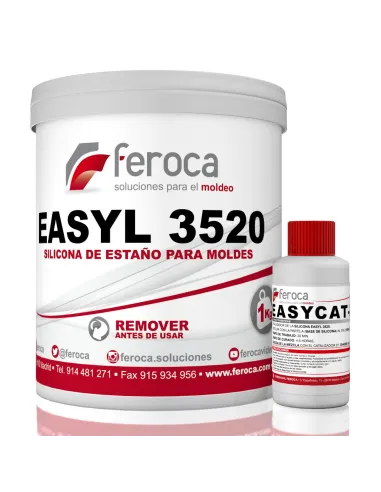
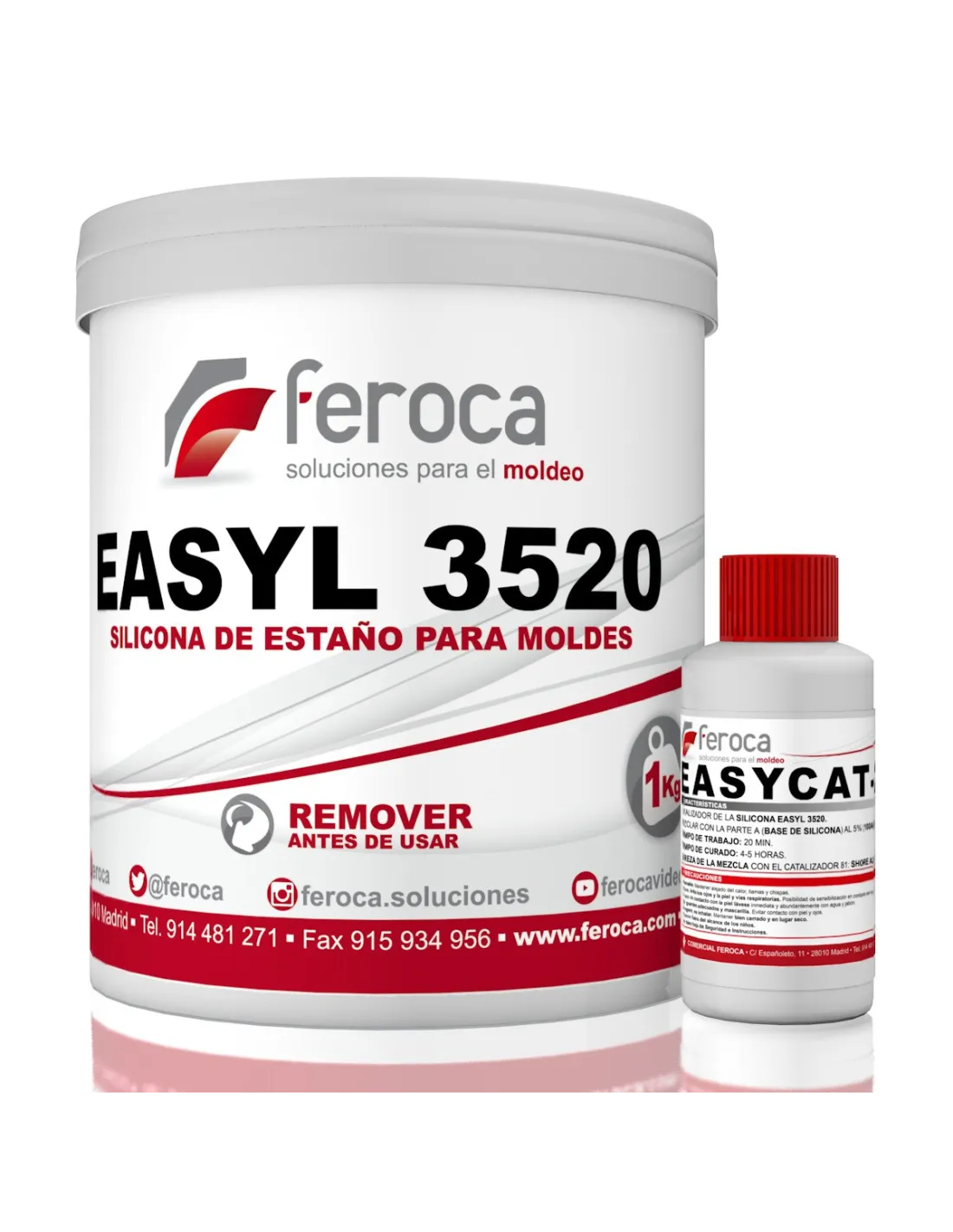
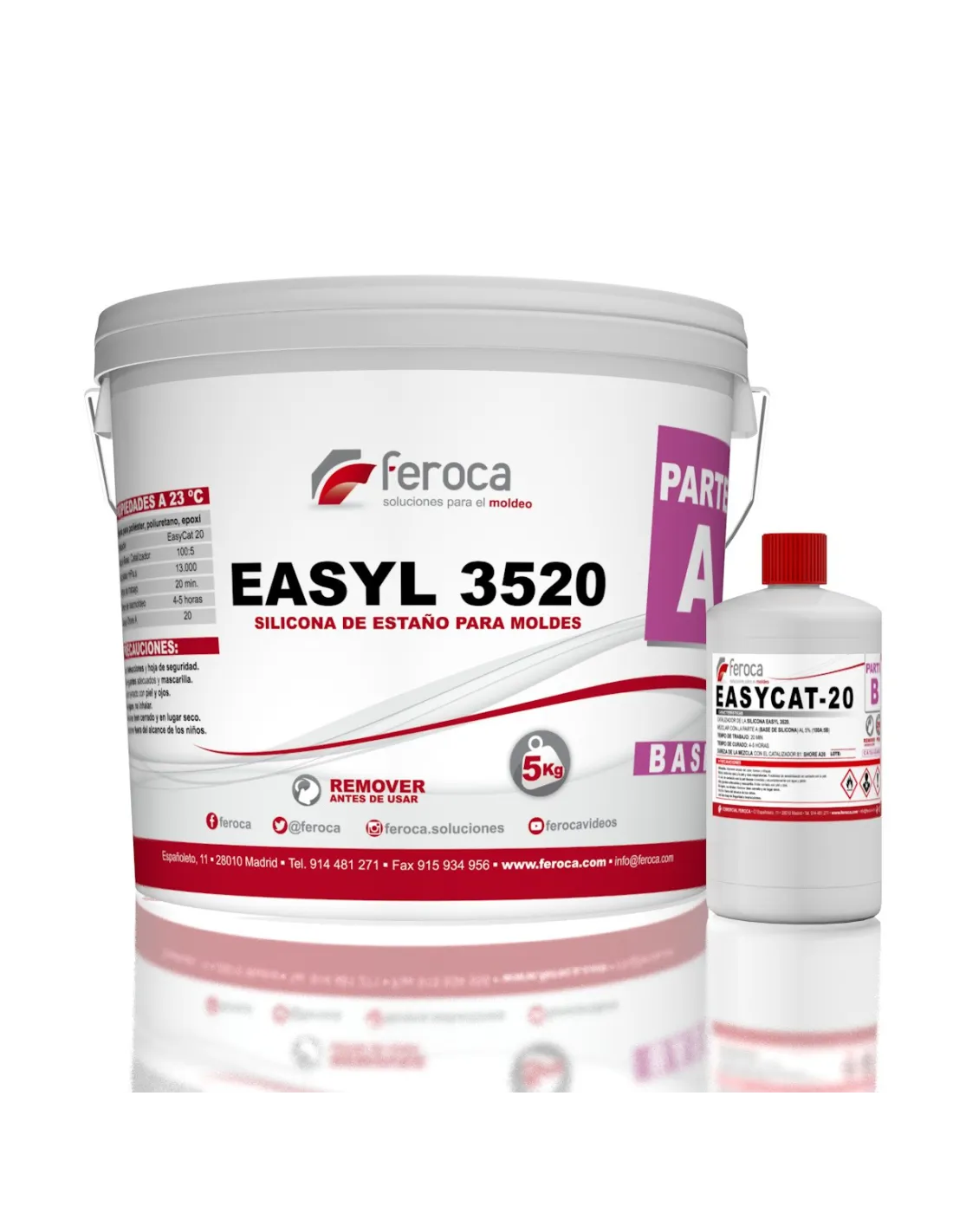
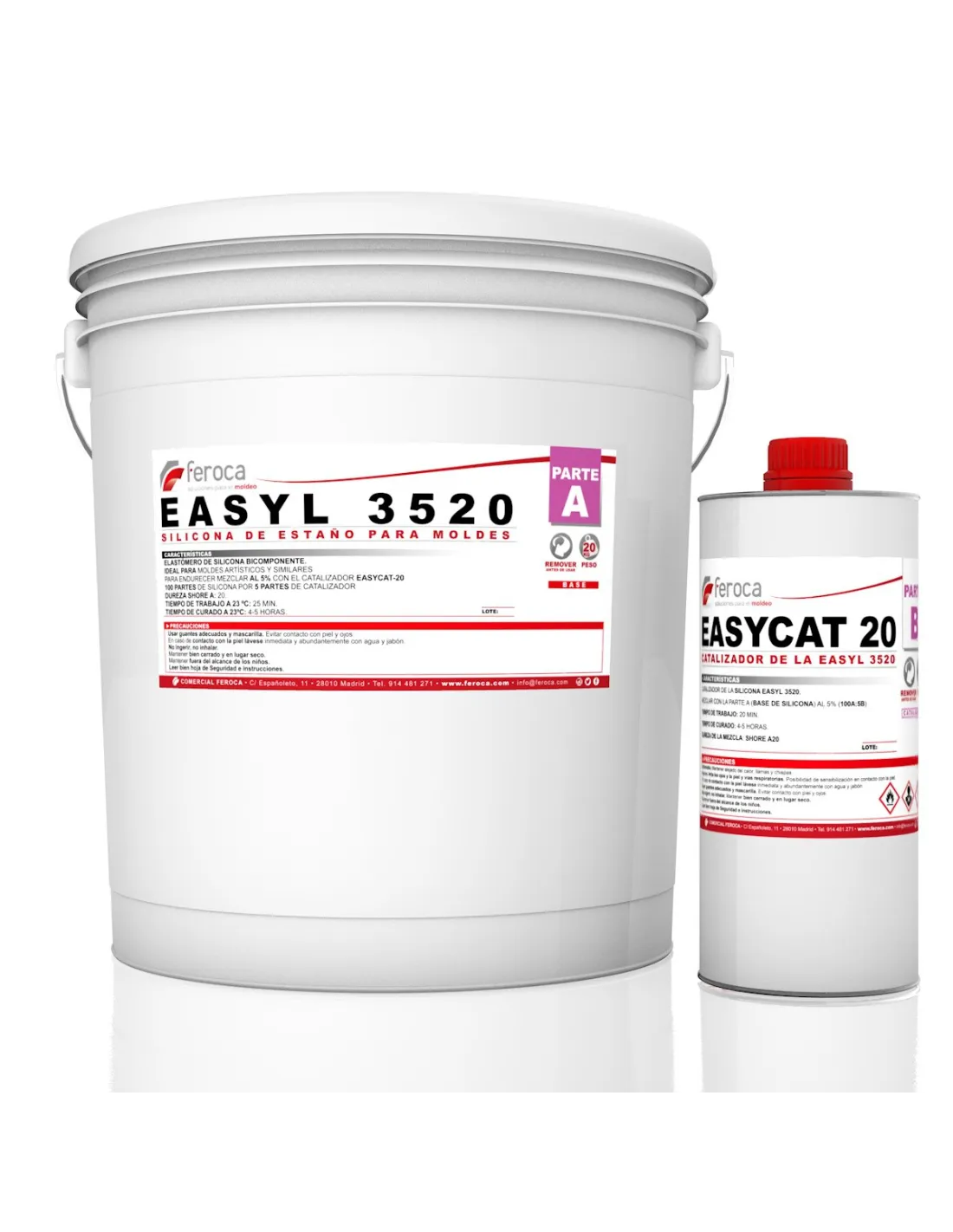
EASYL 3520 is Feroca's reference condensation silicone: versatile, easy to mix and with an unbeatable value for money. At Shore A 20 it is soft enough to demould parts with complex undercuts and stable enough to withstand dozens of castings without losing definition. If you are looking for a general-purpose silicone for resins, plaster, wax or soap, this is the natural starting point.
Technical specifications
| Parameter |
Value |
| Type |
Condensation silicone (tin), RTV-2 two-component |
| Catalyst |
EasyCat 3520 Catalyst |
| Mix ratio (by weight) |
100 Base : 5 Catalyst |
| Mix viscosity |
13,000 cP |
| Working time at 23 °C |
20 minutes |
| Demould time at 23 °C |
4–5 hours |
| Full cure |
24 hours |
| Shore Hardness A |
20 |
| Elongation at break |
400 % |
| Tensile strength |
33 kgf/cm² |
| Shrinkage |
≤ 0.3 % |
| Colour |
White |
| Shelf life (25 °C) |
3 months opened and 6 months closed |
What it is used for
EASYL 3520 is designed for making flexible casting moulds to reproduce parts in a variety of materials. Its Shore A 20 allows the mould to be bent and flexed without damage, making it ideal when the part has cavities, reliefs or difficult draft angles.
- Moulds for casting plaster and gypsum (decoration, restoration, architectural elements)
- Moulds for polyester, polyurethane and epoxy resins
- Moulds for fibreglass
- Reproduction of wax parts (candles, lost-wax casting)
- Moulds for handmade soap
- Rotocasting with casting resins
- Reproduction of carvings, sculptural reliefs and decorative elements
- Prototyping and short production runs in the workshop
How to use it
- Prepare the original: clean the part to be moulded and apply a suitable release agent, such as Ferosil V 32 Paste Release Agent for Silicones, especially on porous or absorbent surfaces.
- Weigh the components: use a precision scale. Mix 100 parts base to 5 parts catalyst by weight. Do not estimate by eye: an error in the ratio affects the cure.
- Mix: stir slowly and continuously for 2–3 minutes, scraping the sides and bottom of the container thoroughly to homogenise the mixture. Avoid mixing too vigorously to prevent air incorporation.
- Degas (optional but recommended): if you have a vacuum chamber, degas the mixture for 1–2 minutes before casting. If not, pour in a thin stream from a height to break up bubbles.
- Cast: pour the silicone over the original in a thin, continuous stream, starting from the lowest point of the mould box. You have 20 minutes of working time at 23 °C.
- Demould: after 4–5 hours at room temperature you can demould. For the full cure of mechanical properties, wait 24 hours before using the mould in production.
- Clean and store: keep the mould in a cool place, away from direct light and from surfaces with tin or latex that could affect future castings.
Usage tips
Temperature and humidity
Condensation silicones cure through ambient moisture. Below 18 °C the cure slows down considerably; above 30 °C the working time shortens. Always work in an environment between 20 and 25 °C and with a relative humidity above 50 % for optimum results. In very dry conditions you can add a few drops of demineralised water to the mould box before casting.
Catalyst amount and final hardness
You can slightly adjust the catalyst proportion between 3 % and 6 % by weight to fine-tune working time and resulting hardness: more catalyst shortens the pot life and may slightly harden the material; less catalyst extends the working time but may leave uncured areas if you drop significantly below 3 %. If you need an even softer version, consult the Feroca catalogue; if you need to brush the silicone on instead of casting it, consider the EASYL Brushable Auto-thixotropic or add the Thixo Additive Thixotropic Additive for Silicones to give the mix body.
Mould life and number of copies
Under normal conditions of use with resins, plaster or wax, a well-maintained EASYL 3520 mould can yield between 25 and 40 demouldings with good definition. To extend its life, apply a release agent before each casting of polyurethane or polyester resin, as these resins are the most aggressive on the mould. With plaster and wax the wear is much lower.
Frequently asked questions
How many copies can I get from a condensation silicone mould?
With a mould made from EASYL 3520 you can obtain between 25 and 40 copies under normal conditions of use. The exact number depends on the material you cast inside: plaster and wax cause very little wear on the mould, while polyurethane and polyester resins are more aggressive. Applying a release agent before each casting considerably extends the life of the mould.
What is the difference between tin silicone and platinum silicone?
Tin silicone (condensation), such as EASYL 3520, is more economical and suitable for general-purpose moulds with resins, plaster or wax. Its service life is somewhat shorter than platinum (25–40 copies versus 60–80) and it is not suitable for food contact or skin use. Platinum silicone (addition) offers greater durability, higher detail fidelity and food-safe or prosthetic-grade versions, but it is more expensive and requires attention to possible inhibition issues.
Can I use this silicone to make epoxy resin moulds?
Yes. EASYL 3520 is compatible with epoxy resins. Always apply a release agent before casting the resin to facilitate demoulding and extend mould life. Bear in mind that freshly cured epoxy resin can generate some heat during cure; for very thick parts with exothermic resins, allow the mass to fully cure before demoulding to avoid distorting the mould.
Can it be applied with a brush instead of casting it?
Is it suitable for food use?
No. EASYL 3520 is a general-purpose condensation silicone and does not have food-safe certification. For chocolate, candy, cake or other food-contact moulds you need a platinum silicone with FDA certification, such as the Easyl 940-FDA from the Feroca catalogue.
What happens if I mix the proportions incorrectly?
An error in the mix ratio can cause uncured areas (sticky or soft), loss of mechanical properties, or incomplete cure that time will not fix. Always weigh with a scale: 100 g of base for every 5 g of catalyst. If after 6–8 hours the material is still sticky in any area, the most likely cause is a dosing error or incomplete mixing.
Can I do rotocasting with this silicone?
Yes. You can make the mould with EASYL 3520 and pour rotocasting resins inside it. The silicone is compatible with the main polyurethane and polyester resins used in rotocasting. Make sure to apply a release agent before each cycle to avoid damaging the mould surface.
How do I store the unopened components?
Store the base and catalyst in their original, tightly sealed containers, in a cool, dry place away from direct sunlight and extreme temperatures. Under these conditions the shelf life is 12 months from the date of manufacture. Once the catalyst has been opened, seal it tightly after each use to prevent ambient moisture from degrading it.
How much product do I need?Calculate the exact quantity before buying and avoid wasting material.
Go to the calculator →