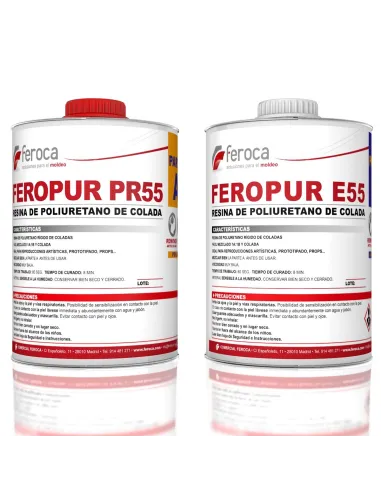
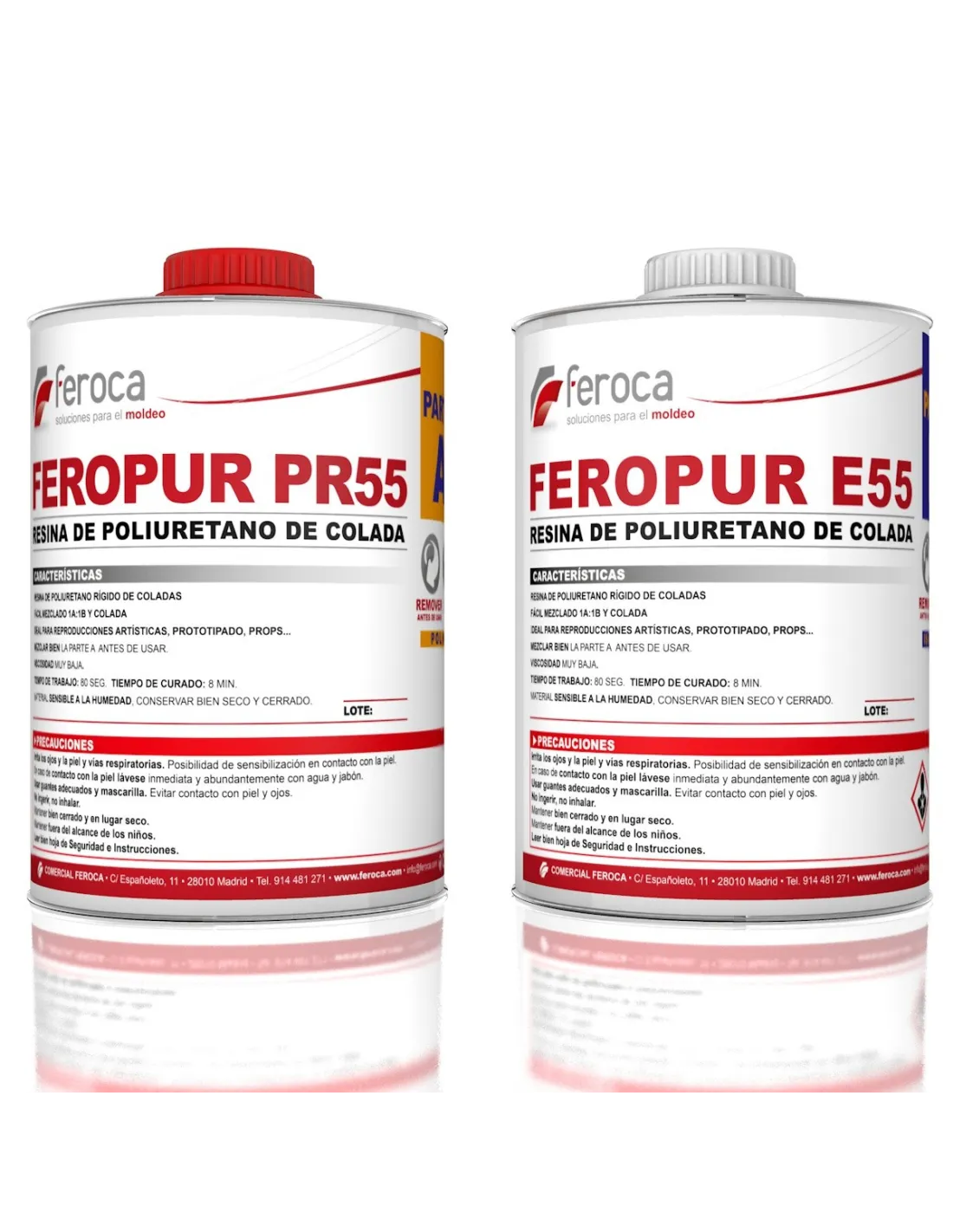
Feropur PR55+E55 is a two-component rigid polyurethane casting resin. With a simple mix ratio (100A:100B by weight and volume), low viscosity and a demould time of just 8 minutes, it is the ideal solution for reproducing series parts with high detail fidelity and an agile workflow.
Technical specifications
Parameter
Value
Application
Casting
Cured colour
Ivory
Shore Hardness
75D
Mix ratio by weight
100A : 100B
Mix ratio by volume
100A : 100B
Pot life
80 seconds
Cure time / demould time
8 minutes
Component A
Resin (polyol), colourless
Component B
Hardener (isocyanate), yellowish
What it is used for
Feropur PR55+E55 is designed for the rapid reproduction of rigid parts in a mould, both in series production and in one-off workshop jobs. Its low viscosity ensures the resin reaches every corner of the mould, capturing detail with precision.
Reproduction of ornamental and decorative parts in silicone moulds
Manufacture of prototypes and technical scale models
Casting of figures, busts and sculptures in small and medium formats
Series production of identical parts with short cycle times
Reproduction of negatives and rigid counter-moulds
Special effects: prop weapons, set dressing elements, scenography pieces
Replicas of industrial parts for dimensional verification or presentation
How to use it
Prepare the mould: make sure the mould is completely dry and clean. If the mould is not made of silicone, apply a paste release agent to facilitate demoulding and protect the surface.
Shake component A: vigorously shake component A (polyol) before opening it to homogenise any sediment or suspended fillers.
Weigh the components: weigh equal parts of component A and component B (100:100 ratio by weight). Use a precision scale to ensure correct curing.
Mix (max. 60 sec): pour component B onto A and mix vigorously for about 60 seconds, scraping the sides of the container thoroughly. Total pot life is 80 seconds from the start of mixing.
Cast into the mould: pour the mixture into the mould in a thin, continuous stream, preferably from the lowest point, so the resin rises and expels air. If you want to colour the part, add paste pigment to component A before mixing.
Wait for demoulding: the part can be demoulded after 8 minutes. For a complete cure and maximum hardness, allow to rest for at least 24 hours at room temperature.
Machining and finishing: once cured, the part can be sanded, drilled, painted or treated with metal effect powder fillers for decorative finishes.
Important notice — Polyurethane resin: isocyanates (component B) are irritants to the respiratory tract, skin and eyes. Always work in a well-ventilated space, wearing nitrile gloves and eye protection. Addition polyurethanes are sensitive to moisture: water reacts with the isocyanate generating CO₂, which causes bubbles in the part and unwanted foaming. Seal containers tightly after each use and do not work with damp materials or in environments with very high relative humidity. Consult the full safety data sheet before using the product.
Usage tips
Keep track of time: 80 seconds is not long
The pot life of Feropur PR55+E55 is very short. Have everything ready before you start mixing: the mould prepared, a pouring funnel or container to hand and the scale zeroed. For parts with complex geometry or large volume, consider working with open moulds and small successive castings. If you need more handling time, work in a cooler environment, as lower temperatures slightly slow down the reaction.
Adjust viscosity with fillers for greater fidelity
The resin accepts mineral or powder fillers to modify its density, weight or surface finish. Add the filler separately to each component before mixing them together and disperse thoroughly before combining the parts. This avoids lumps and ensures a homogeneous mix. Metal effect Magic Powder works very well directly in component A to achieve bronze, copper or iron finishes without painting.
Series production: make the most of the fast demould time
With an 8-minute demould time you can complete several cycles per hour with a single mould. To maintain quality between castings, wipe the mould with a dry cloth between cycles and check that no cured resin remains in the detail areas. If the mould is not made of silicone, renew the release agent every 3–4 castings. If you are just getting started with these materials, the resin moulding kit includes everything you need to take your first steps.
Frequently asked questions
Is it necessary to use a release agent with silicone moulds?
With silicone moulds demoulding is usually natural thanks to the non-stick properties of silicone. However, with moulds made from other materials (plaster, resin, wood) it is essential to apply a paste release agent before casting to prevent the part from sticking. Even with highly detailed or worn silicone moulds, a light coat of release agent extends the life of the mould.
Can I colour the resin before casting it?
Yes. Add paste pigment to component A before mixing with component B. This way the colour is integrated throughout the mass and not just on the surface. Use between 1% and 5% by weight of the total mix for solid colours; lower doses give more translucent tones. Bear in mind that the natural ivory colour of Feropur PR55+E55 may influence the final shade.
Why are there bubbles in my parts?
Bubbles in polyurethane parts have two main causes: air incorporated during mixing and moisture. To reduce air, mix steadily without sudden movements that introduce bubbles, and pour the resin in a thin stream. To avoid moisture problems, work with well-sealed components, in a dry environment and with a completely dry mould. If you have a vacuum chamber, degassing the mix for a few seconds before casting virtually eliminates all bubbles.
How long does it take to reach final hardness?
Feropur PR55+E55 can be demoulded after 8 minutes, but final hardness (75 Shore D) is reached after 24 hours of curing at room temperature (approximately 20–25 °C). If you need to speed up the process, a temperature of 40–50 °C for 1–2 hours significantly improves the final mechanical properties.
Can it be used to make functional or load-bearing parts?
The 75 Shore D hardness makes it a rigid material suitable for low to medium mechanical demand parts: scale models, presentation prototypes, decorative or prop elements. It is not recommended for high-load applications, severe impact or vibration-damping parts such as silent blocks or engine mounts, where a flexible polyurethane elastomer is required.
Is it suitable for reproducing highly detailed parts?
Yes. The low viscosity of Feropur PR55+E55 allows the resin to flow and fill every corner of the mould with precision, capturing fine textures and small details. It is especially effective in well-designed silicone moulds, where the combination of resin fluidity and mould flexibility ensures faithful reproductions.
What happens if I do not mix the two components properly?
An incomplete mix or incorrect ratio results in partial or defective curing: soft, sticky or uncured areas. To avoid this, always weigh the components on a precision scale (do not measure by volume by eye), mix for at least 60 seconds scraping the sides and bottom of the container thoroughly, and always use clean, dry containers.
How much product do I need?Calculate the exact amount before buying and avoid wasting material.
Cookies on this site are used to personalise content and ads to deliver social media features and to analyse traffic. We also share information about your use of the site with our social media partners for advertising, personalisation and web analytics.. More information.