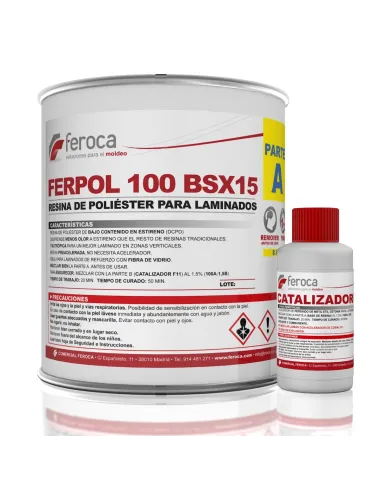
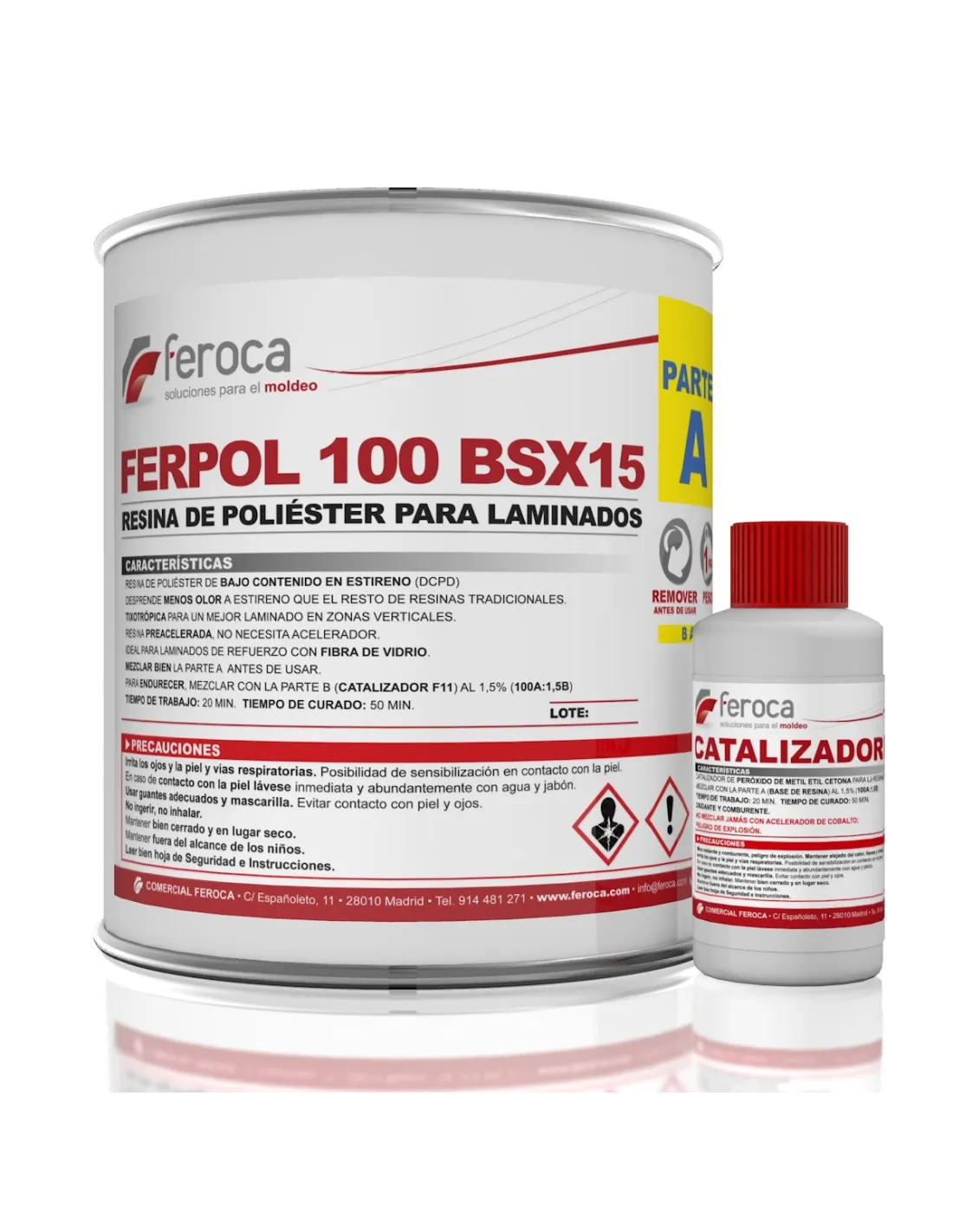
Ferpol 100 BSX15 DCPD is a pre-accelerated polyester resin with DCPD technology (low styrene content), specifically formulated for manual fiberglass laminating. Its pre-accelerated state simplifies the process: just add the catalyst and you're ready to work. The reduced styrene emissions compared to conventional resins make it more manageable in spaces with limited ventilation, without sacrificing the mechanical performance required for professional laminating.
Technical specifications
| Parameter |
Value |
| Type |
DCPD polyester resin, pre-accelerated |
| Application |
Manual contact laminating |
| Liquid colour |
Light brown / reddish |
| Mix ratio |
100 parts resin : 1.5 parts catalyst (by weight) |
| Catalyst range |
1.5 – 2.0% by weight |
| Working time |
~20 minutes at 20 °C |
| Cure time |
~1 hour at 20 °C |
| Styrene content |
Low (DCPD technology) |
| Presentation |
1 kg, 5 kg, 25 kg |
What it's used for
Ferpol 100 BSX15 DCPD is aimed at the manufacture and repair of fiberglass-reinforced polyester parts through the hand laminating process. Its low-styrene profile makes it suitable in contexts where reducing volatile emissions is a priority without giving up mechanical strength. It covers a wide range of applications in repair, fabrication and structural reinforcement:
- Repair of fiberglass swimming pools: cracks, perforations and degraded areas
- Repair of bumpers, underbody panels and motorcycle fairings
- Fabrication of shells and laminated structures with surface tissue or glass mat
- Reinforcement of tanks, bathtubs, showers and polyester sanitary elements
- Fabrication of shells for special effects and durable props
- Construction of rigid mother moulds to support silicone moulds
- Decorative laminates with marble powder (marmolina) or other mineral fillers
How to use it
- Prepare the surface. Sand the area to be treated to remove the contaminated surface layer and achieve mechanical adhesion. Clean the area thoroughly with a dry cloth and remove any dust, grease or moisture.
- Apply release agent if working over a mould. If you are laminating over a mould, apply a coat of release agent and allow to dry before continuing. This step does not apply to surfaces being repaired.
- Weigh and mix. Weigh the required amount of resin. Add the catalyst at a ratio of 1.5 g per 100 g of resin (adjust up to 2.0% if the temperature is low). Mix with a stirring rod for at least 2 minutes until a completely homogeneous liquid is obtained.
- Apply the first coat of resin. Spread the resin over the surface with a brush or roller. This first coat wets the substrate and acts as a base for the fibrous reinforcement.
- Place the fibrous reinforcement. Apply the fiberglass mat (300 g/m² is most common) or chopped fiberglass strands onto the fresh resin. In areas with complex geometry, cut the mat into smaller pieces so it conforms properly.
- Wet out the reinforcement. Apply more resin over the fabric and work with a brush or metal consolidating roller to eliminate air bubbles and ensure complete impregnation of the fibres.
- Repeat the process in layers. For a strong laminate, apply a minimum of 3 layers (resin + mat), allowing to gel between coats if time permits, or laminating wet-on-wet if the process requires it.
- Surface finish. Once the laminate has cured, you can apply a top coat or a gel coat to seal the surface and improve the aesthetic finish and weather resistance.
- Allow to cure. Full cure time is approximately 1 hour at 20 °C. At lower temperatures curing takes longer; above 20 °C it accelerates. Avoid touching the part until it is completely hardened.
Safety warning: Ferpol 100 BSX15 DCPD contains styrene, albeit in reduced quantities. Always work in a well-ventilated space or with local extraction. Wear nitrile gloves, safety goggles and a respirator with an organic vapour filter. The catalyst (methyl ethyl ketone peroxide, MEKP) is an oxidiser that can cause burns on contact with skin and eyes: handle it with care and never mix it directly with accelerators without first diluting it in resin. Consult the safety data sheet before using the product.
Tips and tricks
Control the temperature to manage working time
The working time of ~20 minutes is calculated at 20 °C. In summer or in warm workshops, gelation accelerates noticeably and you may run out of time before completing a coat. Prepare smaller batches and work quickly. If the temperature is low (below 15 °C), curing can be significantly prolonged or even remain incomplete: heat the workshop or use a slightly higher catalyst ratio (up to 2.0%), but never exceed 2% as excess catalyst can make the cured part brittle.
Eliminate bubbles with the consolidating roller
Air bubbles trapped between layers of fibre and resin are the main enemy of a strong laminate. Always use a metal consolidating roller after each coat: run it with moderate pressure in different directions until no bubbles are visible on the surface. In corners and angles, also work with the brush pushing the mat into the base of the angle before rolling.
Combine fibre and fillers to tailor the laminate to each application
For structural laminates, 300 g/m² mat is the standard reinforcement. If you want a smooth surface finish without fibre print-through, add a final coat using 34 g/m² fiberglass surface tissue to seal the texture. To add body to the mix or create filling pastes for filling voids before laminating, you can thicken the resin with crystalline carbonate (marmolina) to the desired consistency.
Frequently asked questions
What catalyst ratio should I use?
The standard ratio for Ferpol 100 BSX15 DCPD is 1.5 g of catalyst per 100 g of resin (1.5% by weight). You can adjust up to 2.0% if working at low temperatures to compensate for reduced reactivity. Do not exceed 2% as excess catalyst does not accelerate curing further, but can make the final part brittle. Always weigh with a precision scale: volume is not reliable for this type of mix.
How many layers of fibre do I need for a strong laminate?
For most repair and shell fabrication applications, a minimum of 3 layers of 300 g/m² mat with Ferpol 100 BSX15 DCPD is sufficient to obtain a rigid and resistant part. For structural applications or impact-prone areas, you can increase the number of layers or alternate with woven fiberglass for greater directional strength. Each additional layer adds rigidity and resistance, but also weight and working time.
How do I repair a crack in a fiberglass swimming pool?
The basic process is: sand the area around the crack to remove the degraded surface layer and achieve adhesion; clean the area thoroughly removing dust and moisture; mix the resin with the catalyst at a 100:1.5 ratio; apply the mix with a spatula or brush, filling the crack, then spread fiberglass mat saturated with resin over the area in at least two or three layers; consolidate well with the roller; allow to cure completely. Once cured, you can sand and apply a gel coat or top coat to restore the original finish.
Can I laminate directly over a silicone mould?
Yes, you can use polyester resin over silicone moulds. Silicone acts as a natural release agent, so applying additional release agent is usually not necessary. Bear in mind that polyester resin during curing can inhibit platinum silicones if it comes into contact with them before they have fully cured. Once the silicone mould is completely cured, laminating polyester over it presents no problem.
What type of fiberglass is recommended for laminates with this resin?
The most common reinforcement is 300 g/m² fiberglass mat, which offers a good balance between wet-out, strength and ease of handling. For a smooth surface finish without fibre print-through, a final layer of 34 g/m² surface tissue is added. For areas requiring greater mechanical strength or rigidity, the mat can be combined with woven fiberglass fabric.
Can I use this resin to make a rigid mother mould?
Yes, Ferpol 100 BSX15 DCPD is a common choice for making mother moulds or support shells for flexible silicone moulds. A gel coat is applied as the first layer over the model or flexible mould, and then fiberglass mat and resin are laminated until the required thickness is achieved. The result is a rigid, lightweight and strong structure that keeps the flexible mould in its correct position.
Why is my polyester resin not curing or remaining tacky?
The most common causes are: incorrect catalyst ratio (too little), working temperature too low, high ambient or surface humidity, or degraded catalyst. Check that you are using at least 1.5% catalyst by weight, that the workshop temperature is above 15 °C and that the surface is dry and clean. The top surface of a polyester laminate may remain slightly tacky due to air inhibition (oxygen contact): this is normal and is resolved by applying a top coat or covering the surface during curing.
Do I need to apply gel coat before laminating?
It depends on the final use of the part. If you are laminating directly over a mould and want a quality surface finish that is weather- and water-resistant, first apply a coat of gel coat and allow it to gel before starting to laminate. The gel coat will end up on the outer face of the part. If the part will be protected or visual finish does not matter, you can laminate directly without gel coat and apply a top coat to the outer face once demoulded.
How much product do I need?Calculate the exact quantity before buying and avoid wasting material.
Go to the calculator →