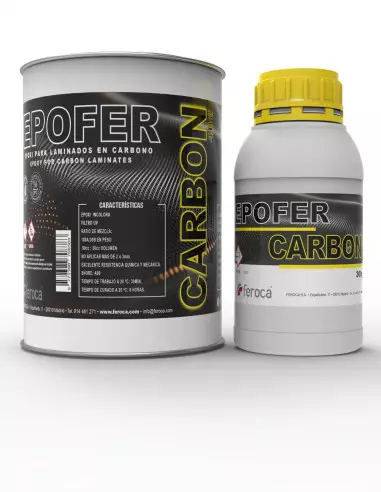
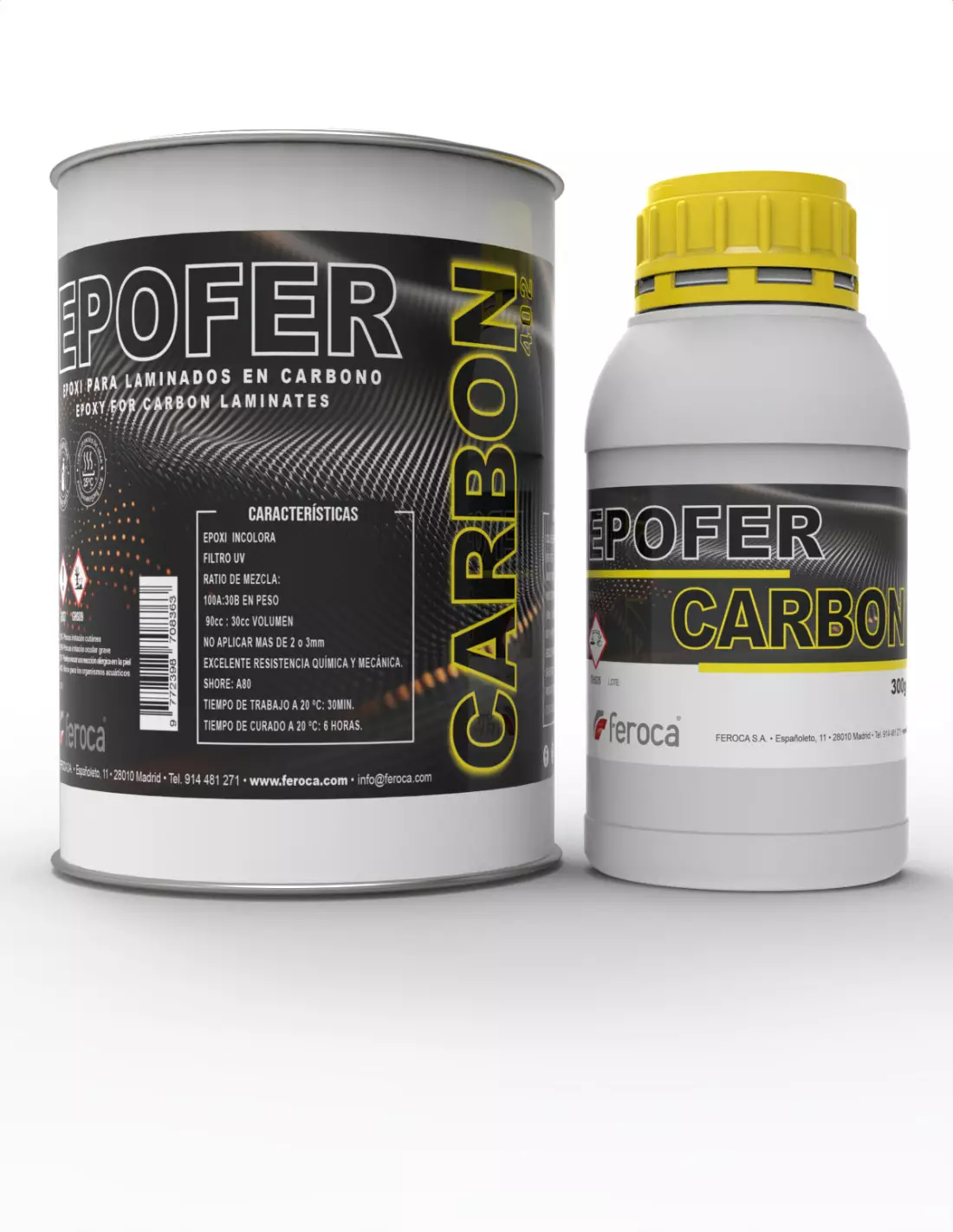
Epofer Carbon 402 is an epoxy laminating resin specially formulated for carbon fabrics where aesthetic finish is a priority. Its colourless UV-filter formulation minimises yellowing over time, keeping the visual appearance of the carbon intact. It is the go-to choice of composite, automotive and technical parts manufacturing professionals when a thin, transparent and durable laminating resin is required.
Technical specifications
| Parameter |
Value |
| Resin type |
Epoxy laminating resin |
| Colour |
Transparent / Colourless |
| UV filter |
Yes |
| Mix ratio by weight |
100A : 30B |
| Mix ratio by volume |
90A : 30B |
| Working time (20 °C) |
25-30 minutes |
| Cure time (20 °C) |
6-7 hours |
| Maximum layer thickness |
2-3 mm |
| Application |
Thin-layer laminating |
| Pigmentable |
Yes |
| Presentation |
Kit 1 kg A + 300 g B (1.3 kg total) |
What it is used for
Epofer Carbon 402 is designed for laminates where carbon fibre fabric is used and the original aesthetic finish needs to be preserved. Its low viscosity facilitates fibre impregnation and its transparency showcases the fabric beneath. It is not a casting resin: it is intended exclusively for thin layers.
- Decorative and structural laminates with carbon fibre fabric
- Manufacturing automotive parts with exposed carbon finish
- Aeronautical and competition components where weight and aesthetics matter
- Marine, sports and technical equipment parts
- Prototypes and models with real carbon finish
- Structural reinforcement of existing parts with carbon cloth
- Laminates with fibreglass or aramid when maximum transparency is required
How to use it
- Condition the resin. If the workshop temperature is below 20 °C or the resin has been stored in a cold place, bring it to temperature before use. Place the closed container in a water bath or next to a radiator until fluidity is restored and any granular or cloudy appearance disappears. Never work below a steady 20 °C.
- Prepare the mould. Apply paste Release agent 34D to the mould or substrate surface and allow to dry according to the release agent instructions.
- Mix the components. Weigh the components at a ratio of 100 parts resin (part A) to 30 parts hardener (part B) by weight. If working by volume, use 90A : 30B. Mix slowly for 2-3 minutes, scraping the sides and bottom of the container thoroughly to ensure a homogeneous mixture.
- Impregnate the fabric. Apply a layer of resin to the mould or part. Place the carbon fabric and apply more resin on top. Work with a brush or roller to distribute the resin evenly.
- Remove air bubbles. Pass the metal deaeration roller over the impregnated fabric with firm, continuous strokes to expel trapped air between the fibres and achieve a compact, void-free laminate.
- Apply peel ply if necessary. To obtain a surface ready for a second laminate or to improve the surface finish, cover the fabric with peel ply and pass the roller over it again.
- Respect the working times. Do not exceed 25-30 minutes of working time. Beyond that point viscosity increases and the resin will not correctly impregnate the fibres. Allow to cure at 20 °C for a minimum of 6-7 hours before demoulding.
- Demould and finish. Once cured, carefully demould the part. If you need to apply a final transparent protective coat, Top Coat Epoxi Epofer EX201+E202 is the ideal complement to seal and protect the laminate.
Important notice — Working temperature: Epofer Carbon 402 is very sensitive to temperature. Below 20 °C the viscosity of the resin increases considerably and a granular or cloudy effect may appear, similar to that produced by olive oil or honey in cold conditions. The resin is not degraded: simply bring the containers to temperature in a water bath or next to a gentle heat source until normal fluidity is restored. Never work in cold conditions: the resulting laminate will have bubbles, poor fibre impregnation and reduced mechanical properties. Minimum working temperature: steady 20 °C.
Usage tips
Control the temperature first and foremost
The most common problem with epoxy laminating resins is working in a cold workshop. Make sure that the resin, hardener, mould and fabric are all at 20 °C or above before starting. A difference of just a few degrees can double the viscosity and ruin the impregnation. If you are working in winter, stand the containers upright in a bucket of warm water (not boiling, 35-40 °C) for 15-20 minutes and stir well before measuring.
Always weigh — avoid measuring by volume if you can
The weight ratio (100A:30B) is the most reliable and repeatable. A precision scale eliminates visual estimation errors. An excess of hardener does not accelerate curing proportionally: it can generate excessive heat, reduce final mechanical properties and cause sticky surfaces that do not cure correctly. Always mix in the same order: add the hardener to the resin, not the other way around.
Do not exceed 2-3 mm per layer
Epofer Carbon 402 is a thin-layer laminating resin. If you need more thickness, wait until the previous layer has gelled (but not fully cured) before applying the next one. Do not use it for castings: the exothermic reaction in mass can generate enough heat to damage the mould, deform the part or cause a defective cure. For transparent protective surface finishes over the cured laminate, use Top Coat Epoxi Epofer EX201+E202.
Frequently asked questions
Can I use this resin for a thick casting?
No. Epofer Carbon 402 is formulated exclusively for thin-layer laminates (maximum 2-3 mm per layer). In thick masses, the exothermic reaction concentrates and can reach temperatures sufficient to damage the mould, deform the part or cause a defective cure. For castings, specific epoxy resins with lower exothermia are available.
Why does the resin appear cloudy or granular when opened?
This is normal behaviour at low temperatures. Just as happens with certain oils, when the resin is stored or used below 15-20 °C it can develop a cloudy or granular appearance. The resin is not in bad condition. Bring the containers to temperature in a water bath or next to a radiator (maximum 35-40 °C) until they recover their clear, fluid appearance. Do not work until the temperature is steadily above 20 °C.
How many layers of fabric can I laminate in a single session?
It depends on the fabric weight and the desired total thickness, but the limit is always the maximum thickness of 2-3 mm per resin application. With 200 g/m² fabrics, 2-3 layers per session can typically be laminated within that limit. If you need more layers, wait for the resin to gel (without fully curing) before continuing to laminate, to ensure adhesion between layers.
Does this resin yellow over time?
Epofer Carbon 402 incorporates a UV filter that significantly reduces yellowing compared to standard epoxy resins. However, no epoxy resin is completely immune to UV radiation over the very long term. For parts with continuous sun exposure, it is recommended to apply a coat of Top Coat Epoxi Epofer EX201+E202 as an additional protective barrier.
Can this resin be pigmented?
Yes, Epofer Carbon 402 accepts pigmentation. Bear in mind that being colourless and transparent, the result with translucent pigments is particularly striking, as it allows the fabric beneath to show through. Use pigments compatible with epoxy systems and do not exceed the proportions recommended by the pigment manufacturer to avoid affecting the cure.
How long do I have to work with the resin once mixed?
At 20 °C you have between 25 and 30 minutes of working time. At higher temperatures the time shortens; at lower temperatures (as long as you are above 20 °C) it may extend slightly. Prepare only the amount you will use within that time and work efficiently. Do not try to extend the working time by cooling the mixture: this can affect the final cure.
Is it necessary to use a release agent with this resin?
Yes, whenever you are laminating over a mould from which you want to demould the part. The adhesion of epoxy resins is very high and without a release agent it may be impossible to separate the part without damaging it. Release agent 34D paste is a proven, compatible option. If you are laminating over an existing part to which you want to permanently bond the carbon, do not use a release agent.
What is the minimum temperature at which I can work with this resin?
The recommended minimum temperature is a steady 20 °C, both in the workshop and in the materials (resin, hardener, mould and fabric). Below this temperature viscosity increases, fibre impregnation is compromised and curing may be incomplete, resulting in parts with sticky surfaces and reduced mechanical properties.
How much product do I need?Calculate the exact amount before buying and avoid wasting material.
Go to the calculator →