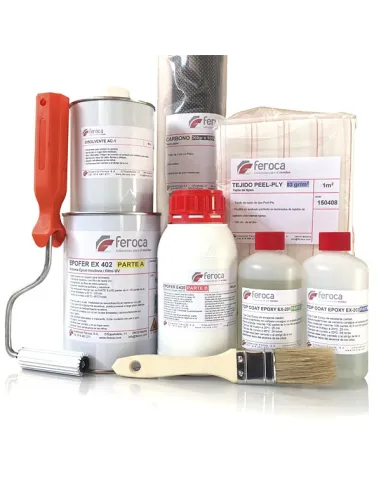
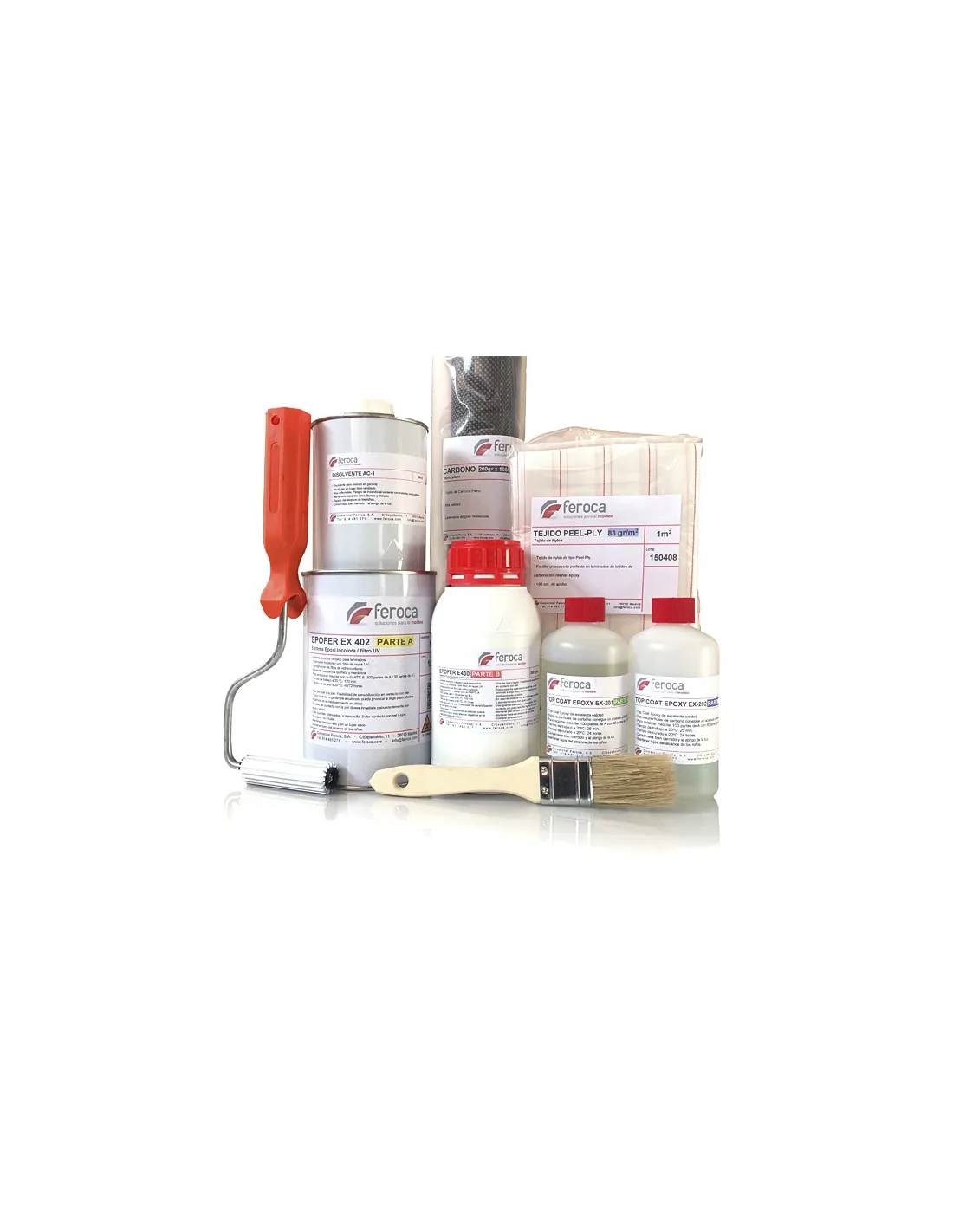
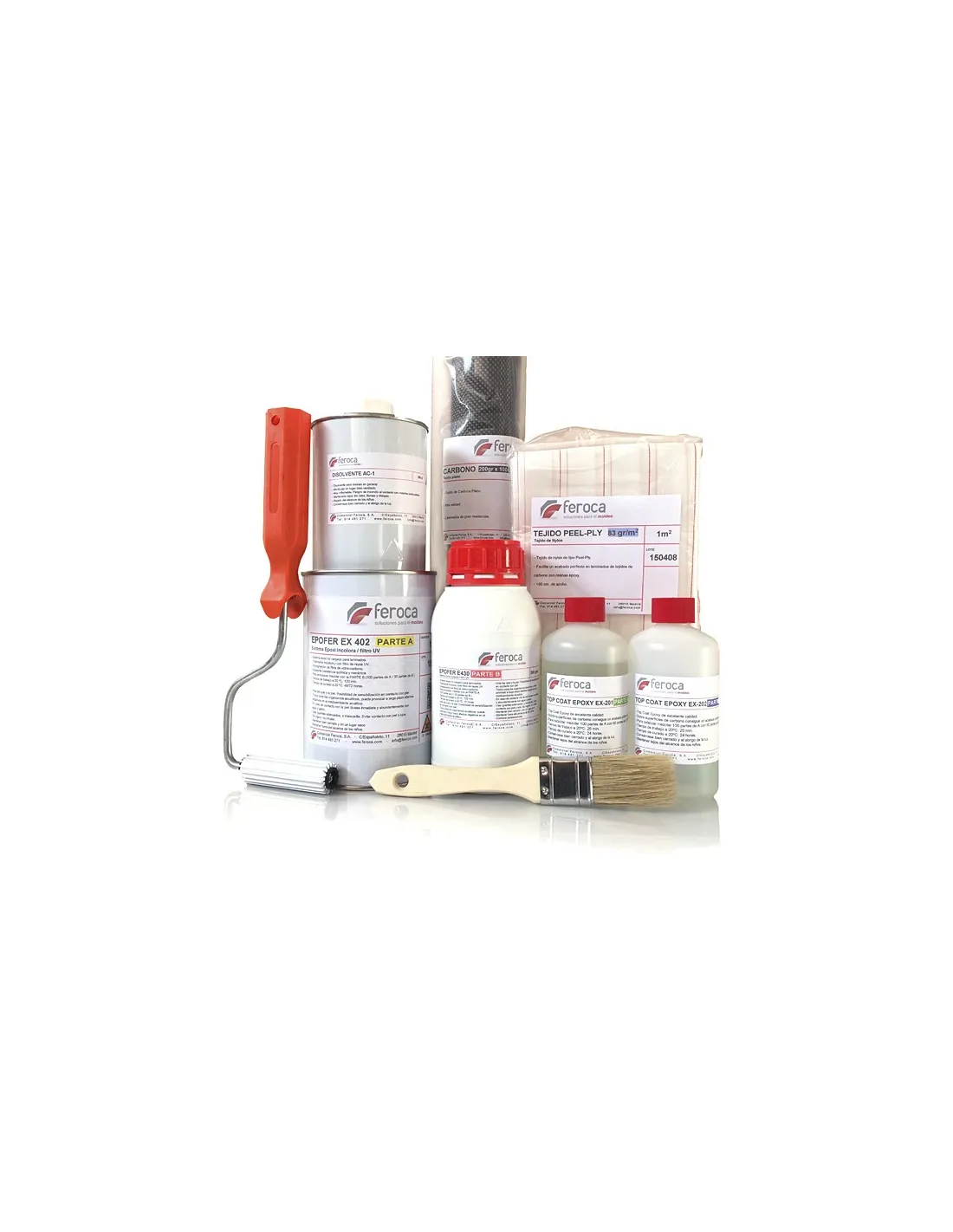
The Carbon/Epoxy Laminating Kit from Feroca brings together in a single package everything you need to get started making laminated parts with carbon fiber and epoxy resin. Designed for those who want professional results from their very first project, it includes laminating resin, carbon fabric, finishing top coat and the essential tools for a clean, controlled process.
Kit contents
| Component |
Quantity |
Description |
| Epofer Carbon 402 + E430 |
1 kg resin + 300 g hardener |
Special epoxy resin for carbon fiber, colorless and UV-stabilized |
| Carbon Fabric 200 g/m² |
0.5 m² |
Standard fabric for structural and decorative laminates |
| Peel Ply 83 g/m² |
1 m² |
Nylon fabric for a uniform surface finish |
| Epofer EX201 + E202 (Top Coat Epoxi) |
250 g resin + 150 g hardener |
Clear, glossy epoxy finish for the final part |
| Metal de-airing roller |
1 unit (70 x 22 mm) |
For removing air bubbles and consolidating the laminate |
| Double brush |
1 unit (15/10 mm) |
For applying and spreading the resin |
| AC1 Solvent |
500 g |
For cleaning tools and working implements |
What it's used for
This kit is aimed at manufacturing small and medium-format carbon/epoxy laminated parts, for both structural and aesthetic purposes. It is ideal for composites workshops, prototyping, part customization and craft manufacturing projects that require the stiffness and finish characteristic of carbon fiber.
- Manufacturing panels and decorative carbon fiber parts
- Coating and reinforcing existing parts (plastic, wood, foam)
- Prototyping lightweight and rigid components
- Automotive, amateur aeronautics and marine projects
- Customizing shells, covers and accessories
- Structural repair of composite parts
- Educational and training projects in composites technology
How to use it
- Prepare the mold or surface: make sure the substrate is clean, dry and treated with the appropriate release agent if you plan to demold the part once cured.
- Mix the laminating resin: combine Epofer Carbon 402 with hardener E430 in the ratio specified by the manufacturer. Mix slowly and evenly for at least 2 minutes to avoid uncured areas.
- Apply the first resin layer: spread a thin coat over the mold using the brush. This layer acts as a wet base for the fabric to adhere to.
- Lay the carbon fabric: place the 200 g/m² carbon fabric over the wet resin, conforming it to the shape of the mold without creating wrinkles or folds. Use the special carbon scissors to cut the fabric precisely.
- Wet out the fabric: apply more resin over the fabric with the brush and run the metal de-airing roller over it to remove bubbles and ensure complete fiber impregnation.
- Repeat layers if greater thickness is needed: for thicker laminates, add additional layers of fabric and resin by repeating the previous steps before the resin from the previous layer has fully cured (wet-on-wet lamination).
- Apply the Peel Ply: place the Peel Ply as the final layer over the wet laminate. This ensures a uniform surface ready to receive the top coat without prior sanding.
- Allow to cure: observe the cure times specified for Epofer Carbon 402 resin at room temperature. A post-cure at moderate temperature will improve the final mechanical properties.
- Remove the Peel Ply: once the part has cured, peel off the Peel Ply by pulling from a corner. The surface will be clean and have the right texture to receive the finish.
- Apply the Top Coat: mix Epofer EX201 + E202 in the correct ratio and apply it in a thin, even coat over the part. This finish protects the laminate and enhances the visual appearance of the carbon fiber.
- Clean the tools: use AC1 solvent to clean the brush, roller and any implements before the resin cures on them.
Warning: epoxy resins are irritating on contact with skin and mucous membranes. Always work with nitrile gloves, safety glasses and in a well-ventilated space. Mixing resin and hardener generates an exothermic reaction: do not prepare large quantities in small containers to avoid overheating. Carbon fiber dust generated when cutting or sanding is irritating to the respiratory tract — use an FFP2 or higher-rated mask during these operations.
Usage tips
Working temperature
The ideal ambient temperature for laminating with epoxy is between 18 °C and 25 °C. Below 15 °C the resin viscosity increases noticeably, making fabric impregnation more difficult and extending cure time. If working in winter, slightly pre-warm the components before mixing (water bath at 30–35 °C) to ease the process.
Cutting carbon fabric
Carbon fiber frays easily when cut with conventional scissors. Always use the special carbon and kevlar scissors that can be added to your workshop kit. Mark cutting lines with masking tape before cutting to get clean edges and prevent the fabric from unraveling.
Mix ratio and weighing
The resin/hardener ratio is critical in epoxy systems: an error in the ratio causes uncured areas or parts with reduced mechanical properties. Always weigh the components using a precision scale (minimum 0.1 g resolution) and mix by scraping the sides and bottom of the container thoroughly. Do not confuse weight ratio with volume ratio.
Frequently asked questions
How many fabric layers can I laminate with this kit?
With the Carbon/Epoxy Laminating Kit and the included 200 g/m² carbon fabric (0.5 m²), you can apply between 2 and 4 layers over an area of approximately 0.25 m², depending on the desired final thickness. For larger parts or a greater number of layers, you can purchase additional carbon fabric and Epofer Carbon 402 resin separately.
Do I need to apply a release agent to remove the part from the mold?
Yes, if you intend to demold the part once it has cured, it is essential to apply a suitable release agent to the mold before you start laminating. Without a release agent, epoxy resin bonds strongly to most surfaces and you will damage the part or the mold when trying to separate them. Check the Feroca catalogue to select the release agent compatible with your mold material.
Can I laminate over polystyrene foam (styrofoam)?
No. Epoxy resin is compatible with polyurethane foams, but expanded polystyrene (styrofoam) dissolves on contact with the solvents present in many epoxy systems. If you need to use foam as a core, use polyurethane foam of suitable density and apply a barrier coat before laminating.
How long does the resin take to cure at room temperature?
The Epofer Carbon 402 + E430 system has an indicative demolding time of 24 hours at 20–25 °C. To achieve maximum mechanical properties, a post-cure at elevated temperature (50–60 °C for 4–8 hours) is recommended. Consult the product's technical data sheet for exact figures depending on working temperature.
What is the Peel Ply for and is it mandatory to use it?
The Peel Ply is a nylon fabric applied as the final layer over the wet laminate. When peeled off after curing, it leaves a uniform, matte surface with a texture that promotes adhesion of the top coat or subsequent layers without the need for sanding. It is not strictly mandatory, but it simplifies the process and improves finish quality.
Can I use this kit to repair damaged carbon fiber parts?
Yes. The kit is perfectly suitable for small-format repairs on carbon fiber parts. The key is to properly prepare the damaged area: remove loose material, sand the overlap zone down to bare fiber and make sure the surface is free of grease and moisture before applying the resin and repair fabric.
Does the top coat protect against UV rays?
Epofer EX201 + E202 (Top Coat) provides a glossy, protective finish. For optimal UV protection on parts exposed outdoors for extended periods, it may be advisable to apply a UV-filter varnish or lacquer over the top coat. The Epofer Carbon 402 laminating resin already includes UV stabilization, but the top coat itself benefits from additional protection in continuous outdoor applications.
What do you use to clean tools and working implements?
The kit includes AC1 solvent (500 g) specifically for cleaning tools, brushes and the de-airing roller before the resin cures on them. Once the resin has cured, mechanical removal is the only option. Always clean implements immediately after use to extend their service life.