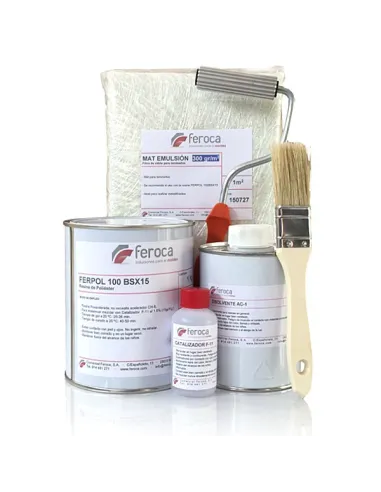
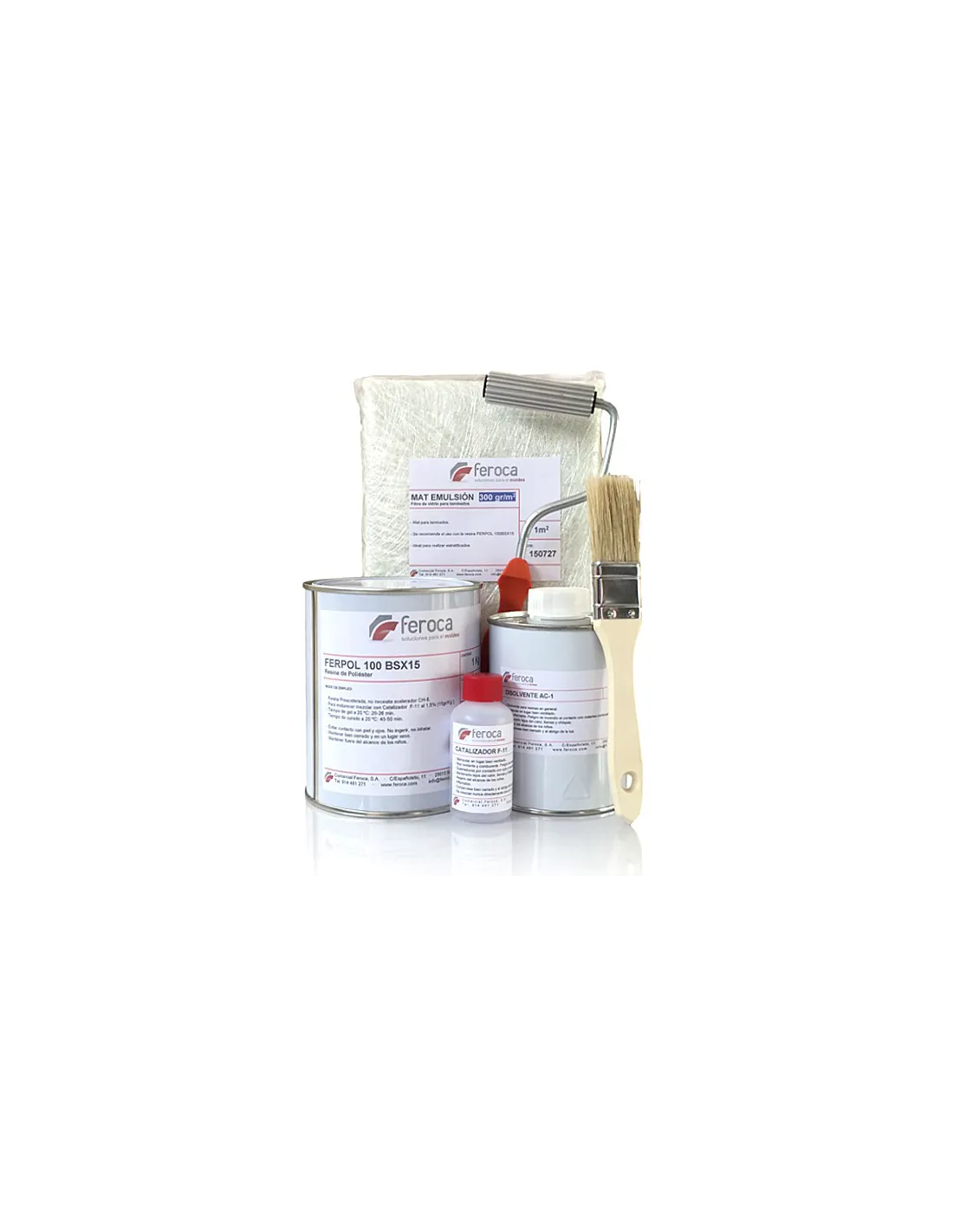
The Feroca Polyester Resin Repair Kit brings together in a single pack everything you need to carry out repairs and small laminated fibreglass parts without having to source components separately. It includes Ferpol 100 BSX15 polyester resin, fibreglass mat, laminating tools and AC-1 acetone for cleaning: a kit ready to go from the very first moment, without having to work out what materials you need.
Technical specifications
What it is used for
This kit is designed for repairs and the manufacture of small parts by laminating fibreglass and polyester resin. It is the most practical solution for one-off jobs in the workshop, on boats, vehicles or industrial parts where buying each component separately makes no sense:
- Repair of fibreglass bodywork, mudguards and spoilers
- Repair of boat hulls, kayaks and surfboards
- Patches and reinforcements on resin tanks, troughs or trays
- Manufacture of small laminated parts or prototypes
- Repair of machinery housings and industrial equipment
- Restoration work on classic vehicle parts
- Structural reinforcements on general-purpose parts
- Sealing and reinforcing cracks in polyester pools
How to use it
- Prepare the surface: clean and sand the area to be repaired until the substrate is rough and free of dust, grease or moisture. Use the included AC-1 acetone for an effective final degreasing.
- Cut the mat: cut the 300 g/m² fibreglass mat into pieces slightly larger than the area to be repaired. For structural repairs, prepare at least 3 layers.
- Catalyse the resin: add the catalyst to the Ferpol 100 BSX15 at approximately 1.5% by weight (between 1 and 2% depending on ambient temperature). Mix thoroughly until you obtain a homogeneous liquid.
- Apply the first coat of resin: saturate the surface with the included brush. This first coat serves as a base so that the mat adheres correctly.
- Place the mat and saturate: lay the first layer of mat onto the wet resin and apply more resin on top with the brush until the fibre is completely saturated. The mat should become transparent with no dry areas.
- Deaerate with the roller: run the metal deaeration roller over the laminate to eliminate air bubbles and ensure adhesion between layers.
- Repeat the process: apply at least 3 layers of mat following the steps above. Allow to gel slightly between layers if the resin requires it.
- Allow to cure: curing time varies with temperature. At 20–25 °C the laminate will be handleable in 30–60 minutes. Full cure is reached in 24 hours.
- Clean the tools: immediately clean the brush, roller and container with AC-1 acetone before the resin cures.
Important notice — polyester resin: polyester resin releases styrene during application and curing. Always work in a well-ventilated space or outdoors. Wear nitrile gloves, safety goggles and a respirator with an organic vapour filter. Catalysed resin generates heat (exothermic reaction): do not work with large quantities in enclosed containers or in very thick layers in a single pass. Keep acetone away from ignition sources.
Usage tips
Catalyst ratio according to temperature
Ambient temperature directly affects working time. Below 18 °C the resin may take a long time to cure or may not cure correctly: slightly increase the catalyst percentage up to 2%. Above 25 °C reduce to 1% to gain more application time. Never exceed 2% or go below 1%: too much catalyst makes the part brittle, too little prevents full cure.
How to achieve a bubble-free laminate
The key is to saturate the mat thoroughly before running the deaeration roller. If the mat remains dry in any area, the resin does not penetrate and delamination occurs. Apply the resin from the inside outward and use the roller with alternating longitudinal and transverse movements. If you want a cleaner, more aesthetic surface finish, close the laminate with a layer of fibreglass surface veil, which seals the pores and makes subsequent sanding easier.
Storage and shelf life
Store the resin in a cool, dry place away from direct sunlight. Once the container is opened, use the resin as quickly as possible: exposure to air reduces its shelf life. The catalyst (MEKP) is flammable and oxidising: store it separately from the resin, in its original container and away from heat sources. AC-1 acetone is also highly flammable: close the container after each use.
Frequently asked questions
How many layers of mat do I need for a strong repair?
For a solid structural repair with this kit, a minimum of 3 layers of 300 g/m² mat is recommended. Each layer adds rigidity and impact resistance. For purely aesthetic or sealing repairs, 1–2 layers may be sufficient, but this is not recommended if the part will be under mechanical stress.
What catalyst ratio should I use?
The standard ratio for the resin included in the kit is approximately 1.5% by weight. The acceptable range is between 1 and 2% depending on ambient temperature: more heat, less catalyst; more cold, more catalyst. Always weigh both components on a scale to be precise.
Can this kit be used for repairs in pools or tanks?
Yes, polyester resin is suitable for repairing cracks in pools, tanks and surfaces that will be in contact with water. The surface must be completely dry before applying the resin. Sand the affected area to remove the contaminated layer, clean with the included acetone and apply the catalysed resin with a spatula or brush, reinforcing with mat.
Can I use this kit to make moulds?
The polyester resin in the kit is not formulated for precision moulds, but it is ideal as a back mould or rigid reinforcing shell for silicone moulds. If you need a rigid backing mould, apply the resin and mat laminate over the already cured silicone. Do not use this laminate in direct contact with uncured platinum silicones, as freshly cast polyester can inhibit their cure.
What type of fibreglass works best with polyester resin?
The 300 g/m² mat included in the kit is the most common and versatile option for polyester laminates. If you need greater mechanical strength you can combine the mat with fibreglass woven fabric. For a smoother, sealed surface finish, add a final layer of 34 g/m² surface veil which makes sanding easier and improves aesthetics.
How long does the laminate take to cure?
At ambient temperature (20–25 °C), the resin gels in 15–30 minutes and the laminate is handleable in 30–60 minutes. Full cure is reached around 24 hours. Below 18 °C curing slows down significantly; above 25 °C it accelerates. Do not force curing with direct heat on freshly laminated parts.
What do I use to clean the tools after using the resin?
Immediately clean the brush, roller and any stained surface with the AC-1 acetone included in the kit, before the resin cures. Once the resin has fully catalysed, it can only be removed mechanically (sanding, scraping). Acetone is flammable: do not use it near flames or heat sources.
Can I cast polyester resin in silicone moulds?
Yes, cured silicone is an excellent mould material for polyester resin castings. Its flexibility allows easy demoulding even on parts with slight undercuts. Bear in mind that the exothermic reaction of the resin can be intense in thick layers: laminate in several thin layers to control the heat generated.
How much product do I need?Calculate the exact amount before buying and avoid wasting material.
Go to the calculator →