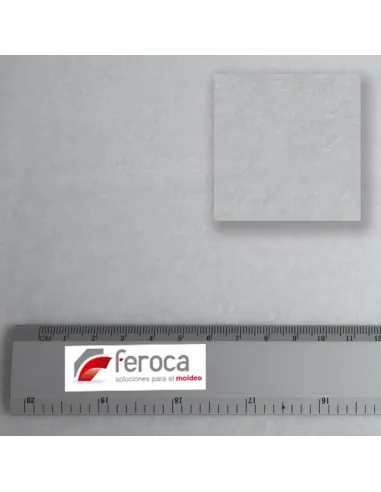
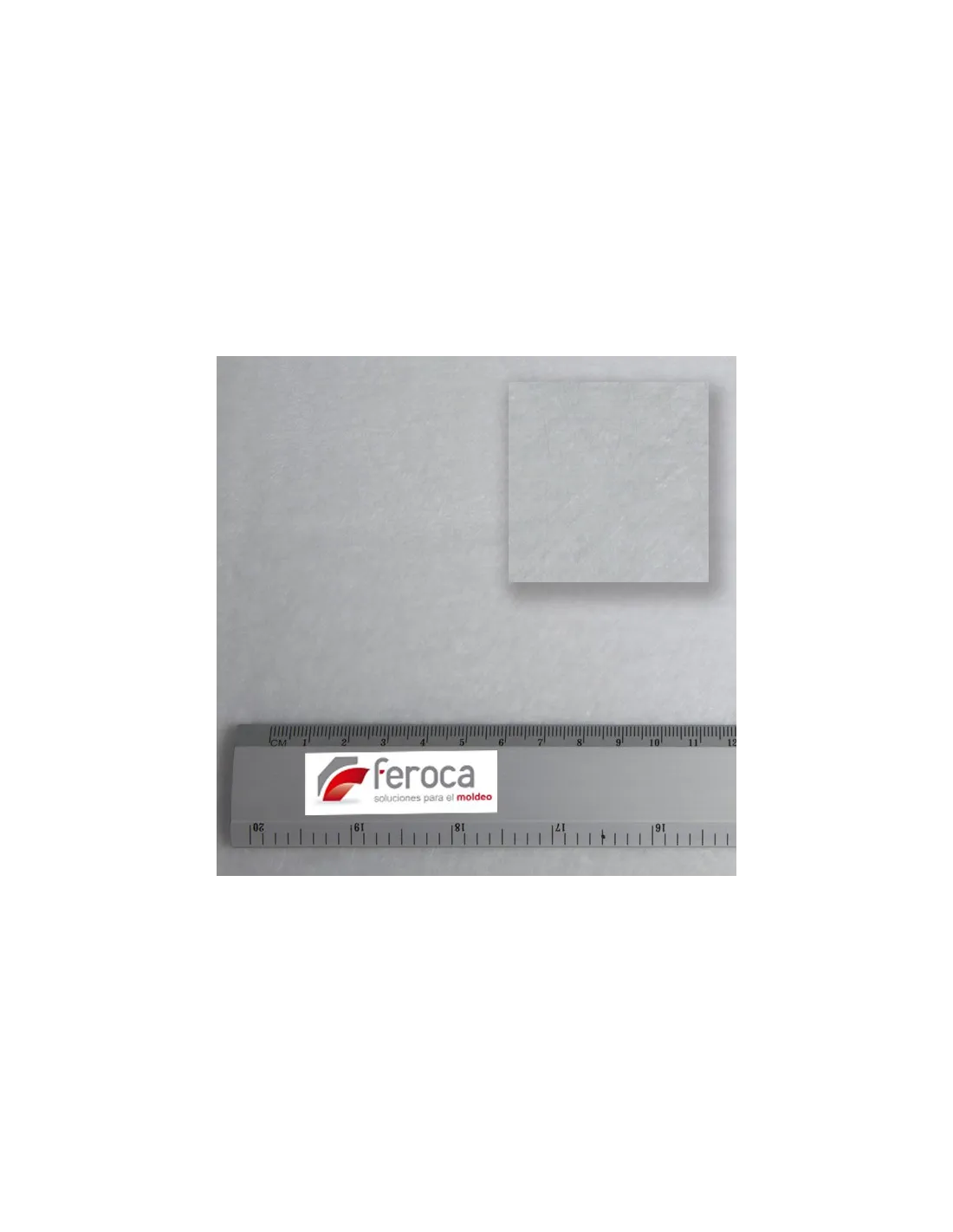
The 34 g/m² surface veil is an extremely lightweight fibreglass mat designed specifically to be applied as the outer layer of laminates. Its main function is to conceal the pattern left by thicker reinforcement mats, achieving a smooth, aesthetic surface with a quality finish. It is the standard solution in any lamination process where the visible face of the part must be clean and uniform.
Technical specifications
| Parameter |
Value |
| Weight |
34 g/m² |
| Type |
Surface veil / Finishing mat |
| Material |
Fibreglass |
| Compatibility |
Polyester resins, epoxy resins, vinylester resins |
| Application |
Surface finishing layer in laminates |
What it is used for
The surface veil is placed as the final layer in the laminate, between the gel coat (or finishing resin) and the first reinforcement mat, or as the outermost layer before demoulding. Its low weight allows it to be easily wetted out without adding any appreciable rigidity or thickness — only a continuous, mark-free surface. It is essential in any part where the visual finish is important.
- Manufacturing of laminated parts in polyester resin with a quality visible face
- Surface finishing on rigid shells for silicone moulds
- Repairs of fibreglass parts where the final layer must be texture-free
- Eliminating the pattern or texture left by 300 g/m² mat on the surface
- Decorative or structural laminates with aesthetic requirements on the outer face
- Sealing and improving the surface impermeability of laminated parts
- Series production of composite parts where uniform finish is required
How to use it
- Prepare the mould correctly: apply a Release agent and, if the part requires it, gel coat. Allow the gel coat to cure to a gel state (tacky) before continuing.
- Cut the surface veil to the required size. Being a very lightweight material, it can be cut easily with scissors or a craft knife.
- Apply a coat of polyester resin (or epoxy) over the gel coat or mould surface using a brush or roller.
- Place the 34 g/m² veil over the fresh resin and press gently with a brush to ensure complete saturation. Use a laminating roller to remove any trapped air bubbles.
- Apply another coat of resin over the veil to ensure full impregnation. The layer should appear translucent with no white areas (which would indicate dry spots).
- Without waiting for it to cure, add the reinforcement layers: start with the 300 g/m² mat and as many structural layers as the design requires. Use a metal deaeration roller to remove air between layers.
- Allow the assembly to cure according to the instructions of the resin used, under appropriate temperature and ventilation conditions.
- Demould the part once cured and check the surface: it should be smooth, without the characteristic print of the reinforcement fabric.
Usage tips
Correct impregnation of the veil
The 34 g/m² veil is very thin and can wrinkle if handled dry on complex surfaces. The most practical approach is to lay it over the resin already applied in the mould, without stretching it, and work from the centre outwards with the brush. If you have areas with sharp angles or pronounced curvature, make small cuts in the veil so it conforms without folds. Folds create air pockets that affect the final finish.
Always combine it with the appropriate reinforcement mat
The surface veil provides no structural strength on its own. Its weight of 34 g/m² is intended exclusively for finishing. For any part that must withstand mechanical stress, combine it with at least two layers of 300 g/m² reinforcement mat. The standard sequence is: gel coat → veil → 300 mat → 300 mat (or more layers depending on the required thickness).
Temperature and working conditions
Always work above 15 °C. At low temperatures, polyester resin takes much longer to cure and may result in reduced mechanical properties. Also avoid high humidity, especially with polyester resins, as it can affect surface cure. If you need to carry out repairs with resin and fibreglass, the polyester resin repair kit includes everything needed for spot repairs.
Frequently asked questions
What exactly is a surface veil layer used for in a fibreglass laminate?
The surface veil acts as a finishing layer between the gel coat and the reinforcement mats. Its function is to prevent the pattern or texture of thicker mats from showing through on the outer surface of the part. The result is a smooth, uniform, blemish-free visible face. This 34 g/m² veil is the standard solution for this purpose in polyester or epoxy resin laminates.
Can the surface veil be used as the only fibreglass layer in a part?
No. The 34 g/m² veil has no structural capacity. It must always be used together with higher-weight reinforcement layers, such as 300 g/m² mat. The veil provides surface quality only, not mechanical strength.
What resins is this fibreglass veil compatible with?
It is compatible with polyester resins (such as Ferpol 100 BSX15), vinylester resins and epoxy resins. In all cases, the application technique is the same: thoroughly wet out the veil with the resin before adding the reinforcement layers.
How many veil layers are normally applied in a laminate?
Typically a single surface veil layer is applied. This is sufficient to eliminate the print-through from reinforcement mats and achieve a smooth finish. Adding more veil layers does not significantly improve the result and unnecessarily increases material consumption.
Can I use this veil for repairs on existing fibreglass parts?
Yes. In repairs, the veil is applied as the final layer over the reinforcement mat layers so that the finish of the repaired area is as uniform as possible. This is especially useful when the part will be visible or painted. For complete repairs, the polyester resin repair kit includes the basic materials needed.
Is gel coat necessary before applying the veil?
gel coat is not mandatory, but it is highly recommended when the best possible surface finish, weather resistance or uniform colour is required. If you do not use gel coat, the veil becomes the outer layer of the part, which also gives a good result, although somewhat less resistant to abrasion and external agents than with gel coat.
How do I prevent the veil from wrinkling when applying it?
Lay the veil over the fresh resin without stretching it, working from the centre outwards. In areas with curvature or angles, make small cuts so the material conforms without folding. Work with the brush or laminating roller using gentle movements to avoid displacing the veil from its position.
What is the difference between the surface veil and the 300 g/m² mat?
The 300 g/m² mat is the structural reinforcement layer: it provides strength and thickness to the laminate. The 34 g/m² veil is the finishing layer: it provides no significant strength, but eliminates the mat print-through on the outer surface. Both are complementary and are used together in any quality laminate.