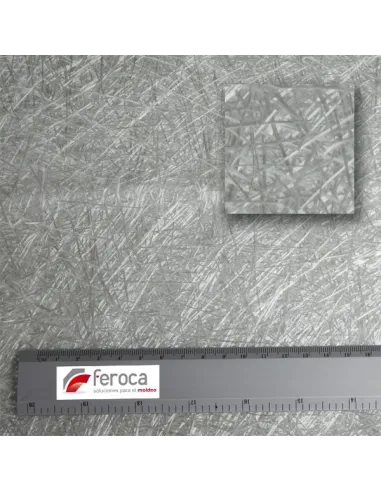
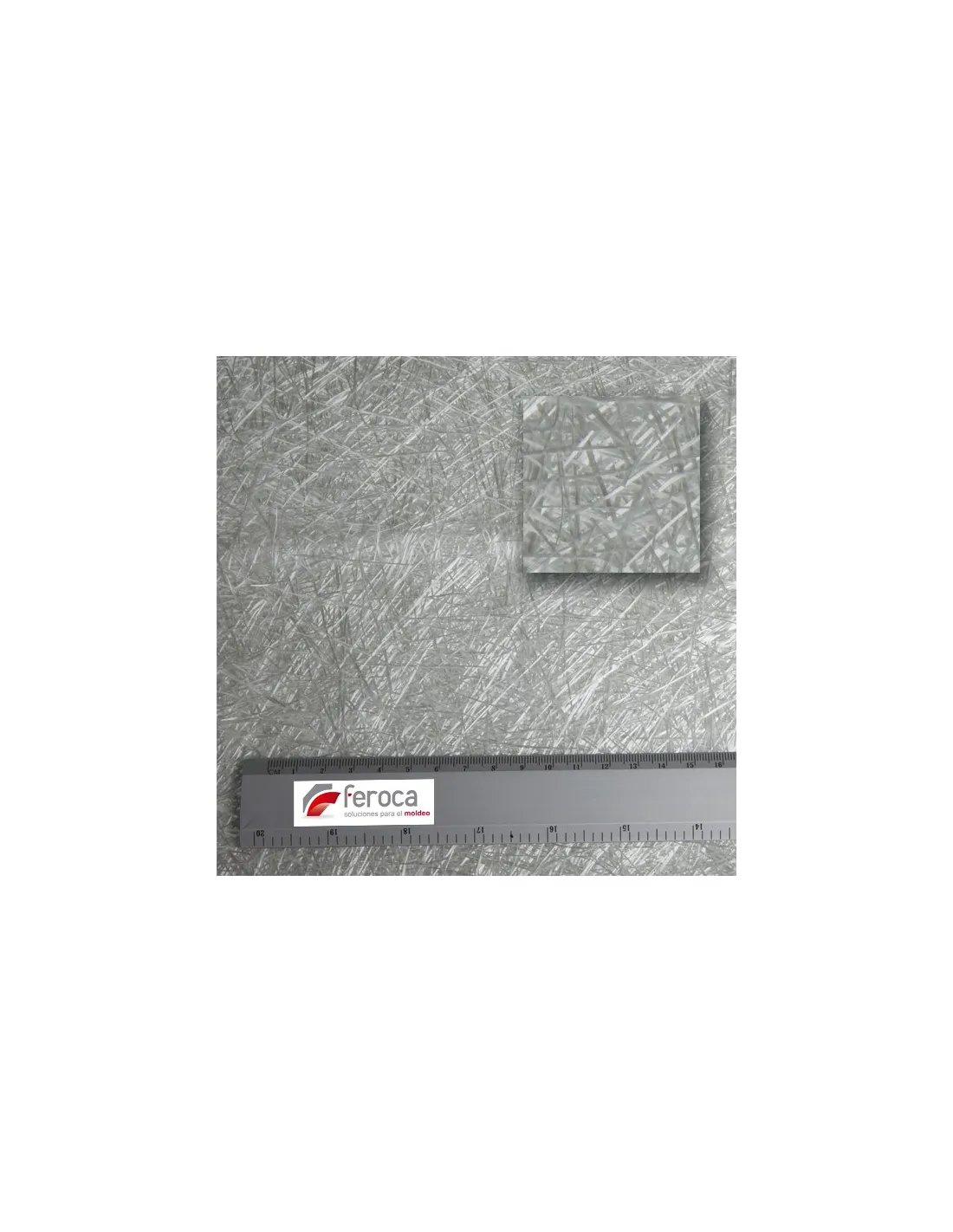
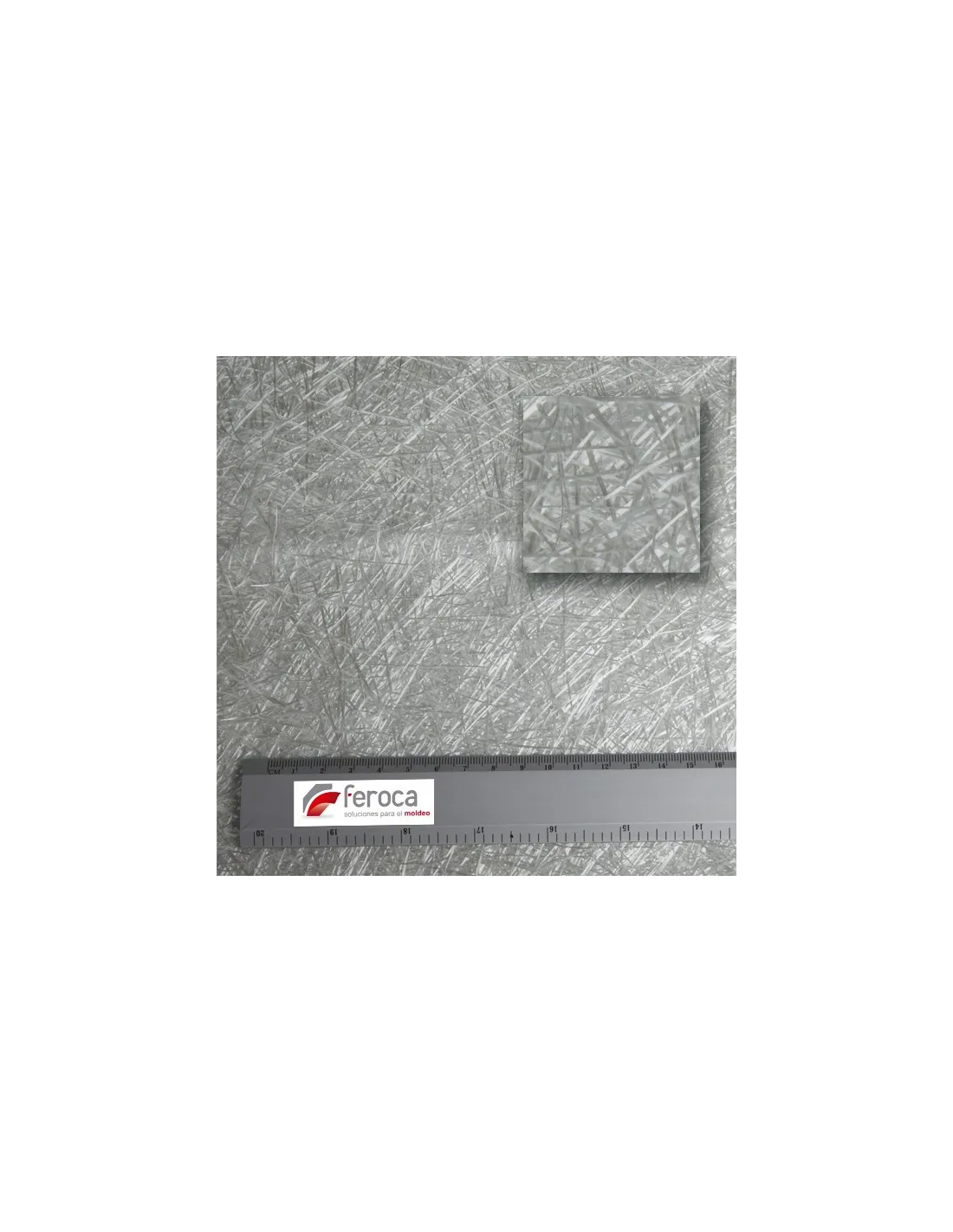
The 300 g/m² fibreglass mat is a textile reinforcement made of glass strands pressed together with an emulsion soluble in polyester and epoxy resins. It is the most widely used laminating material in the workshop for building mould shells, structural repairs and medium-strength composite parts. Versatile, easy to wet out and compatible with the most common resin systems.
Technical specifications
| Parameter |
Value |
| Reinforcement type |
Emulsion mat (fibreglass chopped strand mat) |
| Weight |
300 g/m² |
| Emulsion type |
Soluble in polyester and epoxy resins |
| Application |
Hand lay-up |
| Compatible resins |
Polyester (Ferpol 100BSX15), epoxy (Epofer Laminate 401) |
What it is used for
The 300 g/m² mat is the standard reinforcement for hand lay-up with polyester or epoxy resin. It is used when a structural layer that wets out quickly is needed, offering good mechanical performance at a competitive cost. It is particularly suitable for:
- Rigid shells (mother moulds) over silicone or latex moulds
- Building rigid fibreglass moulds for production runs
- Repairing damaged polyester or epoxy parts
- Structural reinforcement of lightweight composite parts
- Intermediate layers in multi-ply laminates (combined with woven fabric or surface tissue)
- Manufacturing prototypes, technical models and workshop tooling
How to use it
- Prepare the mould or model surface: sand if necessary and apply 34D paste release agent if you intend to demould the finished part.
- Cut the mat to the required size using scissors specifically designed for fibreglass. For repair patches, cut two pieces of different sizes to create a smooth stepped overlap.
- Prepare the resin according to the manufacturer's instructions: Ferpol 100BSX15 for polyester, or Epofer Laminate 401 for epoxy.
- Apply a generous coat of resin over the surface using a brush or roller.
- Place the mat on top of the wet resin and press it in with the roller working from the centre outwards, removing air bubbles until the fibres become completely translucent and fully wetted out.
- Apply a second coat of resin over the wetted mat and repeat the process with a second sheet of mat if the part requires additional thickness or strength.
- To improve the surface finish and watertightness, finish with a 30 g/m² surface tissue wetted out in resin as the final layer.
- Allow to cure in a ventilated area for the time indicated by the resin used before demoulding or handling.
Personal protection during laminating: Fibreglass releases fine particles that irritate skin, eyes and the respiratory tract. Always wear nitrile gloves, a particulate respirator (minimum FFP2) and safety goggles when cutting or handling dry mat. Work in a ventilated space, especially when using polyester resins, which emit styrene vapour.
Usage tips
Avoid print-through of the fibre on the surface
The 300 g/m² mat leaves a visible texture on the part surface if used as the final layer. To obtain a smooth, even finish, always apply a 30 g/m² surface tissue as the last layer before the resin fully cures. This also improves the watertightness of the part.
Correct wet-out: no bubbles, no excess
The most common mistake in hand lay-up is leaving trapped air pockets or applying too much resin. The typical ratio is approximately 2:1 resin to mat by weight. A properly wetted mat changes from opaque white to translucent. If it remains white after rolling, more resin is needed. If the part turns out very heavy and flexible, there is too much resin.
Combining with woven fabric for greater strength
If you need a part with greater resistance to bending or impact, alternate layers of mat with layers of fibreglass woven fabric. The mat provides isotropy and ease of moulding on complex geometries; the woven fabric provides directional strength. This combination is standard practice in production moulds and heavy-duty shells.
Frequently asked questions
What is the difference between fibreglass mat and fibreglass woven fabric?
The mat (or chopped strand mat) is made of glass strands randomly cut and pressed together with an emulsion. This gives it isotropic behaviour (equal strength in all directions) and makes it easy to mould over curved or complex geometries. Woven fabric, on the other hand, has strands oriented in one or more directions, offering greater mechanical strength but being harder to conform to complex shapes. For mould shells and repairs, the 300 g/m² mat is the standard choice due to its balance between ease of use and performance.
Which resins is this mat compatible with?
This mat uses an emulsion soluble in polyester and epoxy resins. The recommended polyester resin for laminates is Ferpol 100BSX15. For applications requiring greater chemical or mechanical resistance, it is also compatible with Epofer Laminate 401. It is not recommended for use with acrylic resins, as the mat's emulsion does not dissolve correctly in that type of system.
How many layers of mat do I need for a mould shell?
For a standard rigid shell (mother mould) over a silicone mould, the usual approach is to apply between 2 and 4 layers of 300 g/m² mat, depending on the size of the part and its intended use. For heavy-duty moulds or large parts, it may be necessary to interleave layers of woven fabric between mat layers to increase rigidity. Always finish with a 30 g/m² surface tissue to improve the finish.
How do you cut fibreglass correctly?
Fibreglass mat must be cut with scissors specifically designed for composite materials, as conventional scissors blunt very quickly. At Feroca you can find 28 cm fibreglass scissors. Always cut wearing gloves and a respirator, as dry mat sheds fine irritating fibres. For repair patches, cut two pieces of different sizes to create a stepped overlap that improves patch integration.
Can I use this mat to repair a polyester part?
Yes, it is one of the most common uses. The 300 g/m² mat with polyester resin is the standard method for repairing composite parts. At Feroca you will find the Polyester Resin Repair Kit, which includes the materials needed for this type of repair. For a well-integrated patch, sand the damaged area back to sound material, apply two stepped layers of mat and finish with surface tissue.
Can fibreglass be used with flexible materials such as polyurethane?
It is not recommended. Fibreglass reinforcements are designed to work with rigid matrices (polyester, epoxy, acrylic). In flexible materials such as polyurethane rubbers, the fibre does not adhere correctly and may delaminate or generate internal stresses that damage the part. If you need to stiffen a flexible structure, the standard solution is to build a separate rigid fibreglass outer shell.
How do you make a fibreglass shell for a silicone mould?
Once the silicone mould has fully cured over the model, apply a coat of polyester or epoxy resin directly onto the silicone (no release agent is needed at the silicone-shell interface, although one should be applied to the model if it will remain exposed). Then laminate 2–4 well-wetted layers of 300 g/m² mat. The resulting shell holds the geometry of the silicone mould and makes it easier to handle and store. It is recommended to finish with a surface tissue to improve the outer finish of the shell.
What personal protection is required when working with fibreglass?
It is essential to wear nitrile gloves (fibreglass penetrates thin latex gloves), an FFP2 particulate respirator when cutting or handling dry mat, and safety goggles. When working with polyester resins, add forced ventilation or an organic vapour respirator, as styrene is an irritating vapour that can be harmful in enclosed spaces.