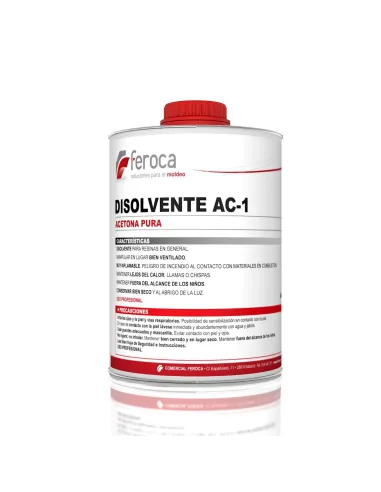
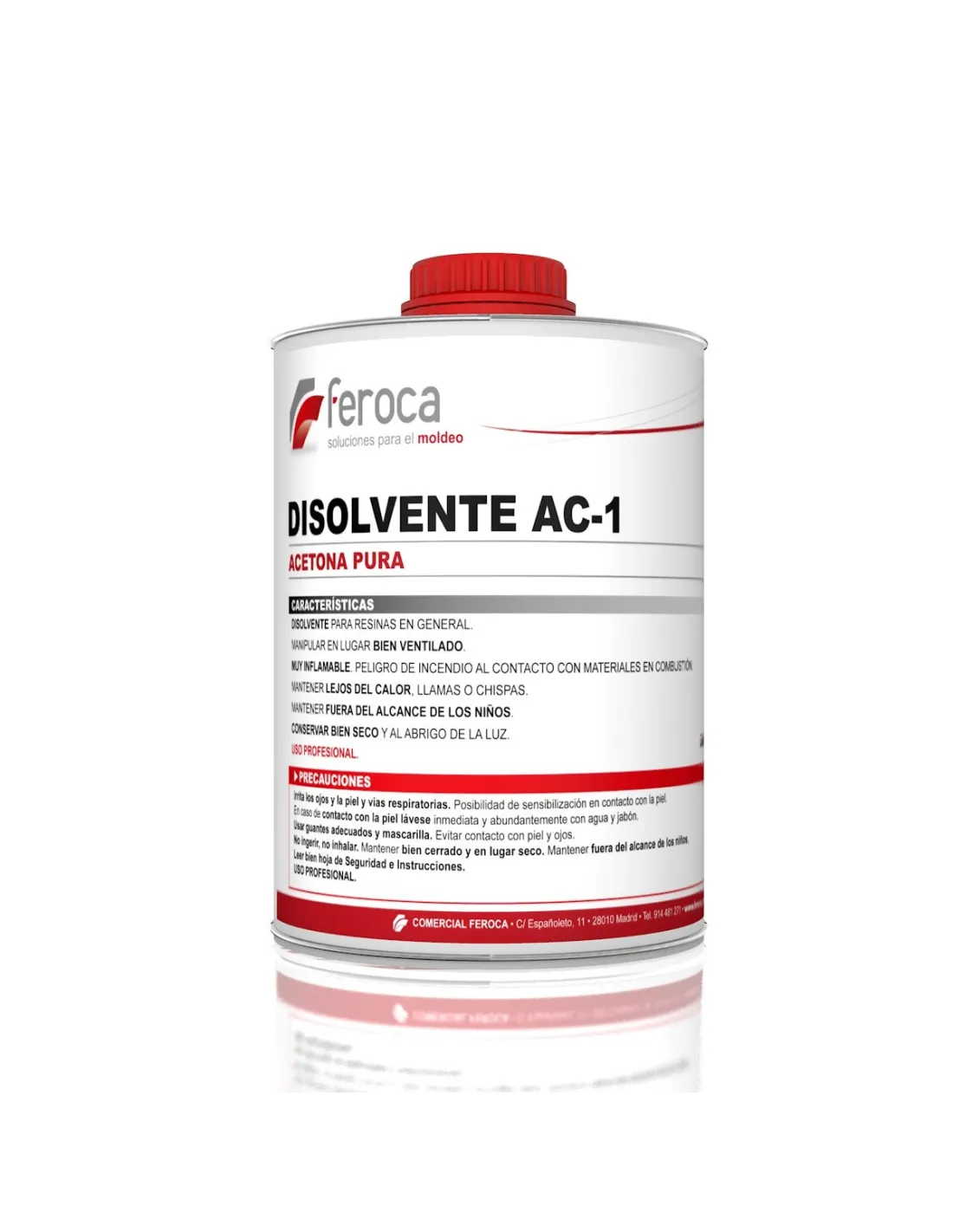
AC-1 Acetone is a general-purpose organic solvent essential in any moulding, composites and special effects workshop. It cleans fresh resin residue, reduces the viscosity of polyester resins and prepares surfaces for finishing — all in a single go-to reference.
Technical specifications
| Parameter |
Value |
| Type |
Organic solvent (ketone) |
| Appearance |
Colourless, transparent liquid |
| Odour |
Characteristic, penetrating |
| Main uses |
Cleaning, thinning polyester resins, removing gloss from thermoplastics |
| Compatibility |
Ferpol polyester resins, thermoplastics |
What it is used for
Acetone is one of the most versatile solvents in the workshop. Its ability to dissolve fresh resin residue, prepare surfaces and kill gloss makes it a go-to product for professionals and advanced hobbyists working with composites, moulding and special effects. Its most common uses are:
- Cleaning brushes, spatulas, rollers and tools impregnated with polyester resin or epoxy resin while still fresh
- Reducing viscosity in Ferpol polyester resins for laminates or low-load castings
- Cleaning surfaces before applying coatings, paints or adhesives
- Removing surface gloss from thermoplastics to improve paint adhesion
- Quick degreasing of moulds and counter-moulds before release agent
- Cleaning silicone or polyurethane parts with uncured material residue
How to use it
- Always work in a well-ventilated space with appropriate PPE: nitrile gloves, safety goggles and a respirator with an organic vapour filter.
- To clean tools: immerse or dampen the tool in acetone immediately after use, before the resin cures. Scrub with a cloth or brush and repeat if necessary.
- To clean surfaces: apply with a clean cloth using even strokes. Allow to evaporate completely before applying resin, paint or release agent.
- To thin polyester resins: add acetone in small amounts (do not exceed 5–10% by weight) and mix thoroughly before adding the catalyst. Excess solvent weakens the cure.
- To remove gloss from thermoplastics: apply with a cloth to the desired area and allow to evaporate completely before painting.
- Store the container tightly closed, away from heat sources and flames. Acetone is highly flammable.
Safety warning: Acetone is a highly flammable liquid (flash point -18 °C). Avoid heat sources, sparks and open flames during use and storage. Vapours can accumulate in low-lying areas; always ventilate the workspace. Use nitrile gloves (latex provides insufficient protection), safety goggles and a respirator with an organic vapour filter. Do not pour waste down the drain: dispose of it as hazardous waste.
Usage tips
Always clean while fresh
Acetone is effective against polyester and epoxy resins before they cure. Once the resin has polymerised, no solvent will remove it completely. Always keep a closed bottle to hand during work and clean tools immediately after use.
Allow to evaporate before the next operation
If you clean a surface with acetone and apply resin or release agent before the solvent has fully evaporated, surface defects may appear (porosity, whitening, loss of adhesion). Wait at least 2–3 minutes under normal temperature conditions before continuing.
Control dilution in polyester resins
Adding acetone to resins such as Ferpol 100 BSX15 reduces viscosity and makes fibre impregnation easier, but excess solvent penalises the mechanical properties of the final laminate and may inhibit curing. Do not exceed 10% by weight, and if you need to reduce viscosity in a more controlled way, consider using the resin at a higher temperature range (between 20–25 °C).
Frequently asked questions
Does it work for cleaning already-cured epoxy resin?
No. Acetone dissolves polyester and epoxy resins before they cure. Once the resin has fully polymerised, the solvent cannot reverse the process. For cured residue you will need to resort to mechanical sanding.
Can I use acetone to clean silicone moulds?
With caution. Acetone does not damage tin or platinum silicones on brief contact, but no residue must remain on the mould before pouring a new casting, as it could affect the curing of platinum silicones. Allow to evaporate completely and air the mould thoroughly before using it again.
What proportion of acetone can I add to a polyester resin?
The indicative limit is 5–10% by weight relative to the resin. Above that percentage, the laminate or casting may become porous, with lower mechanical strength or curing problems. If you regularly need to work with lower-viscosity resins, consider using a lower-viscosity grade directly, such as Ferpol 3501 CV2,5.
Is it compatible with all types of gloves?
No. Latex gloves offer little protection against acetone. Always use nitrile gloves of at least 0.3 mm thickness. For prolonged exposure, neoprene or butyl gloves are more suitable.
Can I pour acetone waste down the drain?
No. Acetone is a hazardous waste. Leftover acetone and impregnated rags must be managed as special waste in accordance with local regulations. Store the waste in a tightly sealed, correctly labelled container and take it to a hazardous waste collection point.
How should I store acetone in the workshop?
In the original airtight container, away from heat sources, sparks and flames. Acetone has a very low flash point (-18 °C), so it must not be stored alongside oxidising products or in areas without ventilation. Keep the container upright and check the seal after each use.
Can acetone inhibit a platinum silicone?
The main risk with platinum silicones is not acetone itself, but the contaminants it may carry during cleaning (latex residue, sulphur, uncured epoxy, etc.). If you use acetone to clean a mould or surface before pouring platinum silicone, make sure the solvent has evaporated completely and that the surface is free of any contaminants.
Which Feroca resins is it recommended for?
How much product do I need?Calculate the exact amount before buying and avoid wasting material.
Go to the calculator →