Shopping Cart


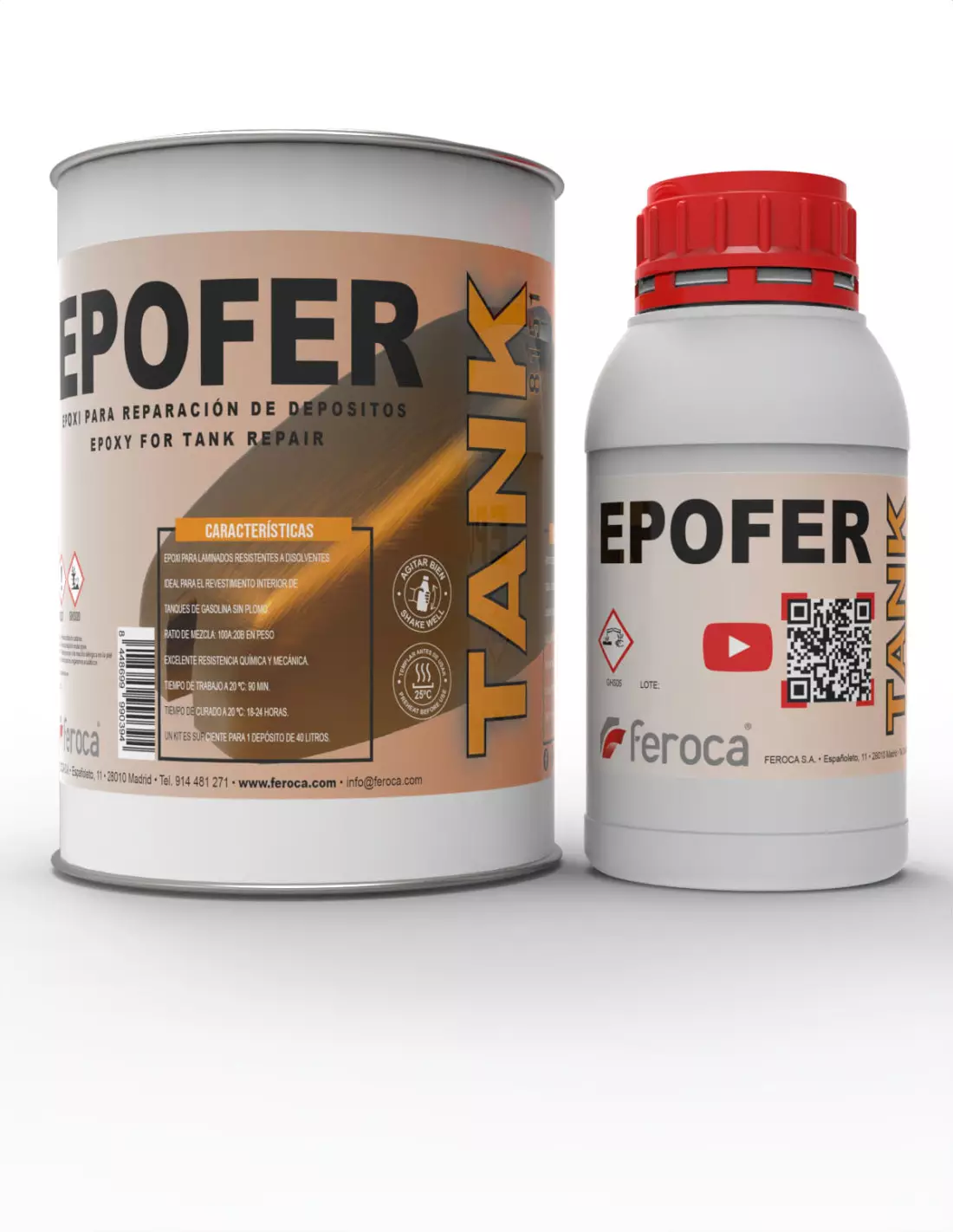
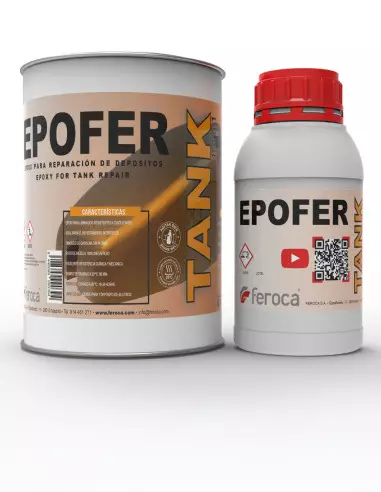
Epofer TANK (8151) -Epoxy for tanks-
402815101
€29.90
36,18 € Tax incl.
36,18 € Tax incl.
Epoxy resin for interior coating of petrol tanks. Mix ratio 100A:20B, 90 min working time, cures in 24 h. 1.2 kg kit for tanks up to 40 L.
Epofer TANK (8151) is a low-viscosity epoxy resin specifically formulated for the interior coating of unleaded fuel tanks and solvent-resistant laminates. Its simple mix ratio (100A:20B by weight), generous 90-minute working time and excellent adhesion to metal make it the professional solution for restoring and protecting tanks against corrosion, wear and fuel vapours.
Technical specifications
| Parameter | Value |
|---|---|
| Reference | 8151 |
| Product type | Epoxy resin for tanks and laminates |
| Colour | Orange |
| Mix ratio (by weight) | 100 parts A : 20 parts B |
| Working time at 20 °C | 90 min |
| Cure time at 20 °C | 18-24 hours |
| Presentation | 1.2 kg kit (1 kg Part A + 200 g Part B) |
| Coverage | 1 kit covers a tank of ~40 L |
| Chemical resistance | Unleaded petrol, solvents, fuel vapours |
What it is used for
Epofer TANK is designed for applications where a durable chemical barrier is required on metal or laminated surfaces in contact with fuel or aggressive solvents. Its most common uses are:
- Interior coating and sealing of unleaded fuel tanks on classic motorcycles, vintage cars and restoration vehicles.
- Protection against corrosion and oxidation in metal tanks that have lost their original coating.
- Sealing of small pores, micro-cracks and corroded areas inside the tank.
- Laminates and coatings for parts that must withstand prolonged exposure to solvents or hydrocarbons.
- Reinforcement of fibreglass or composite tanks subject to contact with fuel.
- Industrial applications where a chemically resistant epoxy layer is required in aggressive chemical environments.
How to use it
- Prepare the tank: thoroughly clean the interior to remove all traces of fuel, oil, loose rust and dirt. You can use metal elements (chains, nuts) together with an acid degreaser (diluted vinegar) which you will shake inside to loosen the rust. Rinse with water and dry completely before continuing.
- Check for moisture: any residual water will prevent epoxy adhesion. If necessary, use compressed air or leave the tank to dry in a warm place for several hours.
- Weigh the components: mix 100 parts of Part A (base) with 20 parts of Part B (hardener) by weight. For the full kit: 1,000 g of A + 200 g of B.
- Mix thoroughly: stir vigorously for at least 2-3 minutes until a completely uniform colour and texture are achieved. Scrape the sides of the container well.
- Pour into the tank: introduce the mixture into the interior of the tank and close or cover the filler opening.
- Rotate the tank continuously: during the first 15-20 minutes, rotate the tank on all axes (top, bottom, sides) so that the epoxy evenly coats all internal walls. Repeat the process every 10 minutes until the resin begins to gel and no longer runs.
- Remove the excess: pour out any surplus before it gels to avoid build-up in flat areas.
- Allow to cure: keep the tank inverted or resting at various angles at 20 °C for 18-24 hours. Do not fit the tank back on the vehicle until curing is complete.
- Check the result: after curing, visually inspect the interior with a torch to confirm that the coverage is uniform and there are no untreated areas.
Important notice — temperature and viscosity: at low temperatures (below 15 °C), Part A may increase in viscosity and appear granular or cloudy, similar to solidified coconut oil. This does not indicate product deterioration. Warm the Part A container in a water bath (water at approximately 40 °C) for 10-15 minutes without opening it, until it recovers its fluidity before mixing. Never apply direct heat or an open flame near the product.
Usage tips
Optimal working temperature
Always work between 18 °C and 25 °C. Above 30 °C the working time is significantly reduced and the epoxy may gel before covering all the walls. Below 15 °C, in addition to the increased viscosity of Part A, curing slows down considerably — in that case allow a minimum of 36 hours before considering the tank cured.
Surface preparation: the key to success
Epoxy only adheres well to clean, dry surfaces free of contaminants. A poorly cleaned tank (with traces of fuel or grease) will cause delamination. If the interior has a layer of old paint or coating in poor condition, remove it mechanically or with solvent before applying Epofer TANK. Adhesion is at its maximum on bare, lightly abraded metal.
Coating thickness control
The more passes you make during the rotation phase, the greater the coating thickness. For tanks in good condition, a single application is sufficient. For tanks with heavily porous or corroded areas, consider applying a second coat once the first has cured (lightly sand the surface with fine-grit paper between coats to promote intercoat adhesion). If you need to repair localised areas before coating, the Epoxy Filler EX610 is compatible and will allow you to fill voids or cracks before applying Epofer TANK.
Frequently asked questions
What type of fuel is this epoxy coating suitable for?
Epofer TANK is formulated to resist unleaded petrol. It is not designed for use with diesel, biodiesel or pure ethanol at high concentrations. Contact Feroca if you have any doubts about compatibility with a specific fuel.
How much product do I need for my tank?
The standard 1.2 kg kit (1 kg of Part A + 200 g of Part B) is sufficient to coat the interior of a tank of approximately 40 litres. For smaller tanks (motorcycles with 10-15 L tanks) there will be leftover product, but it is not possible to make a smaller dose without a precision scale, as the mix ratio must be strictly observed by weight.
How long should I wait before filling with fuel?
After full cure at 20 °C (18-24 hours), the coating has sufficient chemical resistance for contact with petrol. However, it is recommended to wait 48-72 hours at room temperature before filling the tank for the first time to ensure complete curing in areas of lesser thickness.
Can this epoxy be applied over fibreglass or composite?
Yes. Epofer TANK adheres to fibreglass, composite and epoxy laminates that have been correctly prepared (clean, dry and lightly sanded). It is especially useful for fibreglass tanks on classic motorcycles that have lost their original interior waterproofing.
What happens if the mixture is not properly homogenised?
Incomplete mixing leaves uncured or partially cured areas, which will be sticky, soft or soluble in fuel. It is essential to mix thoroughly for at least 2-3 minutes, scraping the sides and bottom of the container well, before pouring the mixture into the tank.
How do I remove uncured epoxy if I made a mistake?
If the epoxy is still in a liquid or very viscous state, you can remove it with solvents such as acetone or methyl ethyl ketone (MEK). Once cured, removal is very difficult and requires mechanical abrasion or aggressive chemical strippers. This is why it is important to ensure proper preparation before pouring the mixture.
Can I use this product as a laminating epoxy for fibreglass parts?
Epofer TANK can be used for solvent-resistant laminates, but its formulation is optimised for tank coating. If you are looking for a general-purpose laminating epoxy resin, Epofer Laminate 401 is the most suitable option within the Feroca catalogue.
Is it compatible with paints or finishes applied afterwards?
On the exterior of the tank there are no restrictions. On the interior, the Epofer TANK coating is the final finish: it is not designed to receive additional layers of paint in contact with fuel. If you need to repair or extend the coating in the future, sand the cured surface and apply a new coat of Epofer TANK.
Video tutorial
DERBI FDS 50, EPOXI FEROCA REPARAR DEPOSITO MUY OXIDADO
- Color
- Orange
- Working Time
- 90min
- Curing Time
- 24horas
- Mixed Weight Ratio
- 100A:20B
No reviews
Tap to zoom