Shopping Cart


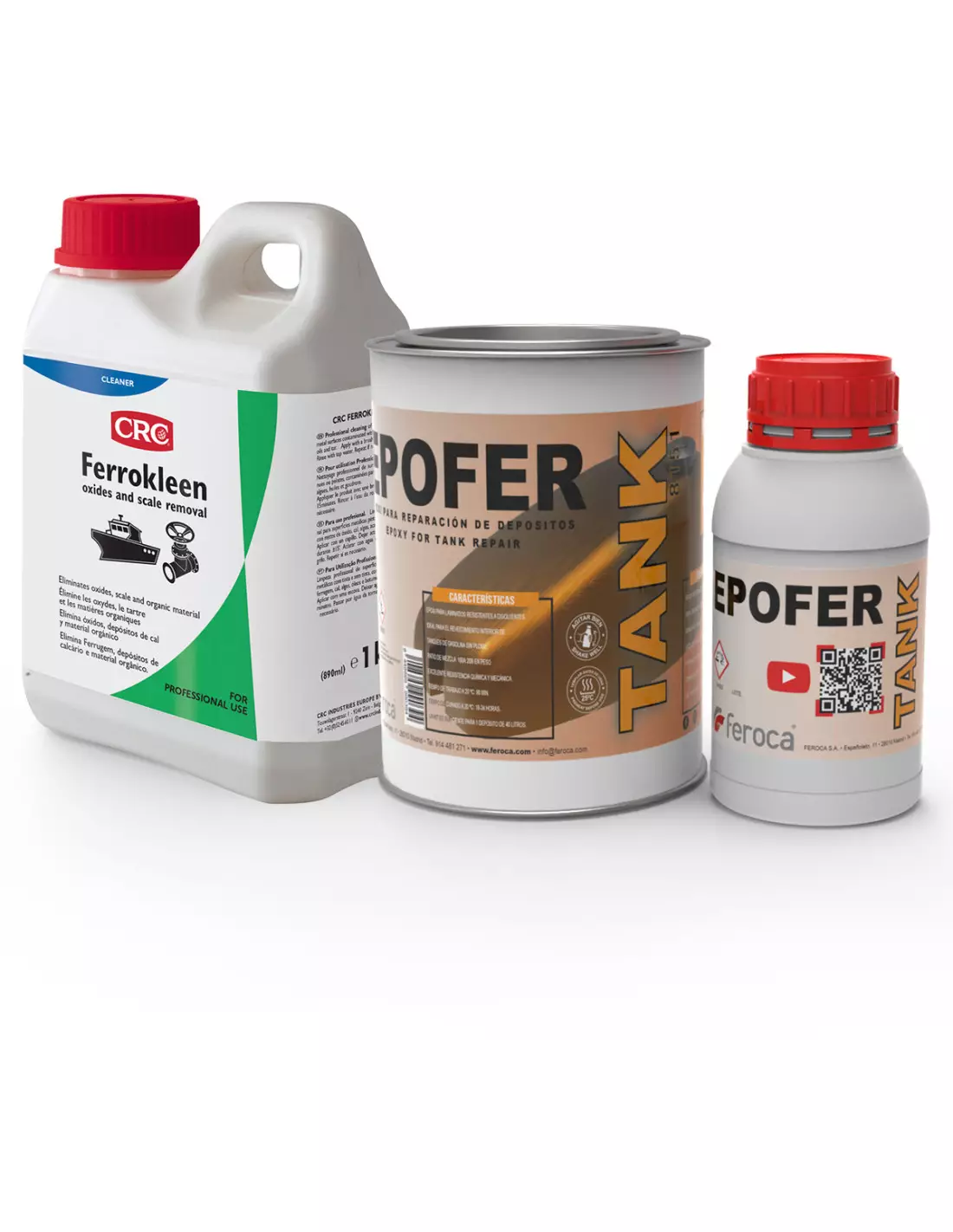
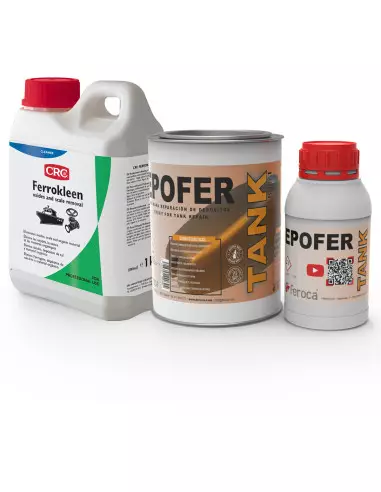
Fuel Tank Repair Kit
200160000
€38.00
45,98 € Tax incl.
45,98 € Tax incl.
Fuel tank repair kit: 1 kg rust remover + 1.2 kg epoxy resin. Mix ratio 100:20 by weight. Cure time 24–48 h at 20 °C.
The Feroca Fuel Tank Repair Kit brings together in a single pack everything needed to clean, de-rust and seal the interior of unleaded petrol tanks damaged by corrosion, pinholes or small cracks. It combines a fast-acting professional rust remover with a high chemical resistance epoxy resin applied by rotational moulding, producing a continuous, adherent and durable internal coating. It is the most complete solution for restoring metal tanks without welding or replacement.
Technical specifications
| Parameter | Value |
|---|---|
| Rust remover included | 1 kg |
| Rust remover working time | 15 min |
| Repair epoxy resin included | 1.2 kg |
| Epoxy mix ratio (A:B by weight) | 100:20 |
| Application technique | Internal rotational moulding |
| Rotational moulding time | 90 min in 10-min intervals |
| Cure time | 24–48 h at 20 °C |
| Resistance | Chemical (solvents, fuel), mechanical, anti-corrosion |
What it is used for
This kit is designed for the repair and internal coating of unleaded petrol tanks that show corrosion, pinholes or cracks. The epoxy resin forms a continuous layer over the entire internal surface of the tank, sealing weak points and protecting them against the aggressive agents in fuel. It is particularly useful for restoring classic vehicles and machinery with tanks that are difficult to replace.
- Repair of petrol tanks on motorcycles, quads and classic vehicles
- Sealing of pinholes and micro-cracks in metal tanks
- Anti-corrosion coating of the interior of deteriorated tanks
- Restoration of tanks with widespread rust before putting back into service
- Long-lasting protection against fuel vapours and direct fuel contact
- Use in restoration workshops, classic mechanics and vehicle preparation
How to use it
- Initial cleaning: Drain the tank completely and remove fuel residues with solvent or hot water. Make sure no flammable liquid residues remain before continuing.
- Applying the rust remover: Pour the rust remover (1 kg) inside the tank. Shake and rotate the tank so the product contacts the entire internal surface. Leave to act for 15 minutes.
- Draining and rinsing: Drain the rust remover and rinse thoroughly with water. Repeat if corrosion is severe. Allow the interior to dry completely before applying the resin.
- Preparing the epoxy resin: Mix components A and B in a 100:20 ratio by weight. Stir carefully for 2–3 minutes until a homogeneous mixture is obtained, free of streaks or stratification.
- Rotational moulding: Pour the mixed resin inside the tank. Seal all openings and begin rotational moulding: rotate the tank on all axes in 10-minute intervals for 90 consecutive minutes, ensuring the resin coats the entire interior surface uniformly.
- Curing: Once rotational moulding is complete, place the tank in a stable position with all openings facing upwards to facilitate air release. Leave to cure for 24–48 hours at 20 °C before fitting or using the tank.
- Inspection: After full cure, visually check the interior with a torch. The coating should be continuous and uniform. If you spot any uncovered areas, apply an additional layer of resin to those points.
Important notice: Always work in a well-ventilated space away from ignition sources. Residual fuel vapours are flammable: make sure the tank is completely free of petrol before introducing the rust remover or the resin. Wear nitrile gloves and safety glasses throughout the entire process. The epoxy resin can cause skin and eye irritation upon direct contact with uncured components.
Usage tips
Working and curing temperature
Ambient temperature directly affects resin viscosity and cure time. Below 15 °C the resin becomes more viscous and may not flow correctly during rotational moulding, leaving areas uncovered. If you are working in a cold workshop, warm the tank slightly (without flame) before pouring in the resin, or bring the kit to room temperature for at least 12 hours before use. Above 25 °C the working time shortens: work more quickly during rotational moulding.
Rotational moulding: the key to a good result
Rotational moulding is the most critical step. Do not interrupt the 90 minutes of rotation: if the resin settles before gelling, the coating will be uneven and thicker at the bottom. Rotate the tank on all possible axes (longitudinal, transverse and diagonal) to ensure coverage in complex interior areas such as ribs, welds and corners. If the tank has large cracks or pinholes, consider reinforcing that area before rotational moulding with Masilla Epoxica 610, which seals exterior imperfections with high chemical resistance before applying the internal coating.
Pre-drying the tank: essential
Any trace of moisture inside the tank after rinsing the rust remover can compromise adhesion of the epoxy resin. Use compressed air to speed up drying and, if available, an industrial dryer or workshop heater at low temperature. The interior must be completely dry to the touch before pouring in the resin. A damp tank can cause bubbles, lack of adhesion or incomplete cure at localised points.
Frequently asked questions
Is this kit suitable for any type of fuel?
The kit is formulated and tested for unleaded petrol tanks. It is not recommended for diesel, pure ethanol or aviation fuel tanks without first verifying the chemical compatibility of the resin with the specific fuel. Contact Feroca if you have any doubts about your particular application.
Can I repair a plastic tank with this kit?
No. The Fuel Tank Repair Kit is designed for metal tanks. The rust remover serves no purpose on plastic, and epoxy resin adhesion to polyethylene or polypropylene (the most common materials in plastic tanks) is very low. Specific repair systems exist for plastic tanks.
How much internal surface can the kit cover?
The 1.2 kg of epoxy resin included is sufficient for most standard-size motorcycle, quad or classic vehicle tanks (approximately 10 to 25 litres), applied by rotational moulding in a single pass. Larger tanks or those with very complex geometries may require a second application or an additional quantity of resin, available separately as Epofer TANK (8151).
What happens if the cure is not complete after 48 hours?
If the resin is still tacky after 48 hours, the most common causes are: ambient temperature below 15 °C, incorrect mix ratio (always weigh the components, never measure by volume) or residual moisture inside the tank. Raise the surrounding temperature to 20–25 °C and wait a further 24 hours. If the problem persists, contact Feroca to assess whether the layer needs to be removed and the process repeated.
Can this kit be used on tanks that will be stored without fuel for a long time?
Yes, this is actually one of the most common uses. In classic or seasonal vehicles that are stored without fuel for months, the epoxy coating protects the metal interior from oxidation caused by ambient humidity, preventing the tank from deteriorating between seasons.
Do I need any additional product to complete the repair?
For most standard repairs the kit is self-sufficient. However, if the tank has large external cracks or pinholes, it is advisable to seal them first with Masilla Epoxica 610 to prevent leaks during rotational moulding. If you need additional resin for large-capacity tanks, Epofer TANK (8151) is the direct complement to this kit.
How long does the coating last before requiring maintenance?
A correctly applied and cured coating is long-lasting under normal operating conditions with unleaded petrol. Service life depends on factors such as the quality of the metal substrate, exposure to aggressive additives and temperature variations. In well-executed restorations, the coating can last many years without any maintenance.
Can I apply the resin with a brush instead of rotational moulding?
This is not recommended for the interior of a tank, as it is practically impossible to reach the entire internal surface with a brush uniformly. Rotational moulding is the correct method and the one that guarantees a continuous coating with no uncovered areas. If you need to apply epoxy resin by lamination on accessible surfaces, Epofer Laminate 401 is specifically formulated for that technique.
No reviews
Tap to zoom