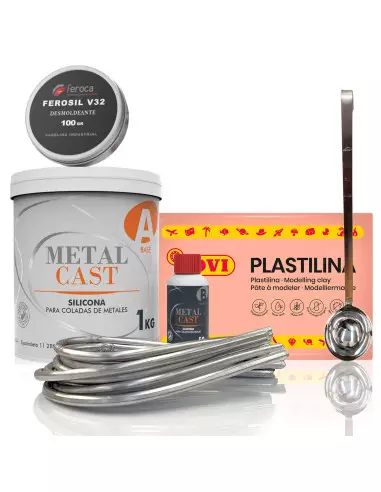
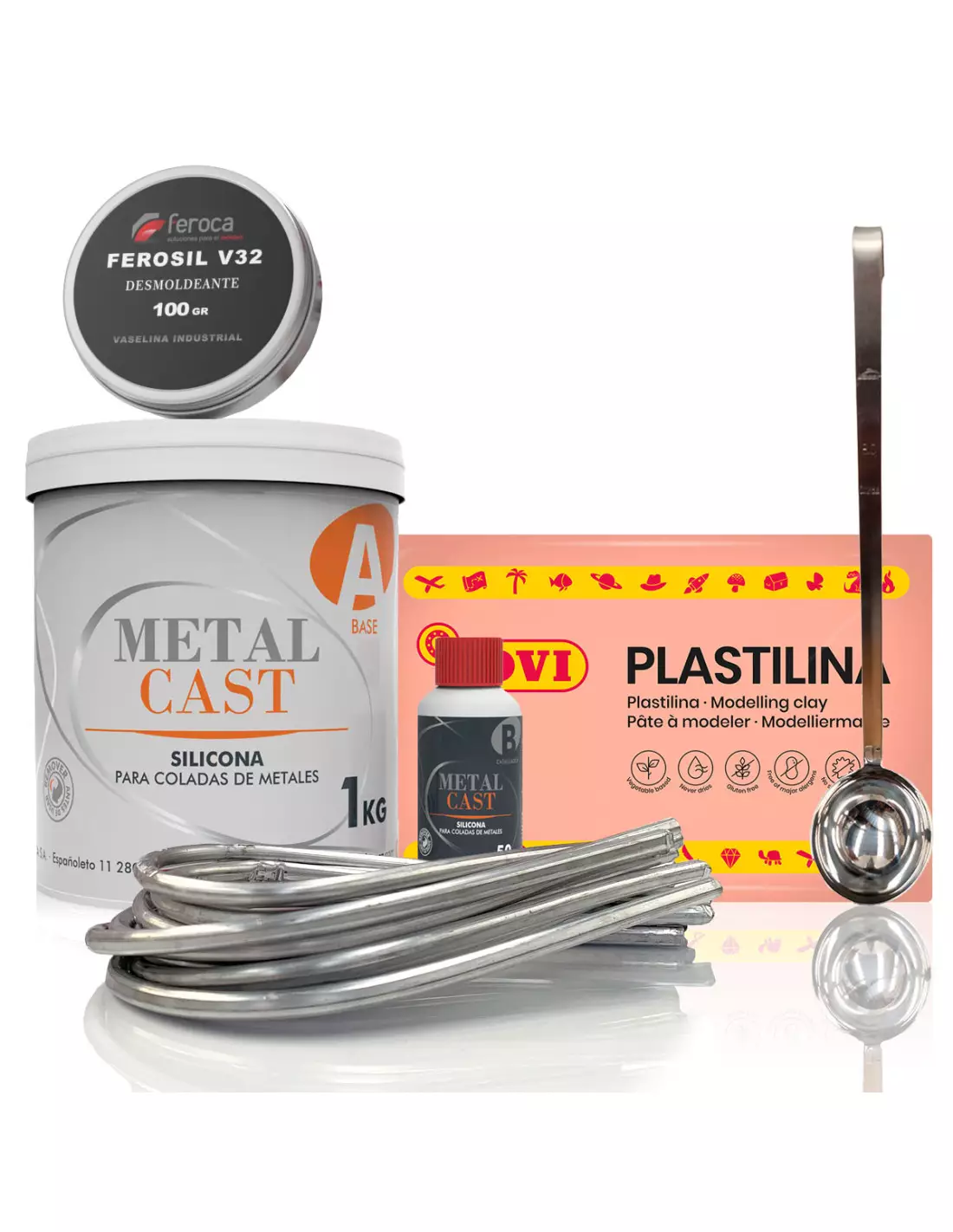
Feroca's metal casting kit brings together everything you need to go from an original piece to serial copies made in low-melting-point alloy. Designed for those who want to produce wargame miniatures, fishing sinkers, inchikus, jigs and lures without investing in professional machinery. With the included components you can create the silicone mould, melt the metal and demould with clean results from the very first attempt.
Kit contents
| Component |
Quantity / Weight |
Function |
| MetalCast – Silicone for metals |
1.050 kg |
Heat-resistant tin silicone for making the mould |
| Ferosil V32 |
100 g |
Spray Release agent to facilitate demoulding |
| Industrial plasticine |
350 g |
Sealing and preparation of the original for silicone pouring |
| Lead/tin rods or Peltre PLS |
10 × 100 g or 3 rods (≈200 g) |
Low-melting-point alloy for pouring into the mould |
| Small casting ladle |
1 unit |
Container for melting and pouring the metal alloy |
What it is used for
This kit is aimed at the serial production of small metal parts from a modelled or purchased original. The included alloys melt at temperatures achievable with domestic or workshop heat sources, making the process safe and repeatable without industrial equipment.
- Wargame and board game miniatures
- Fishing sinkers (round, teardrop, onion-type)
- Inchikus, jigs and lead lures for sport fishing
- Small-format figures and scale models
- Decorative replicas of historical or collectible pieces
- Prototypes and short runs in metal alloy for craft use
How to use it
- Prepare the original: clean the piece you want to reproduce and fix it onto a flat base using industrial plasticine to seal the perimeter. Make sure there are no gaps through which the silicone could escape.
- Apply Release agent: spray a thin layer of Ferosil V32 over the original and the base. Allow to dry for 1–2 minutes before continuing.
- Mix and pour MetalCast silicone: follow the ratio indicated on the silicone packaging. Mix with slow movements to avoid bubbles and pour over the original. Allow to cure at room temperature according to the product instructions.
- Demould the silicone: once cured, carefully remove the silicone from the original. You will have the negative ready to receive the molten metal.
- Melt the alloy: place the lead/tin rods or the peltre in the casting ladle and apply heat (gas burner, kitchen hob, workshop torch) until the metal is completely liquid.
- Pour the metal: with the silicone mould held firmly — you can use elastic bands or a light clamp — pour the molten metal slowly and without interruption. Avoid direct contact with skin.
- Cool and demould the piece: allow to cool until the metal is completely solidified. Flex the mould gently to extract the piece without damaging the mould. It can be reused dozens of times.
- Finish the pieces: remove any flash or casting channels with a file or scalpel and the miniature or sinker will be ready to paint or use.
Usage tips
Preparing the original
The cleaner and more detailed the original, the better the results of the copies will be. Pieces with deep undercuts require two-part moulds: divide the original along the natural parting line with plasticine, cure one half of silicone, remove the plasticine and cure the second half over the first (do not forget to apply Release agent between both parts). If the original is porous (plaster, wood, gypsum), apply a coat of lacquer or sealer before building the mould box.
Safety when melting metals
Always work in a ventilated space. Use leather or high-temperature gloves and safety glasses when handling molten metal. Liquid metal is extremely dangerous in contact with wet surfaces: make sure both the silicone mould and the ladle are completely dry before pouring. A mould with trapped moisture can cause violent spattering.
Extending mould life
MetalCast silicone withstands the heat of low-melting-point alloys, but the more cycles the mould accumulates, the more fine details will deteriorate. To extend its service life, always apply a thin layer of Release agent before each casting and allow the mould to cool between pours if working in continuous series. Store moulds flat, away from heat and direct sunlight.
Frequently asked questions
What metals can I melt with this kit?
The kit includes lead/tin alloy rods or peltre, which melt at approximately 70 °C to 200 °C. The MetalCast silicone in the kit is designed to withstand this temperature range. Do not use this mould with high-melting-point metals such as aluminium, bronze or brass, as they would damage the silicone mould.
How many copies can I get from a single mould?
With correct use and applying Release agent between castings, a MetalCast mould can yield between 50 and several hundred copies, depending on the geometric complexity of the piece and the temperature of the poured metal. Simple shapes without undercuts allow a greater number of cycles.
Do I need an oven or special equipment to melt the metal?
No. The low-melting-point alloys included in the kit melt with a common heat source: gas burner, conventional kitchen hob or workshop torch. The included casting ladle is sufficient for the quantities needed for small pieces.
Can I also use the silicone mould for resins or plaster?
Yes. Moulds made with MetalCast are compatible with polyurethane resins, plaster and other casting materials. If you mainly want to work with resins, also check out Feroca's resin moulding kit, optimised for that type of material.
What do I do if the piece has undercuts or tricky draft angles?
For pieces with complex geometry it is necessary to make a two-part mould. Using the industrial plasticine included in the kit you define the mould parting line, cure each half separately and then assemble both parts for casting. This procedure is within reach of any user with a little practice.
Is it dangerous to work with molten metals at home?
With the appropriate precautions it is an accessible technique for hobbyists. Use heat-resistant gloves, safety glasses and work in a ventilated space. Make sure both the mould and the tools are completely dry before any contact with liquid metal. Keep children and pets away from the work area.
Can I make moulds of objects with very fine detail?
Yes. MetalCast silicone faithfully reproduces the finest details of the original, making it ideal for wargame miniatures or other pieces with delicate textures and reliefs. The key is to mix the silicone thoroughly, avoid bubbles in the mix and make sure the original is clean and correctly prepared.
How much metal do I have to start with?
The kit includes 10 rods of 100 g of lead/tin alloy (approx. 1 kg in total) or 3 pewter rods totalling around 200 g, ready to use. For small pieces such as fishing sinkers or wargame miniatures this is enough for hundreds of copies. When the metal runs out, you can restock with Feroca's lead/tin rods or Peltre PLS separately.