
Shopping Cart
- Feroca
- Mold Making Silicones
- 0 likes
- 10553 views
- 0 comments
Silicone for moulds is the go-to material when you need to reproduce parts with fine detail, make dozens of castings without the mould deteriorating, and demould complex geometries without damaging the original. It's flexible, durable, chemically and physiologically inert, and can handle everything from epoxy resin to wax or soap. If you're choosing between tin and platinum silicone, or you're not sure what Shore Hardness you need, this guide explains everything using the actual products you'll find at Feroca.
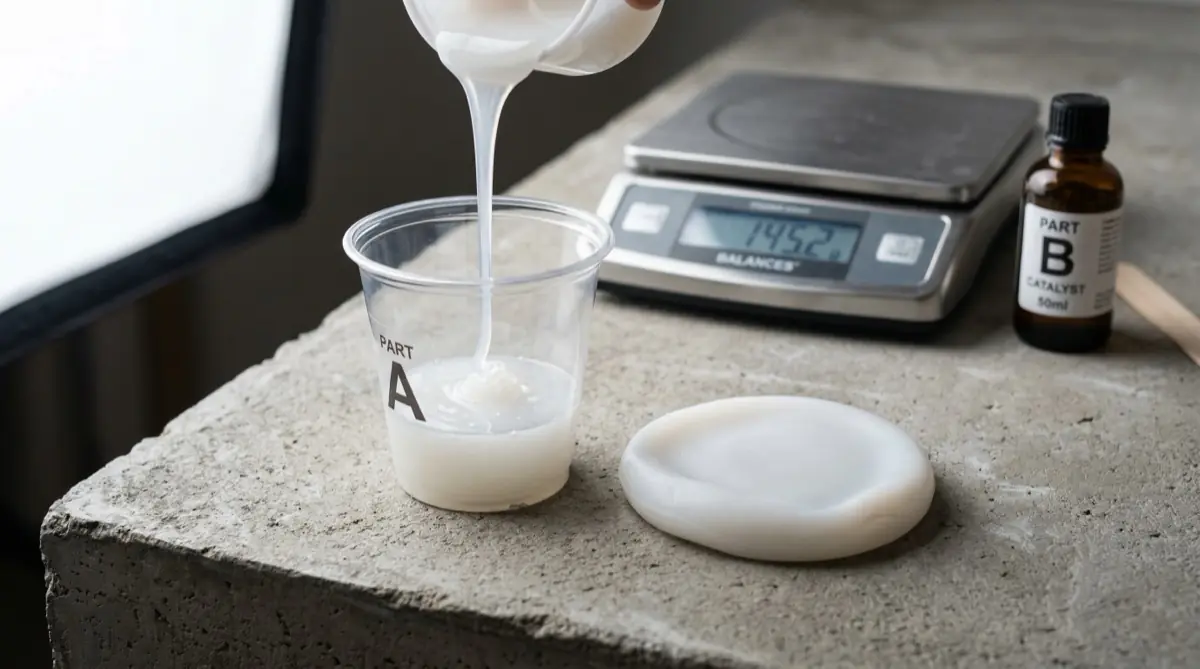
Types of silicone for moulds
There are two curing systems and one special putty format. The choice between them determines the quality of the mould, its durability, and the cost.
Condensation silicone (tin)
Condensation silicones cure through a polycondensation process in the presence of ambient moisture. They are more affordable than platinum silicones and offer an excellent price-to-quality ratio. Their main limitation is a small amount of shrinkage upon curing (≤0.3%) and a somewhat shorter mould lifespan compared to platinum silicones.
At Feroca the reference product is EASYL 3520: Shore A20, 100:5 ratio by weight, 20-minute working time and 4–5 hours curing time. It's the standard silicone for casting moulds with resins, plaster, wax, and soap. If you need to see the interior piece to make the opening cut precisely, EASYCLEAR offers the same performance in a translucent version. For brush-applied moulds on vertical or large-format pieces, EASYL Brushable is self-thixotropic: it won't sag on vertical surfaces without needing to add a thickener.
Addition silicone (platinum)
Addition silicones cure via a platinum catalyst without releasing by-products, resulting in virtually zero shrinkage (<0.1%), greater mould durability, and higher chemical resistance. They are more expensive but justify the cost in series production, high-precision parts, or skin-contact applications.
EASYPLAT 00-30 is the entry point into Feroca's platinum silicone range: Shore 00-30 (extremely soft), 1:1 mix ratio, 30–40 minutes working time. Ideal for FX, prosthetics and animatronics where maximum softness is required. For block moulds where firmness matters more, EASYPLAT MOLD-40 offers Shore A40 with the same translucency. The PlatSil range covers the intermediate hardness levels: PlatSil 73-15 (Shore A15, 20 min working time), PlatSil 73-20 (Shore A22, cures in 1 hour) and PlatSil FS-10 (Shore A13, fast cure in 25 min).
Silicone putty
Alumilite's Mold Putty is a two-component putty (50/50) that cures in 20 minutes with just 2–3 minutes of working time. No liquid mixing, no mould boxes, no degassing. Perfect for quick moulds of small pieces, educational use, and prototyping.
Platinum vs tin silicone — comparison table
| Feature | Condensation (Tin) | Addition (Platinum) |
|---|---|---|
| Price | More affordable | Higher cost |
| Shrinkage | ≤0.3% | <0.1% (virtually none) |
| Mould durability | High (dozens of castings) | Very high (hundreds of castings) |
| Inhibition risk | No | Yes (see warning below) |
| Skin-safe | No | Yes (specific models) |
| Food Safe | No | Yes (FDA models: Easyl 925/940) |
| Working temperature | Up to ~150 °C (MetalCast: 300 °C) | Up to 200–220 °C |
| Recommended use | Craft moulds, decoration, cosplay, general moulding | FX, prosthetics, series production, high precision |
How to choose the right Shore Hardness
Shore Hardness determines how rigid or soft the mould will be once cured. A hardness that's too high will cause the mould to break pieces with undercuts during demoulding; too low and the mould won't hold its shape well over repeated castings.
| Shore Hardness | Feel | Best for | Product |
|---|---|---|---|
| 00-30 | Very soft gel | FX prosthetics, synthetic skin, animatronics | EASYPLAT 00-30 |
| A10–A15 | Very soft | High-definition FX moulds, pieces with heavy undercuts | PlatSil FS-10 / 73-15 |
| A20 | Soft, flexible | General-purpose moulds: resins, plaster, wax | EASYL 3520 / EASYCLEAR |
| A25 | Soft-medium | Lifecast, food moulds (chocolate, soap) | Easyl 925-FDA |
| A40 | Medium, elastic | Block moulds for cutting, flat pieces and reliefs | EASYPLAT MOLD-40 |
| A50 | Firm | Moulds for low-melting-point metals (up to 300 °C) | MetalCast |
How to make a silicone mould step by step
The process described here is the single-sided casting mould, the most common type for flat pieces, reliefs, and decoration. For three-dimensional pieces, a block mould or a blanket mould with a fibre shell is used.
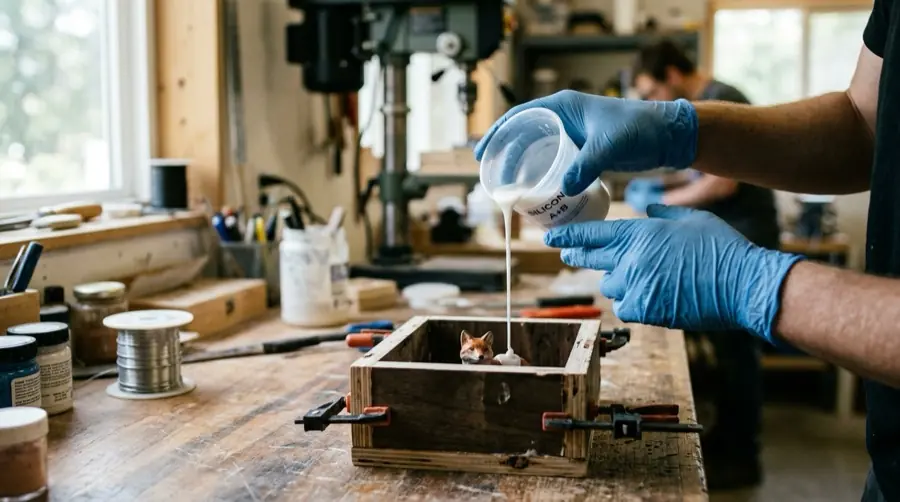
- Prepare the original. The original must be clean and dry. If it's porous (plaster, wood, unglazed ceramic), apply a coat of sealer or petroleum jelly before pouring the silicone.
- Build the mould box. Surround the original with watertight walls (LEGO, acetate, MDF strips sealed with plasticine). The walls should extend 1–2 cm above the height of the original.
- Calculate the amount of silicone. Fill the box with water until the original is covered, measure the volume — that's the volume of silicone you need. Empty and dry thoroughly.
- Mix the silicone. Weigh the components according to the indicated ratio. For EASYL 3520: 100 parts base + 5 parts catalyst. Mix slowly in circular motions to avoid incorporating air. Mix for 2–3 minutes until completely homogeneous.
- Pour. Pour the silicone from height, in a thin stream, into a low point of the box. This helps bubbles rise and burst before reaching the original. Cover the entire original with at least 1 cm of silicone above it.
- Cure. Do not move the mould during curing. At 23 °C: EASYL 3520 cures in 4–5 hours; platinum silicones in 1–4 hours depending on the model. Full cure is always longer (24 hours for tin, 12–24 for platinum).
- Demould. Remove the mould box walls and carefully extract the mould from the original. The original should come out without resistance if the silicone was correct for that material. If there are undercuts, flex the mould gently.
Inhibition in platinum silicones — what it is and how to avoid it
Important notice for platinum silicones
The platinum catalyst can be neutralised (inhibited) by certain substances that prevent the silicone from curing. The result is a silicone that remains sticky or doesn't cure in contact with the original.
Common inhibiting substances: sulphur-based clays, some cyanoacrylate adhesives, paints with metallic driers, uncured natural latex rubber, materials containing organic tin, and some plastics.
How to avoid it: before using platinum silicone on an original you're unsure about, do a small test: apply a drop of mixed silicone onto the material and let it cure. If it hasn't cured after 3 hours, the material is incompatible. Solution: seal the original with several coats of hairspray, shellac or diluted PVA, let it dry completely, and test again.
Condensation silicones (tin) do not have this problem. If you can't guarantee the absence of inhibitors in the original, EASYL 3520 or EASYCLEAR are safer options.
Types of mould by application technique
Casting mould
Liquid silicone is poured over the original placed inside a mould box. Produces high-definition moulds with no brush marks. Requires low-viscosity silicone. This is the standard technique with EASYL 3520, EASYCLEAR and EASYPLAT 00-30.
Blanket or brush-on mould
Silicone is applied by brush or spatula in layers over the original, without a mould box. Saves material and is ideal for large or fixed originals. The silicone must not sag: use the thixotropic additive or, alternatively, EASYL Brushable. A blanket mould always requires a rigid fibreglass or plaster shell to support it.
Block mould
The original is completely embedded in silicone. The mould is cut once cured to extract the original and the piece. Ideal for three-dimensional figures. The translucency of EASYCLEAR or EASYPLAT MOLD-40 lets you see exactly where to cut.
Applications by sector
- Artistic moulding and decoration: moulds for epoxy resins, plaster, wax and soap. EASYL 3520 is the standard reference.
- Cosplay and set design: moulds for armour pieces, props and decorative elements. Both tin and platinum work well.
- Special effects and FX prosthetics: high-definition moulds for silicone prosthetics, masks and animatronics. Precision matters here: low-Shore platinum silicones (EASYPLAT 00-30, PlatSil FS-10).
- Food moulds: chocolate, sweets, ice, confectionery. Only FDA-certified silicones: Easyl 925-FDA (Shore A25) or Easyl 940-FDA (Shore A40).
- Metal casting: for low-melting-point alloys (pewter, tin, bismuth up to 300 °C): MetalCast Shore A50.
- Lifecasting and skin moulds: capturing live body shapes. Self-releasing platinum silicones (hair-releasing): KEY-FORM or EASYGEL Silk Cast.
Frequently asked questions
What is the main difference between platinum and tin silicone?
Platinum silicone (addition) has virtually zero shrinkage, greater mould durability, and can be used on skin or in food moulds. Tin silicone (condensation) is more affordable, just as valid for most artistic moulding applications, and has no inhibition risk. For general-purpose moulds with resins, plaster or wax, EASYL 3520 is the most efficient option.
What silicone should I use for epoxy resin moulds?
Any RTV-2 silicone is compatible with epoxy resin: both EASYL 3520 and EASYPLAT 00-30. Epoxy doesn't contain platinum inhibitors, so both options work. If you're going to do many castings in series, the platinum version will last longer. For occasional or craft use, EASYL 3520 is sufficient.
Why has my platinum silicone come out sticky?
It's inhibition. The original or some material in contact with it contains a substance that neutralises the platinum catalyst. The most common causes are sulphur-based clays, certain adhesives or paints with metallic driers. Seal the original with several coats of hairspray or shellac, let it dry completely, and try again. If the problem persists, switch to condensation silicone (tin), which doesn't have this issue.
How many castings can a silicone mould handle?
It depends on the material being cast and the type of silicone. With aggressive resins (high-exotherm polyurethane), a tin mould can handle 30–50 castings; a platinum one, 100–200. With plaster or wax, moulds last much longer because these materials are less aggressive. Avoiding very hot pours and cleaning the mould between castings significantly extends its lifespan.
Do I need a Release agent for silicone?
In most cases, no. Silicone has natural non-stick properties and doesn't adhere to itself or to most materials. It may be necessary with very porous originals (untreated wood, plaster) where the silicone can penetrate. In that case, apply a thin coat of petroleum jelly or mould release wax before pouring.
Can silicone be used for chocolate moulds?
Yes, but only with silicones certified for food contact (FDA). At Feroca you'll find Easyl 925-FDA (Shore A25) and Easyl 940-FDA (Shore A40). Standard silicones without FDA certification must not be used in contact with food.
What Shore Hardness do I need for a general casting mould?
Shore A20 is the standard for casting moulds with pieces that have undercuts or complex geometries. It's soft enough to flex the mould during demoulding without damaging the piece, and firm enough to maintain its shape over repeated castings. If the piece is flat or has little depth, you can go up to Shore A30–40 for a more stable mould.
Can I make a silicone mould on top of another silicone mould?
Not directly. Silicone doesn't adhere to itself, so it wouldn't cure with a firm bond. If you need to make a counter-mould or shell, use epoxy resin or fibre-reinforced plaster. To copy an existing mould, seal the silicone surface beforehand with a specific silicone separation agent.
Comments (0)