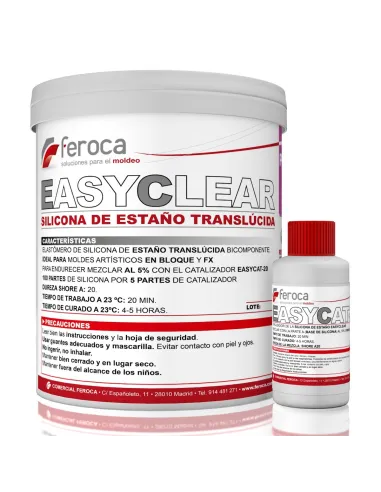
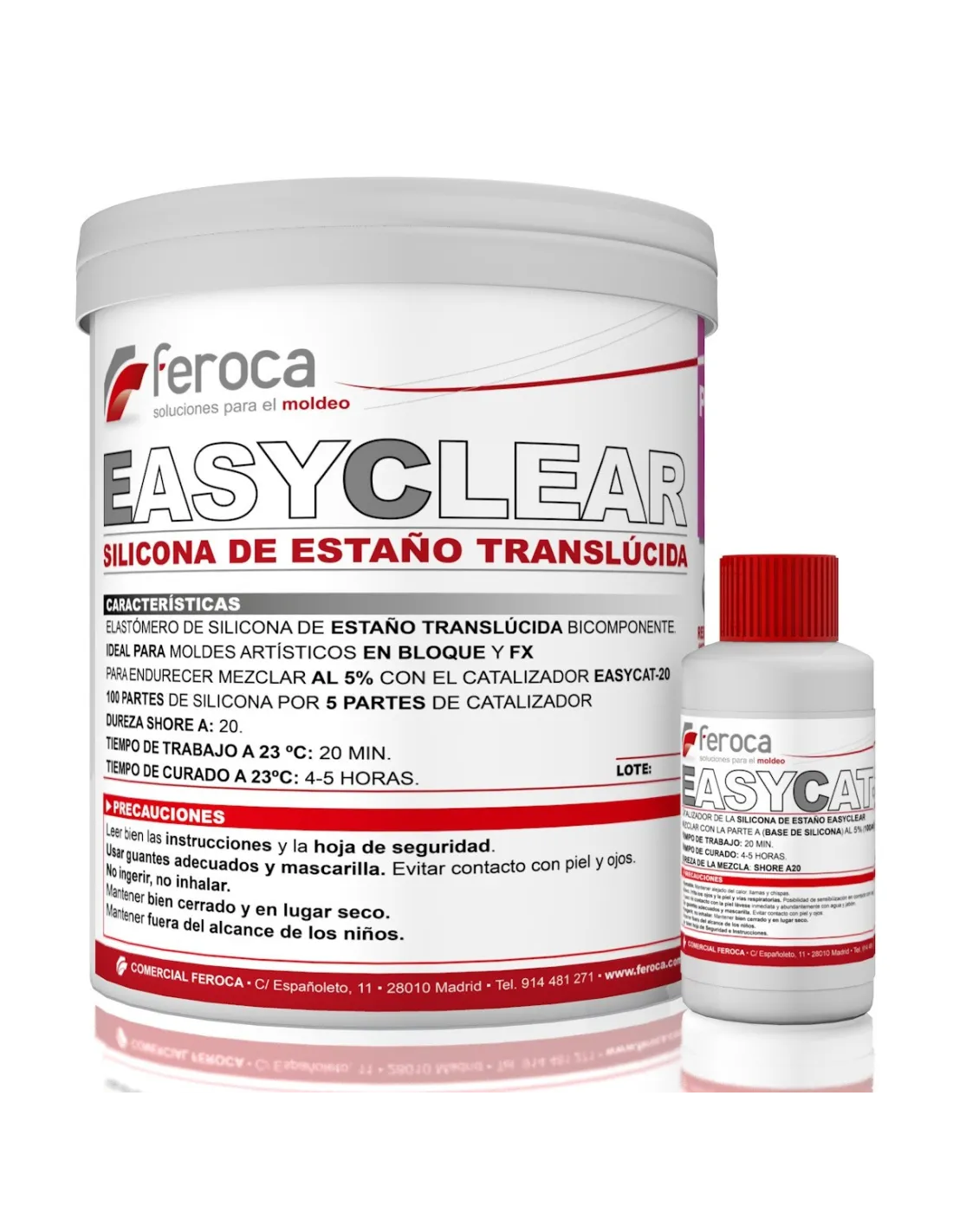
EASYCLEAR is a two-component condensation (tin) translucent silicone with Shore A20 hardness that cures at room temperature in 4-5 hours. Its translucent finish and simple mix ratio (100:5 by weight) make it a highly practical choice when you need to see the original through the mould, locate parting lines with precision, or work on special effects projects requiring a soft, semi-transparent material.
Technical specifications
| Parameter |
Value |
| Silicone type |
Condensation (tin) |
| Colour |
Translucent |
| Shore Hardness |
A20 |
| Mix ratio (by weight) |
100A : 5B |
| Pot life |
20 min |
| Cure time |
4-5 hours at room temperature |
| Mixed viscosity |
13,000 cps |
| Elongation at break |
400% |
| Tensile strength |
33 kgf/cm² |
| Shelf life (25 °C) |
3 months opened and 6 months closed |
What it's used for
Thanks to its translucency, EASYCLEAR is especially useful in situations where being able to see the original through the mould makes a real difference: locating the exact parting line, controlling piece centring, or simply working with greater confidence on complex geometry parts. It is compatible with the most common casting materials used in the workshop:
- Block moulds for parts with complex geometry or difficult demoulding
- Cut moulds where translucency allows you to locate the exact parting plane before opening
- Plaster and gypsum castings
- Polyurethane, polyester and epoxy resin castings
- Fibreglass castings
- Moulds for wax and handmade soap
- Hyperrealism pieces and special effects (FX) requiring a soft, translucent material
How to use it
- Prepare the original and the mould box. Clean the original piece thoroughly and build the mould box to the appropriate size. Apply a Release agent such as Ferosil V 32 if the original material could bond to the silicone.
- Weigh the components. Mix 100 parts of base (component A) with 5 parts of catalyst (component B) by weight. A precision scale is essential to maintain the correct ratio.
- Mix thoroughly. Stir slowly and evenly for 2-3 minutes, scraping the sides and bottom of the container carefully to avoid uncatalysed areas.
- Degas if you have a vacuum chamber. Applying vacuum for 1-2 minutes eliminates air bubbles and improves detail reproduction. If you don't have a vacuum chamber, pour in a thin stream from a height to reduce air entrapment.
- Pour over the original. Do so slowly and continuously, starting from the lowest point of the mould box so that air is displaced upwards. If you need higher viscosity for vertical applications, add Thixo Additive before adding the catalyst.
- Allow full cure. Leave to cure for 4-5 hours at room temperature (minimum 20°C) without moving the mould. At lower temperatures the cure time increases; avoid working below 15°C.
- Demould carefully. Remove the mould box and extract the silicone mould. Clean any Release agent residue before the first casting.
Tips and advice
Temperature and humidity: key factors in curing
Condensation silicones cure by reacting with ambient moisture. In very dry environments (relative humidity below 40%) the cure may slow down or remain incomplete in the inner areas of the mould. Ideal working conditions are between 20°C and 25°C with a relative humidity of 50-60%. If your workshop is dry, slightly humidifying the environment will speed up the process.
How to make the most of the translucency when marking the parting line
The great advantage of EASYCLEAR over opaque silicones is that you can mark the parting line from the outside of the cured mould, without having to open it blind. Once cured, place the mould over a light source and use a marker or needle to trace the cut path before inserting the scalpel. This reduces the risk of damaging the original piece or the mould cavity itself.
Speeding up the cure with EasyCat 3520
If you need to reduce the pot life or cure time, you can use the EasyCat 3520 Catalyst as an accelerator. Bear in mind that increasing the catalyst proportion beyond the recommended ratio can reduce the final mechanical properties of the mould: always adjust within the margins specified by the manufacturer.
Frequently asked questions
How many copies can I get from a condensation silicone mould?
With a well-maintained condensation silicone mould you can get approximately 30-40 copies in good condition. EASYCLEAR, being Shore A20, is a soft material that makes demoulding of undercut pieces easier, helping to preserve the mould over more cycles. Using a Release agent with each casting extends the mould's service life.
Can I use this mould to cast epoxy resin?
Yes. EASYCLEAR is compatible with epoxy, polyurethane and polyester resins. Bear in mind that freshly mixed epoxy resin can inhibit platinum silicones, but it does not affect condensation silicones like EASYCLEAR. Always apply a Release agent before casting to facilitate demoulding and extend the mould's life.
Can I add pigment to this silicone?
Yes, you can pigment EASYCLEAR with silicone-compatible pigments. Bear in mind that adding pigment will reduce or eliminate the translucency, which is precisely the defining feature of this product. If you need an opaque, coloured mould, consider other products in our catalogue. Do not exceed 3% pigment by weight relative to the total mix, to avoid altering the mechanical properties or the cure.
Is it suitable for Food Safe moulds?
No. EASYCLEAR is a condensation (tin) silicone and does not carry Food Safe certification. For moulds intended for food contact, it is essential to use a platinum silicone with Food Safe (FDA) grade, such as Easyl 940-FDA, and to carry out the recommended post-cure.
Can I use this silicone to make a prosthetic or body mould?
No. Condensation silicones are not suitable for skin contact, especially for full body moulds or sensitive areas. For Life Casting or dermal prosthetics applications, it is necessary to use platinum silicones specifically formulated for that purpose.
Can the cure be accelerated by increasing the amount of catalyst?
In moderation, yes. Slightly increasing the catalyst proportion reduces the cure time, but excessive amounts can degrade the mechanical properties of the mould (lower strength, increased brittleness). A more controlled alternative is to use the EasyCat 3520 Catalyst following the manufacturer's instructions.
What is the difference between a tin silicone and a platinum silicone?
Tin (condensation) silicones like EASYCLEAR are more affordable and ideal for general-purpose moulds, with a service life of approximately 30-40 copies. Platinum (addition) silicones are more durable (60-80 copies or more), support Food Safe grade and are compatible with skin contact applications. However, platinum silicones are sensitive to inhibition upon contact with certain materials (sulphur, latex, fresh epoxy, etc.), which does not affect tin silicones.
Can I make a cut mould with this silicone?
Yes, and this is precisely one of the most valued uses of EASYCLEAR. Its translucency allows you to see the original inside the cured silicone block and mark the cut path precisely before inserting the scalpel. This is especially useful on parts with complex geometry where a poorly placed cut could ruin the mould.
How much product do I need?Calculate the exact quantity before buying and avoid wasting material.
Go to the calculator →