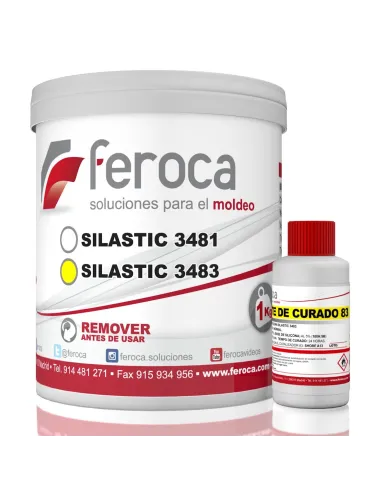
Silastic 3483 is a condensation (tin) silicone with low Shore A13 hardness, formulated for making flexible moulds with high chemical resistance for casting polyurethane, polyester and epoxy resins. Its excellent elasticity facilitates demoulding of parts with complex undercuts, and its low modulus makes it a solid choice when the original has fine relief details or delicate geometries. Available in three catalyst variants — standard, fast and very fast — to suit any workshop's timing requirements.
Technical specifications
Parameter
Cat. S83 (Standard)
Cat. 81F (Fast)
Cat. 81VF (Very fast)
Cure type
Condensation (tin)
Condensation (tin)
Condensation (tin)
Colour
White
White
White
Mix ratio (by weight)
100A : 5B
100A : 5B
100A : 5B
Mixed viscosity (mPa·s)
17,000
17,000
17,000
Working time at 23 °C
90–120 min
30–45 min
8–10 min
Demould time at 23 °C
24 h
5 h
2 h
Shore Hardness A
13
15
17
Tensile strength
4.9 MPa
—
—
Shelf life (25 °C)
3 months opened and 6 months closed
What it is used for
Silastic 3483 is designed for making flexible moulds when the casting material is a reactive resin. Its low hardness and good flow make it especially suitable for originals with fine relief details, pronounced bas-reliefs or geometries with undercuts where a harder silicone would compromise mould integrity during demoulding. It is also widely used in decorative moulding and for wax casting of candles, thanks to its Shore A13 which allows extraction without distorting the piece.
Moulds for two-component polyurethane resin casting
Moulds for polyester and epoxy resins
Artistic reproductions, sculptures and decorative pieces
Moulds for wax candles with complex geometries
Replication of originals with pronounced undercuts or fine bas-reliefs
Series production of workshop parts where an agile and cost-effective mould is needed
Industrial prototypes where the number of copies does not justify a platinum silicone
How to use it
Prepare the original. Make sure it is clean, dry and free from dust or grease. If the original is porous (plaster, wood, ceramic), apply a coat of Ferosil V 32 Paste Release Agent to facilitate demoulding and seal the surface.
Build the mould box. Surround the original with a watertight mould box (foam board, wood, sulphur-free clay, etc.) leaving at least 1–1.5 cm of lateral and top clearance to ensure adequate mould wall thickness.
Weigh the components. Mix by weight: 100 parts base (component A) to 5 parts catalyst (component B). Use a precision scale; volume ratio is not reliable with condensation silicones.
Mix. Add the catalyst to the base and mix with a spatula or rod for 2–3 minutes, scraping the sides and bottom of the container thoroughly until a uniform colour is achieved. Avoid mixing too vigorously to prevent air entrapment.
Degas (recommended). If you have a vacuum chamber, apply vacuum for 2–3 minutes to remove any trapped bubbles from the mixture before pouring.
Pour. Pour the silicone from a raised point in a thin stream to minimise bubbles. Fill the mould box until the original is covered with at least 1 cm of silicone above it.
Cure. Allow to cure at room temperature (23 °C) for the demould time corresponding to the chosen catalyst (2 h with 81VF, 5 h with 81F, 24 h with S83). Higher temperature and humidity speed up curing.
Demould. Remove the mould box, carefully extract the silicone mould and separate the original. The mould is ready to use.
Usage tips
Choose the catalyst according to available time
The S83 catalyst (standard) with 90–120 min working time is best when you have a large or complex original and need time to pour carefully and degas. The 81F (fast) is practical in production environments when moulding is repetitive and moulds are small. Reserve the 81VF (very fast) for manual brush-on applications or when you need the mould in under two hours; with only 8–10 min of working time, vacuum chamber degassing is essential.
Work with the silicone at a controlled temperature
Silastic 3483 is temperature-sensitive: below 18 °C curing slows down noticeably and interlayer adhesion issues may arise if you build the mould in stages. Above 30 °C working time shortens considerably, especially with the fast catalysts. Ideally work between 20–25 °C. If you need to increase flow without changing final hardness, you can add DC Fluid 50 silicone oil — formulated specifically for tin silicones — at a maximum ratio of 10%.
Reinforce the mould with fabric if greater structural rigidity is needed
Since Silastic 3483 has Shore A13, large moulds or those with thin walls may distort when dense resins are poured. To prevent this, apply a first layer of silicone, allow it to gel and lay a cotton fabric or fibreglass mesh before pouring the rest. You can also make a rigid shell (mother mould) from plaster or rigid polyurethane resin once the silicone mould has cured. If you need the silicone to adhere to vertical walls without sagging during the first layer, mix in Thixo Additive Thixotropic Additive for Silicones until the desired consistency is achieved.
Frequently asked questions
How many reproductions can a condensation silicone mould withstand?
With proper use and storage, moulds made with Silastic 3483 yield between 30 and 40 copies. Service life depends on the type of resin cast, the chemical aggressiveness of the resin catalyst, and how the mould is cleaned and stored between uses. Storing the mould clean, in a cool place away from UV light significantly extends its service life.
Can I cast epoxy resin directly in this type of mould?
Yes. Silastic 3483 has very good chemical resistance to epoxy, polyester and polyurethane resins. However, with highly exothermic epoxy resins it is advisable to cast in thin layers to avoid subjecting the mould to excessive temperatures that could deform or prematurely degrade it.
Is it necessary to apply a release agent before pouring the silicone?
It depends on the material of the original. Condensation silicone does not adhere to most non-porous surfaces (metal, glass, polypropylene), so it is not always essential. However, for originals made of plaster, wood, ceramic, stone or any porous surface, applying Ferosil V 32 is highly recommended to facilitate demoulding and prevent the silicone from penetrating the pores of the original.
What is the difference between a condensation silicone and an addition silicone?
Condensation silicones (such as Silastic 3483) cure by reaction with ambient moisture and release a by-product (ethanol or acetone). They are more economical and versatile, though with a shorter mould life (30–40 copies) and not suitable for Food Safe use or prosthetics. Addition (platinum) silicones cure without by-products, offer longer mould life (60–80 copies), can be Food Safe grade and are compatible with prosthetics materials. Their main limitation is inhibition on contact with certain materials.
Can I add pigment to the silicone to identify layers or customise the mould?
Yes, you can add silicone-specific pigments. The maximum recommended proportion is 3% by weight on the base so as not to alter the mechanical properties or the cure. Exceeding that percentage may retard curing or modify the final hardness of the mould.
Can this type of silicone be used to make candle moulds?
Yes, Silastic 3483 is one of the most common choices for wax candle moulds. Its Shore A13 allows candles with complex geometries or fine ribs to be demoulded without damaging the piece, and wax does not react with condensation silicone. For scented candles it is advisable to verify that the essential oils or fragrances used do not contain components that could migrate into the silicone and degrade it over time.
Is it compatible with expanding or flexible polyurethane resins?
Yes, as long as the polyurethane resin is a standard two-component casting system. Expanding polyurethane resins generate heat and internal pressure during curing; in that case the mould should have sufficiently thick walls (minimum 1.5–2 cm) and be contained within a rigid shell to prevent distortion. If you are starting out with polyurethane resins, the Moulding Kit for Resins is a good starting point.
What is the difference between Silastic 3483 and Silastic 3481?
The main difference is hardness: Silastic 3481 has Shore A24 while Silastic 3483 has Shore A13. The 3483 is softer and more elastic, making it more suitable for originals with pronounced undercuts or when you need a very flexible mould. The 3481, with its greater hardness, provides dimensionally more stable moulds for simpler geometries or when less deformation during casting is required.
How much product do I need?Calculate the exact amount before buying and avoid wasting material.
Cookies on this site are used to personalise content and ads to deliver social media features and to analyse traffic. We also share information about your use of the site with our social media partners for advertising, personalisation and web analytics.. More information.