Shopping Cart


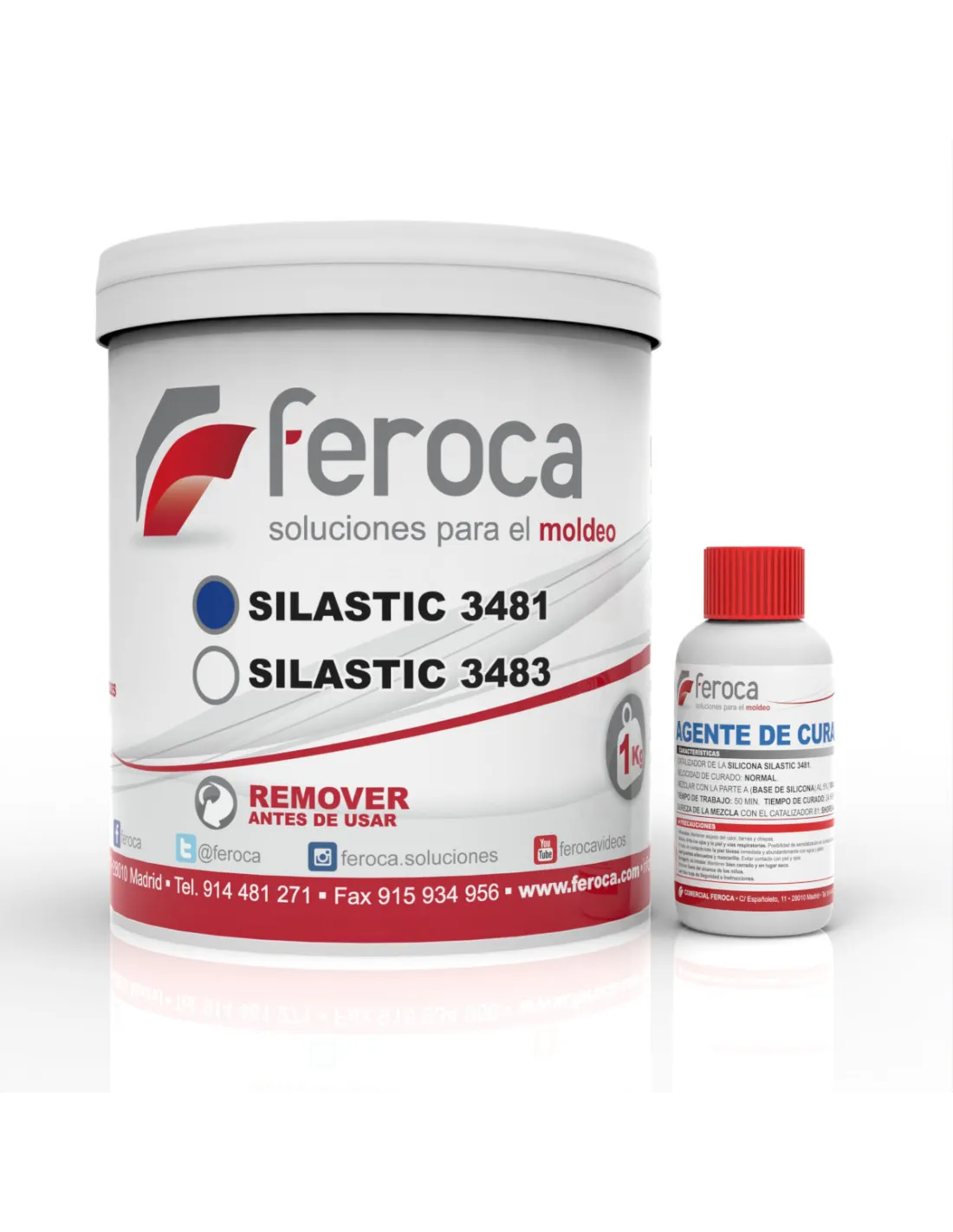
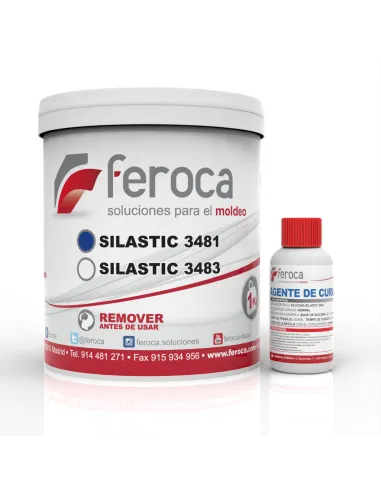
Silastic 3481 Base + Catalyst
201348101
€27.00
32,67 € Tax incl.
32,67 € Tax incl.
Condensation silicone Shore A21. Ratio 100:5, 90 min working time. Resistant to epoxy, polyurethane and polyester resins. 3 catalysts available.
Silastic 3481 is a high chemical resistance condensation (tin) silicone, specifically formulated to produce durable moulds with prolonged contact with epoxy, polyurethane and polyester resins. With a Shore A21 hardness, high flowability and three available cure speeds, it adapts to any production pace in the workshop — from long production runs to one-off artistic reproduction or jewellery work.
Technical specifications
| Parameter | Curing Agent 81 (Standard) | Curing Agent 81F (Fast) | Curing Agent 81VF (Very Fast) |
|---|---|---|---|
| Colour | White | White | White |
| Mix ratio (by weight) | 100A : 5B | 100A : 5B | 100A : 5B |
| Working time at 23 °C | 90–120 min | 30–45 min | 8–10 min |
| Demould time at 23 °C | 24 hours | 5 hours | 2 hours |
| Shore Hardness A | 21 | 22 | 22 |
| Mixed viscosity (mPa·s) | 25,000 | 25,000 | 25,000 |
| Tensile strength (MPa) | 4.9 | 4.0 | 4.0 |
| Cure type | Condensation (tin) | ||
| Shelf life (25 °C) | 3 months opened and 6 months closed | ||
What it's used for
Silastic 3481 is designed for repetitive production of flexible moulds where the casting material is chemically aggressive. Its formulation resists the progressive degradation caused by resins, making it a standard reference in reproduction workshops, jewellery, architectural decoration and special effects where mould durability is critical.
- Moulds for casting epoxy, polyurethane and polyester resins
- Reproduction of figures, statuettes and decorative pieces in series
- Moulds for jewellery and costume jewellery with resin
- Recreation of architectural textures and reliefs
- Production of decorative elements for set design and special effects
- Duplication of original pieces for industrial prototypes
How to use it
- Prepare the original: make sure the original piece is clean, dry and dust-free. If it is porous (plaster, wood, ceramic), apply one or two coats of Ferosil V 32 Release agent and allow to dry completely before pouring the silicone.
- Build the mould box: surround the original with a watertight mould box (foam board, wood, polystyrene) leaving at least 10–15 mm of clearance all around and above the piece.
- Weigh the base: calculate the required amount of Silastic 3481 Base and weigh it accurately using a scale with at least 1 g resolution.
- Add the catalyst: incorporate the chosen catalyst at a ratio of 5 parts per 100 parts of base (by weight). If you need greater flowability to capture fine details, you can add a few drops of thixotropic additive before mixing.
- Mix slowly: stir for 3–5 minutes with slow movements, scraping the walls of the container to ensure a homogeneous mix and minimise air bubble entrapment.
- Pour the silicone: pour in a thin stream from the lowest point of the mould box, letting the silicone rise and cover the original on its own. This reduces bubble formation on the detail surface.
- Allow to cure: respect the demould time according to the chosen catalyst (2 h with 81VF, 5 h with 81F, 24 h with the standard 81). Do not force demoulding ahead of time.
- Demould and clean: carefully remove the mould, clean off any mould box residue and let the mould rest for at least 1 additional hour before the first casting to ensure complete cure.
Usage tips
Choose the catalyst to match your working pace
The standard catalyst (81) is the most versatile: with 90–120 minutes of working time you can degas in a vacuum chamber, fill complex mould boxes or work on large pieces without rushing. The fast catalyst (81F) is useful when you need to speed up production but still control the pour. The very fast (81VF) is designed for small moulds or brush-on layering applications where cycle time matters. Never mix catalysts together.
Temperature and humidity affect the cure
Condensation silicones cure by reaction with ambient moisture. The higher the temperature and relative humidity, the faster the cure. Below 15 °C the process can slow down considerably. If you work in summer or in a humid workshop, bear in mind that the working times stated are indicative at 23 °C and 50% RH. In winter or with heavy air conditioning, add a safety margin.
Pigmentation and viscosity adjustment
You can colour Silastic 3481 with silicone-compatible pigments at a maximum proportion of 3% by weight of the total mix. Exceeding that percentage can affect the cure and the mechanical properties of the mould. If you need a thicker consistency for brush application on vertical or detail areas, use Thixo Additive to increase thixotropy without compromising the cure.
Frequently asked questions
How many copies can I get from a condensation silicone mould?
With Silastic 3481 you can expect between 30 and 40 copies under normal conditions of use with resins. Mould life depends on the casting material, the chemical aggressiveness of the resin and care taken during demoulding. For longer runs (60–80 copies), consider a platinum silicone.
Can I use this silicone for Food Safe applications?
No. Silastic 3481 is a condensation (tin) silicone and is not certified for Food Safe use. For chocolate, confectionery or ice cube moulds you must use a platinum silicone with FDA certification, such as Easyl 940-FDA, including the recommended post-cure at 100 °C for 4 hours.
Can I cast platinum silicone inside a mould made with this silicone?
No. Tin silicone inhibits the cure of platinum (addition) silicones. If you need final pieces in platinum silicone, the mould must also be made of platinum silicone. Both families are not compatible in direct contact.
Is it necessary to apply a Release agent before pouring the silicone?
It depends on the material of the original. On non-porous surfaces (metal, ABS plastic, already cured resin) Silastic 3481 generally does not adhere and no Release agent is required. However, on porous materials (plaster, wood, cardboard, unglazed ceramic) it is essential to seal the surface with a Release agent such as Ferosil V 32 to prevent absorption and facilitate demoulding. On polychrome or fragile pieces always apply Release agent and carry out a prior test on a non-visible area.
Can I add more catalyst to speed up the cure?
Not recommended. Increasing the catalyst proportion above 5% does not significantly speed up the cure and can produce a mould with worse mechanical properties, more brittle and with lower tensile strength. If you need greater speed, choose the 81F or 81VF catalyst directly.
What is the difference between Silastic 3481 and Silastic 3483?
The main difference is hardness. Silastic 3481 has a Shore A21 hardness, while Silastic 3483 is softer, with Shore A13. For moulds of pieces with pronounced undercuts or complex geometries, the 3483 makes demoulding easier. For moulds requiring greater rigidity and dimensional stability, the 3481 is the right choice.
Can I use silicone oil to reduce the viscosity of the mix?
Yes, silicone oil (DC Fluid 50) is compatible with condensation silicones such as Silastic 3481 and allows viscosity to be reduced to improve filling of fine details. However, excessive use can reduce the final hardness of the mould and its mechanical resistance. Use it sparingly and always carry out a prior test.
Can I pigment the silicone and in what quantity?
Yes, you can add silicone-specific pigments to Silastic 3481. The maximum recommended proportion is 3% by weight of the total mix (base + catalyst). Exceeding that limit can interfere with the cure and alter the mechanical properties of the resulting mould.
Video tutorials
2 · Tutorial: One-part silicone mould
3 · Tutorial: Two-part silicone mould
7 · Tutorial: Silicone mould with shell
8 · Brush-on mould with fibreglass shell
Simbiox Sculpting Armature and Rotomolding
- Color
- White
- Working Time
- 90min
- Curing Time
- 24horas
- Shore Hardness
- A21
- Mixed Weight Ratio
- 100A:5B
No reviews
Tap to zoom