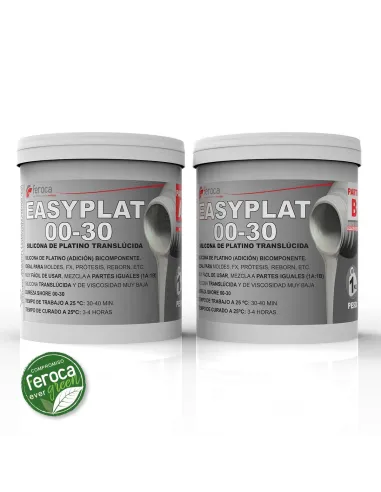
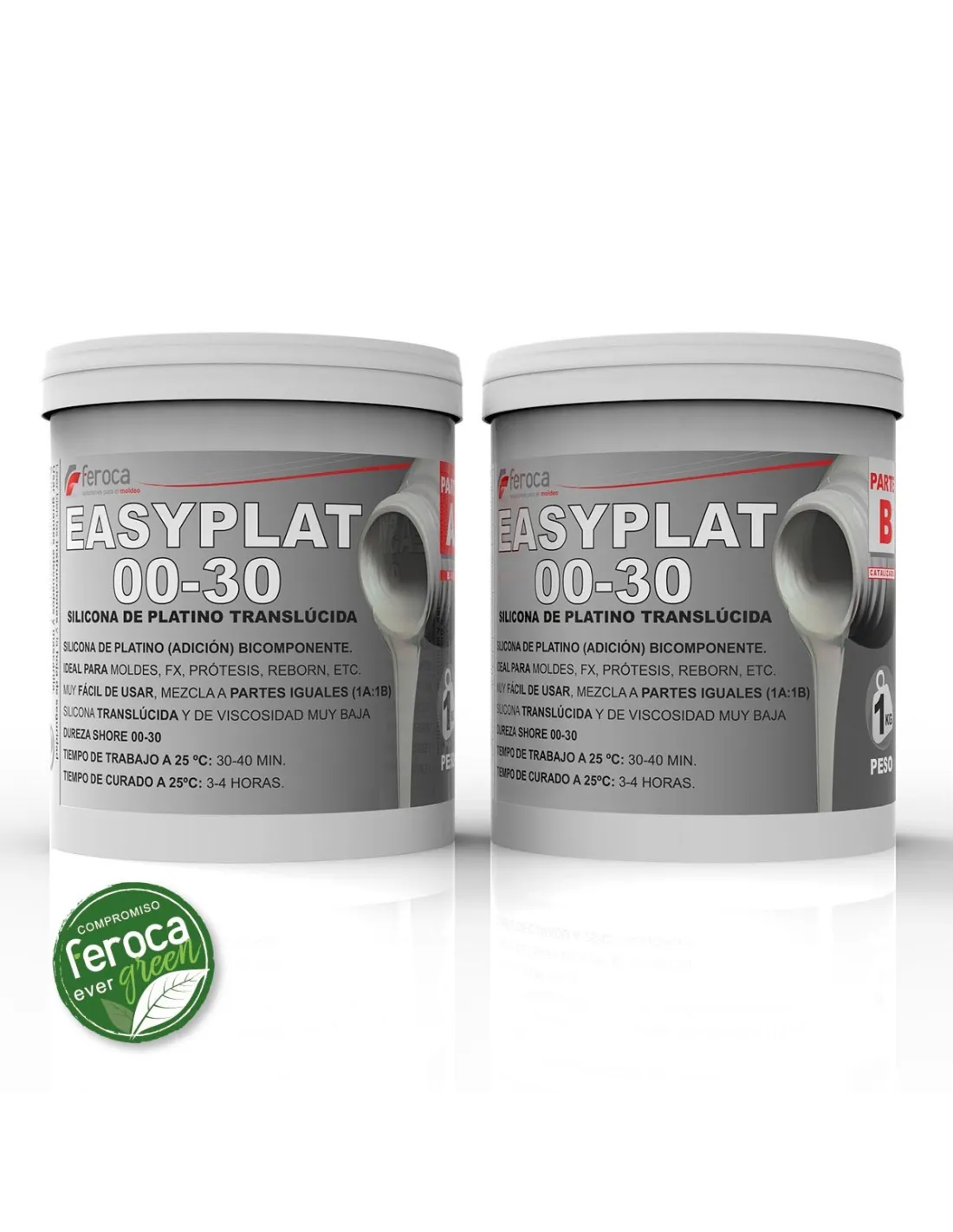
Translucent Shore 00-30 platinum silicone. 1:1 mix ratio by weight and volume, 30-40 min working time, 3-4 h cure. For FX prosthetics, animatronics and Reborn dolls.
EASYPLAT 00-30 is a two-component platinum (addition) silicone with Shore 00-30 hardness and a translucent finish. Its 1:1 mix ratio by weight and volume simplifies the process, and its extremely low viscosity combined with its extraordinary softness after curing make it the go-to material for prosthetics, special effects and hyperrealistic replicas that demand skin-like feel. If you're looking for an ultra-soft silicone that allows intrinsic pigmentation and featherable edges, this is your option.
Technical specifications
Parameter
Value
Cure type
Platinum (addition)
Colour
Translucent
Shore Hardness
00-30
Mix ratio by weight
100A : 100B
Mix ratio by volume
100A : 100B
Working time at 25 °C
30-40 min
Cure time / demould time at 25 °C
3-4 hours
Tensile strength
≥ 0.85 MPa
Tear resistance
≥ 2.4 kN/m
Mixed viscosity
2800 mPa·s
What it's used for
Thanks to its ultra-soft hardness and translucent appearance, EASYPLAT 00-30 adapts to any application where the final material must mimic the feel and look of human skin or reproduce high-resolution details with maximum fidelity.
Special effects (FX) prosthetics and character makeup for film and theatre
Animatronic parts requiring smooth movement and realistic elastic response
Manufacturing of Reborn dolls and sex dolls with hyperrealistic finish
Body part replicas and fine-detail sculptures
Silicone masks and intrinsically pigmented artificial skins
Anaplastology prosthetics (nipple, ear, nose) with custom pigmentation
Flexible moulds for casting resins, waxes and plasters on pieces with moderate undercuts
Encapsulation of soft prosthetics combined with deadener for added softness
How to use it
Prepare the original surface. Make sure the model is clean and dry. If the original is porous (plaster, gypsum, wood), apply a coat of sealer or Release Agent 34D to prevent adhesion and facilitate demoulding.
Weigh or measure the components. Mix part A and part B in a 100:100 ratio by weight or by volume. Use a precision scale for best results, although the 1:1 ratio also allows the use of graduated containers.
Add pigments or additives (optional). If you need intrinsic colour, incorporate Silicone Pigments or Key-Pigments for FX before mixing A and B. If you want a thicker consistency for brush application or layering, add Thixo Additive in small amounts.
Mix A and B. Stir slowly and evenly for 2-3 minutes, scraping the sides and bottom of the container thoroughly. Avoid incorporating excess air.
Degas (recommended). If you have a vacuum chamber, subject the mixture to vacuum for 1-2 minutes to remove bubbles, especially for fine-detail moulds or prosthetic pieces.
Pour or apply. You have a working time of 30-40 minutes at 25 °C. Pour in a thin stream from an elevated point to encourage trapped air to escape, or apply by brush layer by layer if you have added thixotropic agent.
Allow to cure. At room temperature (25 °C), the material will be ready to demould in 3-4 hours. Do not accelerate curing with heat in the presence of heat-sensitive materials.
Demould carefully. The high elongation of EASYPLAT 00-30 allows pieces with undercuts to be extracted without damaging the mould or the reproduced piece.
Warning: platinum silicone inhibition
Addition-cure (platinum) silicones are sensitive to inhibition. Contact with the following materials may prevent full or partial curing, leaving the surface tacky:
Sulphur-based clays and plasticines (most conventional modelling plasticines)
Tin (condensation) silicones — do not use tin silicone moulds as a direct support
Latex in any form
Polyester and epoxy resins freshly cast or not fully cured
Uncured urethane rubbers
Vinyl
Petroleum jelly (Vaseline) and some tin silicone-based release agents
Always perform a compatibility test on a small area of the original before proceeding with the full mould.
Usage tips
Temperature control to adjust timing
Ambient temperature directly affects working time and curing. At temperatures above 25 °C, working time shortens and curing is faster; below 20 °C, it lengthens. In summer or in warm workshops, chill the components before mixing to gain extra time. Never work below 18 °C if you want to guarantee a complete cure within the stated timeframe.
Pigmentation and deadener for soft prosthetics
For encapsulated prosthetics, you can further soften the material by adding deadener (silicone plasticiser) at an approximate ratio of 180-200% of the total mix (1A : 1B : 180-200% deadener). Incorporate Key-Pigments for FX directly into the mix to achieve realistic skin tones. The translucent finish of EASYPLAT 00-30 facilitates layering of different tones, mimicking the chromatic depth of human skin.
Using thixotropic agent and mother mould
When working with large pieces or in a vertical position, add Thixo Additive to increase viscosity and brush the silicone on without it dripping. Note that the thixotropic agent does not alter the cure time. For soft silicone moulds like this one, always use a rigid mother mould (plaster, resin or fibreglass) to support the piece during casting of the reproduction material and prevent deformation.
Frequently asked questions
Why has my platinum silicone remained tacky after curing?
The most likely cause is inhibition through contact with an incompatible material. The main culprits are sulphur-based clays, latex, tin silicones, uncured epoxy or polyester resins, and vinyl. With EASYPLAT 00-30, always perform a compatibility test on a small area before applying to the full original. If the model surface is suspect, seal it with lacquer or shellac and allow to dry completely before pouring the silicone.
Can I use a tin silicone mould to reproduce pieces with platinum silicone?
No. Platinum silicone does not cure on tin silicone because it inhibits the platinum catalyst. If you need to make the mould with condensation silicone, you will not be able to cast EASYPLAT 00-30 directly into it. In that case, use moulds made from another material (polyurethane, plaster) or work with platinum silicones throughout the entire process.
How long should I wait before demoulding?
At 25 °C, EASYPLAT 00-30 reaches sufficient cure to demould in 3-4 hours. If the temperature is lower, extend the waiting time. Do not force demoulding before that period even if the surface appears dry: the interior may not have fully cured, which would compromise the final mechanical properties.
Is a vacuum chamber necessary to work with this silicone?
It is not essential, but highly recommended when seeking maximum detail or working on professional-quality prosthetic pieces. The low viscosity of EASYPLAT 00-30 (2800 mPa·s) already helps bubbles rise on their own, but degassing in a vacuum chamber guarantees a completely pore-free result.
How is an anaplastology prosthesis made with this silicone?
The standard process includes: taking an impression of the area to be replicated (with a lifecast silicone such as EASYGEL Silk Cast), obtaining the positive in plaster, applying release agent between silicone surfaces, mixing EASYPLAT 00-30 with the appropriate Silicone Pigments for the skin tone, casting or brushing on and curing. For edge encapsulation and blending with the patient's skin, the use of an encapsulant (Key-cap Plastic) is recommended.
Can I add deadener to obtain an even softer silicone?
Yes. For encapsulated prosthetic applications, the recommended ratio is 1A : 1B : 180-200% deadener. Bear in mind that by increasing the plasticiser percentage to that extent, the resulting material will be extremely soft and must always be encapsulated to maintain its integrity.
Can I use this silicone to make moulds of pieces with sharp angles or undercuts?
Yes. The Shore 00-30 hardness and high elongation of EASYPLAT 00-30 allow pieces with moderate undercuts to be demoulded without damaging either the mould or the piece. For very pronounced undercuts or complex geometries, consider splitting the mould into several parts.
Does the thixotropic agent alter the cure time?
No. Thixo Additive only modifies the viscosity of the mix to facilitate brush application or vertical layering. The working and cure times of EASYPLAT 00-30 remain unchanged.
How much product do I need?Calculate the exact amount before buying and avoid wasting material.
Cookies on this site are used to personalise content and ads to deliver social media features and to analyse traffic. We also share information about your use of the site with our social media partners for advertising, personalisation and web analytics.. More information.