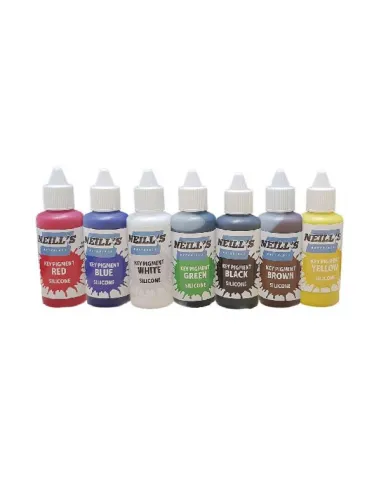
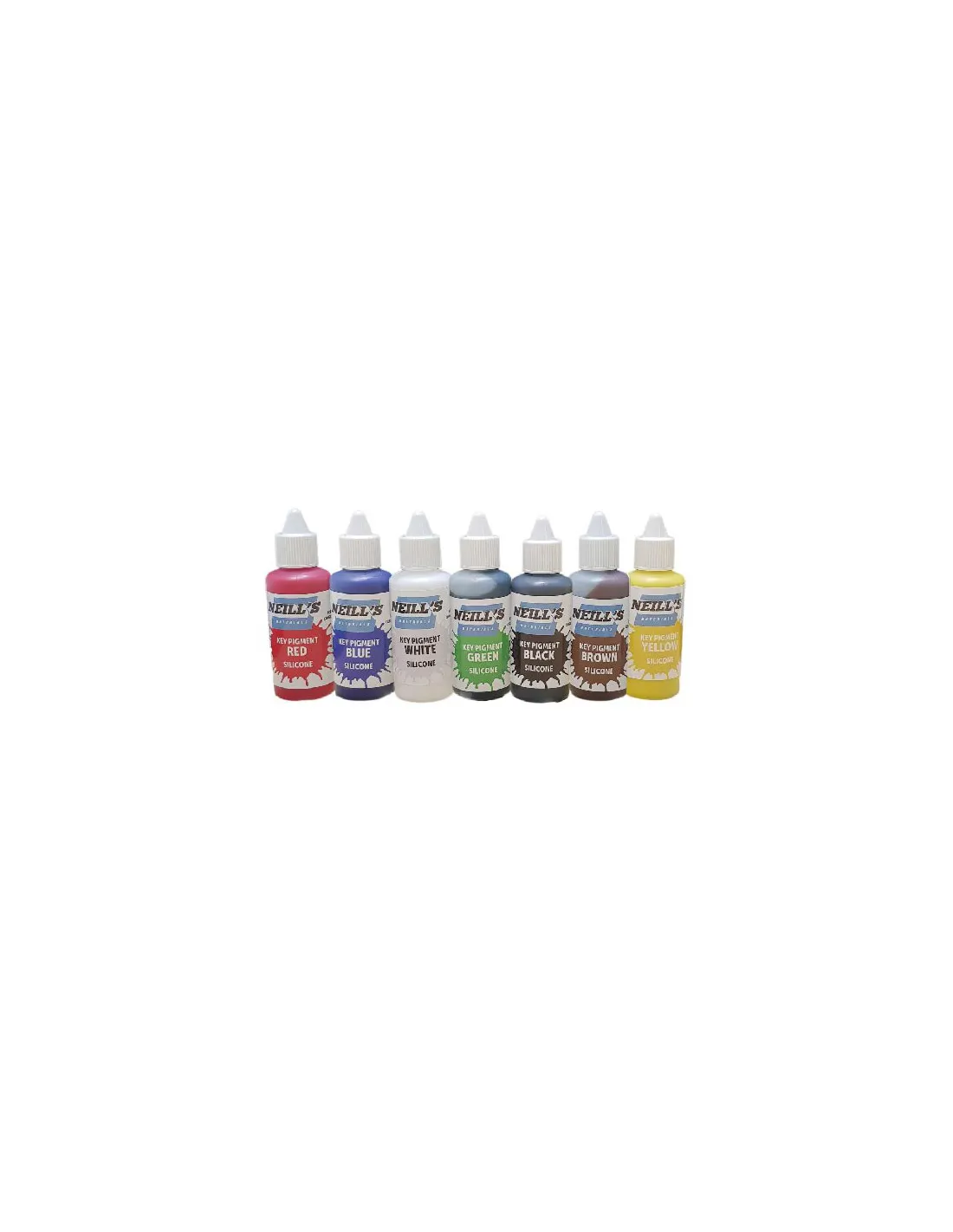
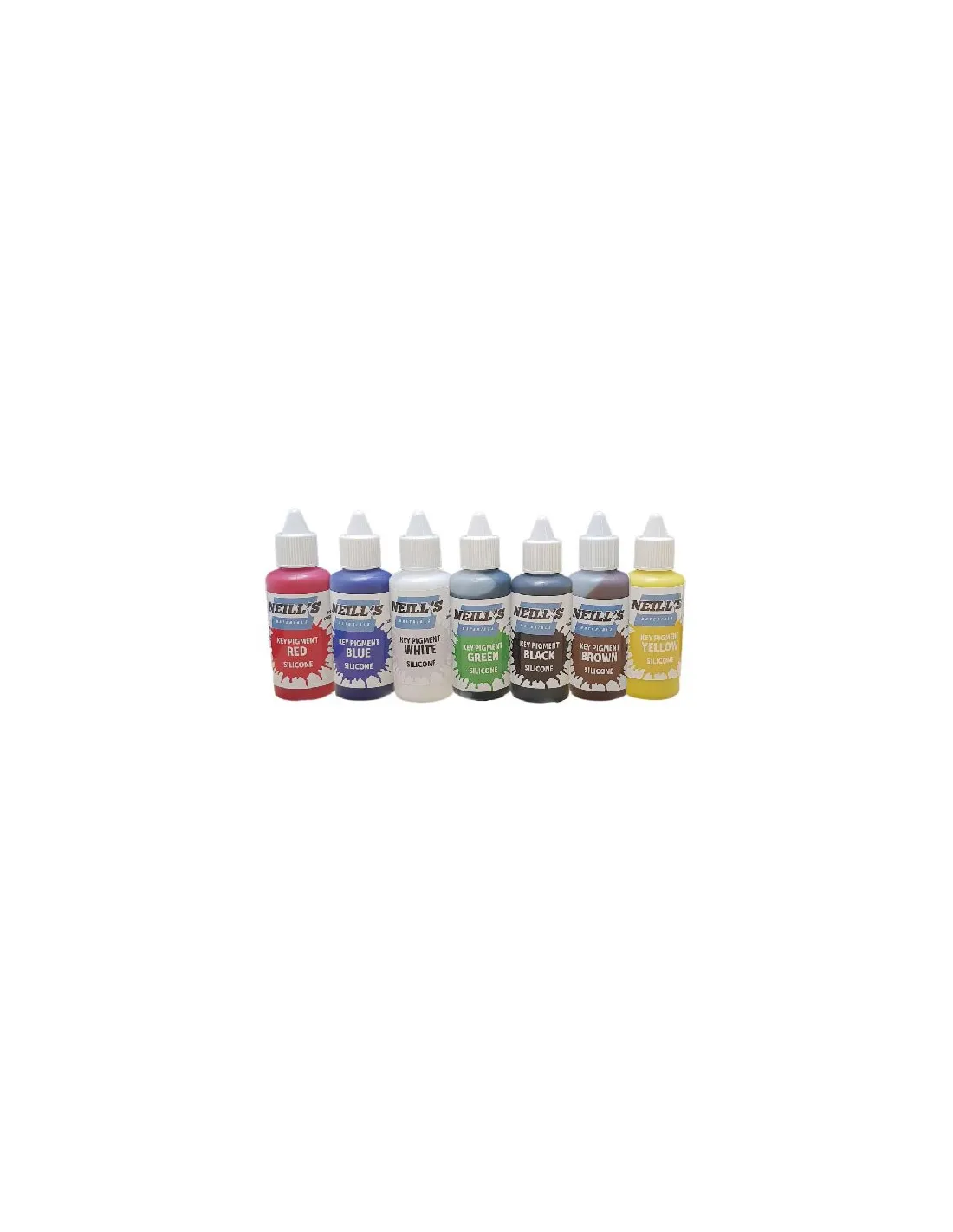
Feroca's silicone pigments are highly concentrated colorants formulated specifically for tinting platinum (addition) and tin (condensation) silicones. Their high concentration guarantees exceptional performance: a few drops are enough to achieve intense, uniform colours, making them a very economical and reliable option for the professional workshop.
Technical specifications
| Parameter |
Detail |
| Colorant type |
Silicone pigment |
| Compatibility |
Platinum (addition) and tin (condensation) silicones |
| Concentration |
High — small amounts produce intense colours |
| Presentation |
50 g container |
| Colour range |
Several shades available |
What it's used for
These pigments are designed to be incorporated directly into the liquid silicone mix before pouring or application. They are ideal in any process where coloured silicone is needed, both for layer identification and for artistic and prosthetic effects.
- Colouring silicone moulds to identify layers or registration zones
- Manufacturing prosthetics and special makeup effects with soft platinum silicones
- Creating decorative and artistic silicone pieces
- Painting on silicone when mixed with silicone paint bases
- Manufacturing figures, replicas and prop pieces
- Production of industrial or technical parts where colour is a functional indicator
- Colouring ultra-soft silicones for encapsulation or tissue simulation applications
How to use it
- Prepare your silicone components (part A and part B, or base and catalyst) according to the instructions of the product you are going to use.
- Add the desired amount of pigment to part A (or to the base) before mixing the components together. Start with a very small amount (1–2 drops or a spatula tip per 100 g of silicone) and adjust to achieve the desired shade.
- Mix the pigment with part A until you obtain a completely uniform colour with no streaks.
- Add part B (catalyst) and mix the whole batch carefully, following the working times and ratios indicated for your silicone.
- Pour or apply the coloured silicone according to the usual process (casting, brushing, injection).
- Allow to cure under the conditions recommended for the silicone used.
Important notice — Platinum silicones: If you are working with addition (platinum) silicones, make sure the pigments you use are compatible with this type of silicone. The curing of platinum silicones can be inhibited by contact with certain materials: sulphur, tin, latex, some sulphur-containing clays, cyanoacrylate adhesives or organic contaminants. Use only pigments formulated specifically for platinum silicones (such as Feroca's) and work with clean tools and surfaces free from contaminants. If curing does not occur correctly or the piece remains tacky, inhibition is the most likely cause.
Usage tips
Dosage: less is more
Given their high concentration level, it is easy to use too much. Add the pigment incrementally: mix, observe the colour and repeat until you reach the desired shade. Bear in mind that the colour may vary slightly once the silicone cures, especially in thick layers. Running a small cure test before the final work will save you from surprises.
Homogeneous mixing to avoid streaks
Always integrate the pigment into one of the components before making the final mix. If you try to add it after combining both components, it will likely not disperse evenly and streaks or uncoloured areas will appear. Use a clean spatula or mixing rod and scrape the walls of the container thoroughly throughout the process.
Colour mixing and cleaning
You can combine several pigments to achieve custom shades. Mix the pigments first in a small amount of silicone as a test before preparing the full batch. To clean tools with uncured pigment residue, use naphtha or a compatible solvent. Once the silicone has cured, the pigment is trapped in the matrix and does not stain or migrate.
Frequently asked questions
Are these pigments compatible with any type of silicone?
Yes. Feroca's silicone pigments are compatible with both platinum (addition) and tin (condensation) silicones. It is important not to use pigments from other product families (for example, pigments for epoxy resins or polyurethane) in silicones, as they can cause cure inhibition or fail to disperse correctly.
How much pigment do I need to add to my silicone?
The exact ratio depends on the desired shade, but given the high concentration level, 0.5–2% by weight relative to the total silicone is usually sufficient. Start with small amounts (1–2 drops per 100 g) and adjust to taste. Do not exceed 5% to avoid altering the mechanical properties of the silicone.
Can the pigment inhibit the cure of a platinum silicone?
Feroca's silicone pigments are formulated to be compatible with platinum silicones and do not cause inhibition. Inhibition problems arise when non-specific colorants are used (such as inks, resin pigments or incompatible organic dyes). Always use pigments designed for this type of silicone.
At what stage of the process should I add the pigment?
Always before mixing the two silicone components together. The ideal approach is to incorporate the pigment into part A (or base) and mix until you achieve a uniform, streak-free colour. Then add part B (catalyst) and mix the whole batch. This ensures perfect colour dispersion.
Can several colours be mixed to obtain custom shades?
Yes, Feroca's silicone pigments are miscible with each other and can be combined to achieve any shade. Always test in a small quantity before preparing the full batch, as the colour may vary slightly after curing.
Does the colour remain stable after curing?
Yes. Once the silicone has cured, the pigment is integrated into the material matrix and the colour is stable — it does not migrate or stain surfaces in contact. Stability to light and heat also depends on the formulation of the base silicone used.
Can they be used to paint on already-cured silicone?
Silicone pigments on their own are not a paint; they are formulated to be mixed into liquid silicone. To paint on already-cured silicone surfaces, the best approach is to use them mixed with a silicone paint base such as Plat-Paint New, which is designed specifically for application on cured silicone.
Are they suitable for skin-contact applications in special effects?
The pigments are designed for workshop use and production of silicone pieces. For applications involving direct and prolonged skin contact (prosthetics, special effects), biocompatibility also depends on the base silicone used. Consult the technical data sheets for the products and, if in doubt, contact the Feroca technical team.
How much product do I need?Calculate the exact amount before buying and avoid wasting material.
Go to the calculator →