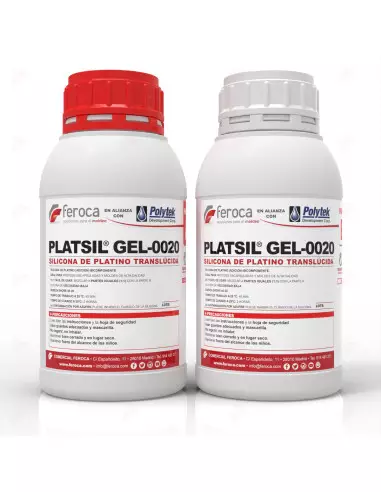
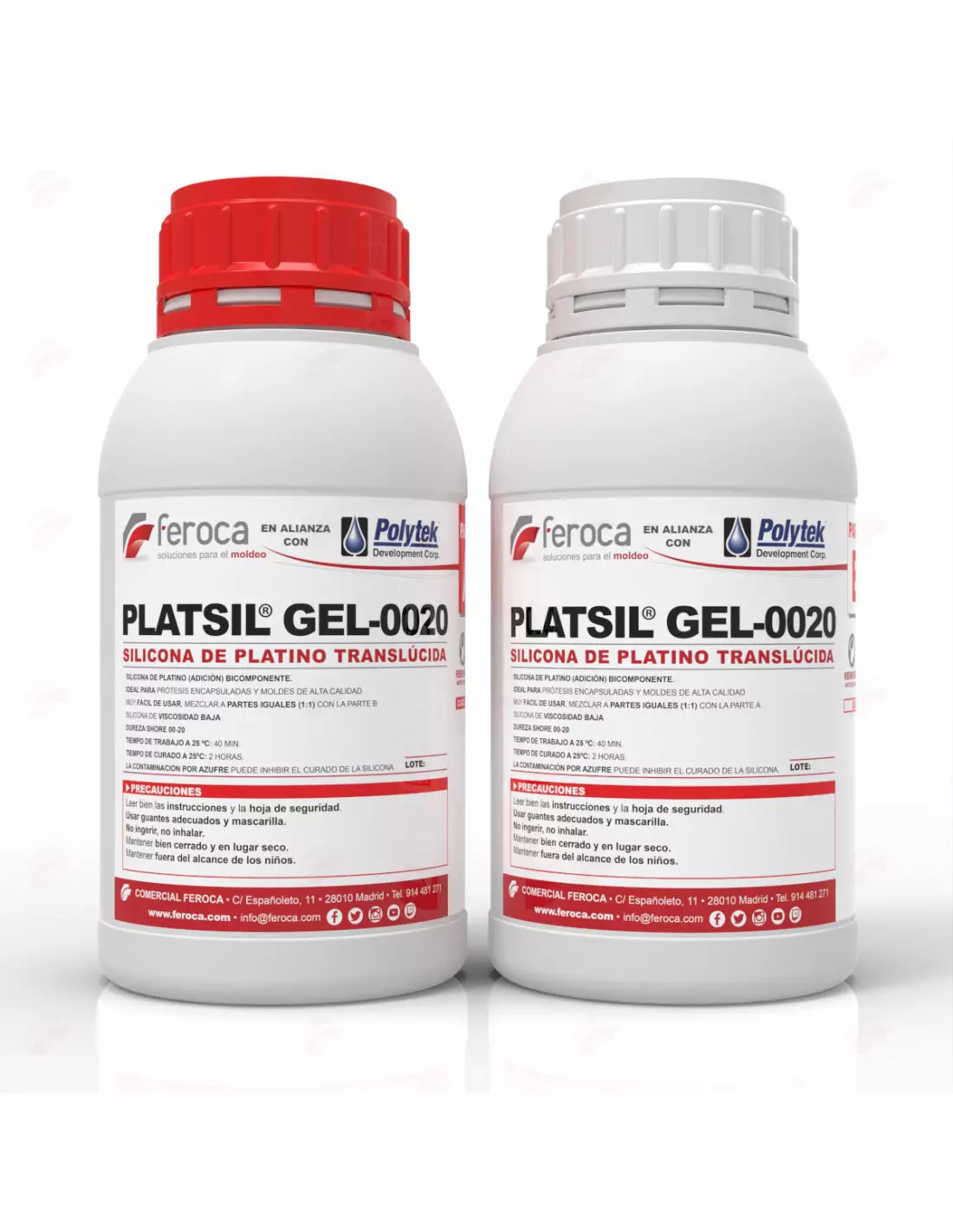
PlatSil Gel-0020 is a two-part platinum (addition) silicone with an extraordinarily low Shore Hardness (Shore 00-20), translucent and with a simple 1:1 mix ratio by both weight and volume. Developed by Polytek, it is the industry reference for special effects prosthetics, animatronics and medical simulation thanks to its extreme flexibility, reliable cure and virtually negligible shrinkage.
Technical specifications
| Parameter |
Value |
| Type |
Platinum (addition) silicone |
| Color |
Translucent |
| Shore Hardness |
00-20 |
| Mix ratio (weight) |
100A : 100B |
| Mix ratio (volume) |
100A : 100B |
| Mixed viscosity |
3,900 cP |
| Pot life (25 °C) |
40 min |
| Cure time (25 °C) |
2 hours |
| Shrinkage |
Negligible |
What it's used for
Thanks to its Shore 00-20 hardness, PlatSil Gel-0020 is the go-to choice when you need a silicone that faithfully mimics the texture and feel of human skin or soft tissue. Its translucent color makes precise pigmentation straightforward using silicone pigments or Key-Pigments for FX, achieving realistic skin tones. Typical applications include:
- Special effects (FX) prosthetics and anaplastology: ears, noses, scars, nipples, facial prosthetics
- Hyper-realistic masks and Artificial Flesh for character make-up
- High-fidelity animatronics and silicone puppets
- Medical simulation and surgical training
- Reborn babies and full-body silicone dolls
- Soft molds for delicate parts with easy demolding
- Prosthetic encapsulation (combined with deadener for extra softness)
How to use it
- Prepare the model surface: seal if porous and apply a Release agent if needed. Make sure there are no inhibiting contaminants (see warning).
- Weigh or measure parts A and B in a 1:1 ratio by weight or volume. Use a precision scale for best results.
- Mix both parts with a spatula for at least 2–3 minutes, scraping the sides and bottom of the container thoroughly for a homogeneous blend.
- If you need to thicken the mix for brush application, add PlatThix at this stage.
- To color the mix, add silicone-specific pigments in small amounts and blend until the color is uniform.
- Degas the mix in a vacuum chamber if you need bubble-free results (especially recommended for high-fidelity pieces).
- Pour or brush onto the mold or directly onto the model. You have 40 minutes of pot life at 25 °C.
- Allow to cure at room temperature for 2 hours before demolding.
- Once the piece is demolded, if it is a prosthetic, apply Skin Imitator or an encapsulant to blend the edges with the skin.
Warning — Platinum silicone inhibition: PlatSil Gel-0020 is an addition-cure (platinum) silicone. Contact with certain substances can inhibit its cure, leaving the surface tacky or uncured. The main inhibitors are: sulfur-containing clays and plasticines, latex, tin silicone (condensation), freshly cast polyester resins, epoxy, urethane rubbers, petroleum jelly, and some metals or paints. Always perform a compatibility test on a small area before use. If you are working over tin silicone molds, PlatSil Gel-0020 will not cure correctly — they are not compatible.
Tips and tricks
Pigmentation and realistic skin effects
The translucent base of PlatSil Gel-0020 is ideal for building up skin colors in layers, just as you would in painting. Use Key-Pigments for base skin tones or Flocking to add texture and depth. Add the pigment to component A before adding B to make dispersion easier. Do not exceed 3–5% pigment by total weight to avoid affecting the cure.
Brush application with thixotropic agent
For thin-layer applications (encapsulated prosthetics, brush-on masks) thicken the mix with PlatThix. The thixotropic agent only modifies viscosity — it does not affect pot life or cure time. Apply successive thin layers, allowing each layer to gel before adding the next for precise thickness control.
Using deadener for ultra-soft prosthetics
If you need an even softer silicone for prosthetic encapsulation, mix PlatSil Gel-0020 with deadener (silicone softener) at an approximate ratio of 1A:1B:180–200% deadener. This combination is standard practice in anaplastology and professional FX. Always work with a rigid counter-mold to prevent deformation during pouring.
Frequently asked questions
What products inhibit the cure of a platinum silicone?
The main inhibitors are: sulfur-containing clays and plasticines, latex, tin silicones (condensation), freshly cast polyester resins, epoxy, urethane rubbers, petroleum jelly, and some metals or unsealed paints. PlatSil Gel-0020 will not cure correctly if it comes into contact with any of these materials. Always perform a prior test on a small area before working on unknown surfaces.
Can I use a tin silicone mold and then cast platinum silicone into it?
No. Tin silicone (condensation) inhibits the cure of platinum silicone. If you pour PlatSil Gel-0020 into a tin silicone mold, the piece will remain tacky and uncured in the contact areas. To work with platinum silicones you need molds made from compatible materials: plaster, resin, fiberglass, sealed wood, or platinum silicone.
How long should I wait before demolding?
At 25 °C, PlatSil Gel-0020 reaches full cure in 2 hours. You can slightly accelerate the cure by raising the ambient temperature (oven at 40–50 °C), but do not demold before the piece has fully solidified to avoid distortion. At lower temperatures the cure slows down.
How are silicone prosthetics made for special effects or anaplastology?
The basic process is: (1) take a Life Cast impression of the area using a lifecast silicone such as KEY-FORM; (2) make a plaster positive; (3) sculpt the prosthetic over the positive; (4) make the counter-mold; (5) pour PlatSil Gel-0020 pigmented with Key-Pigments between the mold and counter-mold; (6) cure and demold; (7) encapsulate the edges and apply make-up. For ultra-soft prosthetics, it is recommended to add deadener to the mix.
Is an encapsulant necessary for silicone prosthetics?
It is highly recommended. The encapsulant allows the edges of the prosthetic to be blended seamlessly with the actor's or patient's skin for an invisible finish. Without encapsulant the edges remain visible and subsequent pigmentation is more difficult. Check out Feroca's Key-cap Plastic for this purpose.
What deadener ratio should I use with a platinum silicone for encapsulated prosthetics?
For encapsulated prosthetic applications, the typical ratio is 1A:1B:180–200% deadener by total silicone weight. This ratio provides extreme softness that perfectly mimics adipose tissue. For applications requiring more firmness, reduce the deadener percentage according to the desired result.
Does the thixotropic agent alter the silicone's cure time?
No. The thixotropic agent (PlatThix) only modifies the viscosity of the mix to make brush application or application on vertical surfaces easier. The pot life and cure time of PlatSil Gel-0020 (40 min and 2 hours respectively) are not affected by its addition.
Can this silicone be used to make reborn babies?
Yes. PlatSil Gel-0020 and PlatSil Gel-0030 are the reference silicones for making reborn babies and full-body silicone dolls. It is recommended to work with rigid molds, apply a Release agent between parts, use a vacuum chamber to eliminate bubbles, and pigment with silicone-specific products. The Shore 00-20 hardness provides the soft, realistic feel that is characteristic of these pieces.
How much product do I need?Calculate the exact amount before buying and avoid wasting material.
Go to the calculator →