Shopping Cart


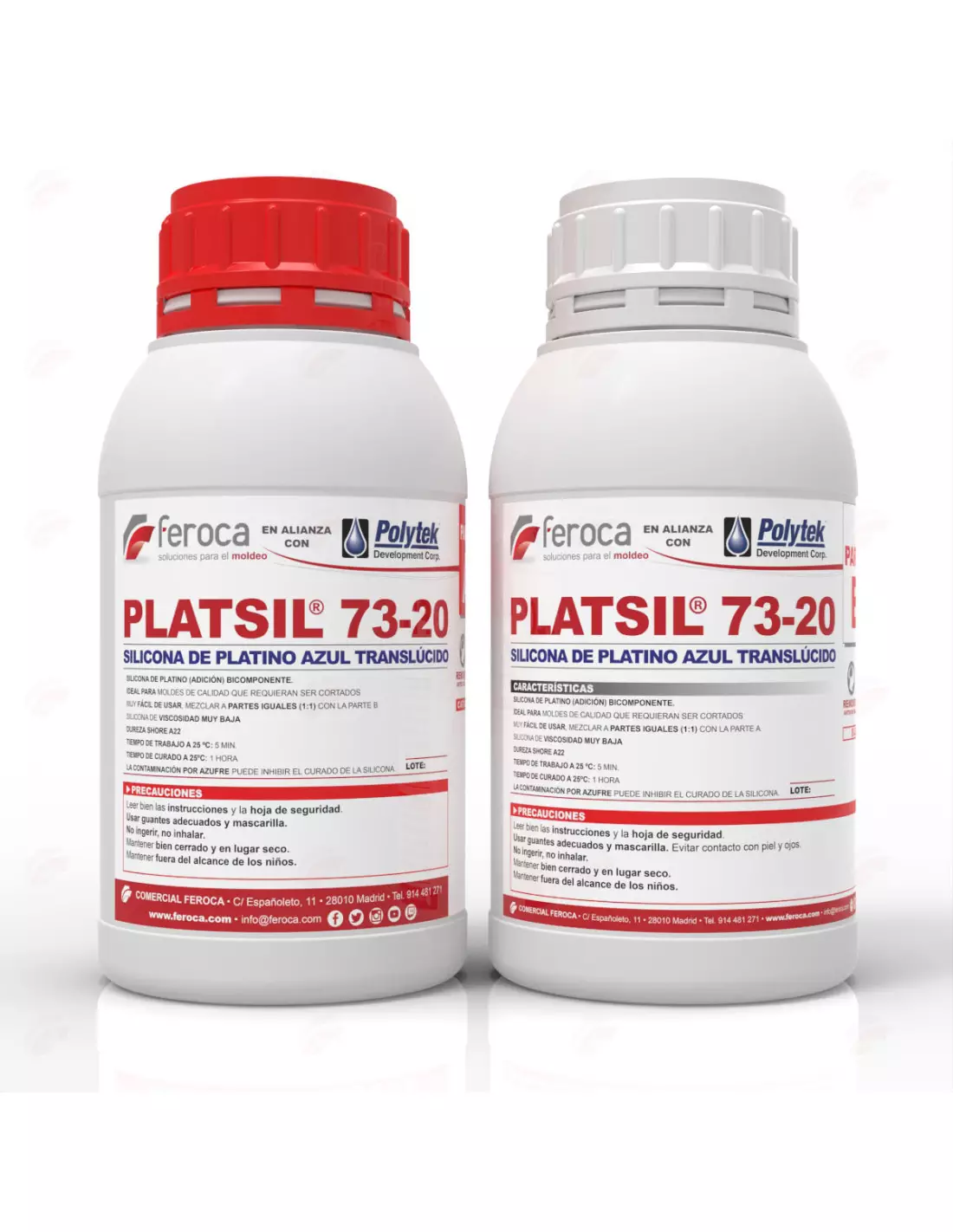
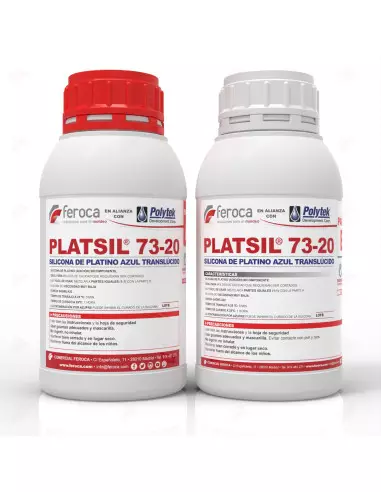
PlatSil 73-20 -Platinum Silicone-
290035101
€46.00
55,66 € Tax incl.
55,66 € Tax incl.
Translucent platinum silicone Shore A22, 1A:1B mix ratio by weight or volume. Working time 5 min, cure time 1 hour.
PlatSil 73-20 is a two-component platinum (addition) silicone from Polytek's PlatSil range, a reference in the industry for over 15 years. Its equal-parts mixing ratio, reliable cure and translucent blue appearance make it a solid choice for professional casting moulds where you need to see inside the mould, locate parting lines or confirm that the silicone has reached all hard-to-access areas.
Technical specifications
| Parameter | Value |
|---|---|
| Cure system | Platinum (addition) |
| Colour | Translucent blue |
| Shore Hardness | A22 |
| Mix ratio by weight | 100A : 100B |
| Mix ratio by volume | 100A : 100B |
| Working time | 5 minutes |
| Cure time | 1 hour |
| Mixed viscosity | 3,000 cP |
| Shrinkage | Negligible |
| Application method | casting (thickenable with PlatThix) |
What it is used for
PlatSil 73-20 is designed primarily for producing high-detail flexible casting moulds. Its translucent blue appearance is especially practical when you need to see the model inside the mould or determine where to make cuts. It is suitable for reproducing complex artistic or technical pieces in short and medium production runs.
- Casting moulds for polyurethane, epoxy or plaster
- Moulds for complex-geometry parts where fill verification is required
- Moulds that need to be cut after curing (translucency makes it easy to see the model and mark parting lines)
- Reproduction of sculptures, figures and decorative pieces
- FX and film and television props
- Prosthetics and character make-up (compatible with the PlatSil range for hyperrealism applications)
- Moulds for food-contact applications once full-system compliance has been verified
- Brush-on application when thickened with thixotropic agent PlatThix
How to use it
- Prepare the model: ensure the surface is clean, dry and free from contaminants that may inhibit the cure (sulphur, latex, freshly cured polyester resins, urethane rubber, etc.). Apply a release agent if the model requires it.
- Prepare the container: use a clean, dry cup. Weigh or measure components A and B in a 1:1 ratio, both by weight and by volume.
- Mix: combine the two components and mix thoroughly for 1–2 minutes, scraping the sides and bottom of the container thoroughly. You have 5 minutes of working time, so work quickly and without interruption.
- Degas (optional but recommended): if you have a vacuum chamber, degas the mix before casting to remove trapped air bubbles.
- Cast: pour the silicone in a thin, continuous stream from the lowest point of the mould or model so that air can escape progressively. Use the translucency to confirm that the silicone has reached all areas.
- Allow to cure: at room temperature (approx. 25 °C), full cure is achieved in 1 hour. Do not demould prematurely.
- Demould: remove the mould carefully. If you need to cut it to release the model, the translucent blue colour lets you see exactly where the model is and mark the cut line with precision.
Warning: inhibition risk
PlatSil 73-20 is a platinum (addition) silicone. Platinum acts as a catalyst and can be poisoned by certain materials, preventing full or partial cure. The main inhibitors are: sulphur-containing clays and plasticines (such as standard sulphur-based oil clay), latex, tin silicones (condensation), freshly cured polyester resins, urethane rubber, epoxies, petroleum jelly and certain metals or unsealed surfaces. If the silicone remains tacky after the stated cure time, contact with an inhibitor is the most likely cause. Always perform a compatibility test on the model before making the final mould.
PlatSil 73-20 is a platinum (addition) silicone. Platinum acts as a catalyst and can be poisoned by certain materials, preventing full or partial cure. The main inhibitors are: sulphur-containing clays and plasticines (such as standard sulphur-based oil clay), latex, tin silicones (condensation), freshly cured polyester resins, urethane rubber, epoxies, petroleum jelly and certain metals or unsealed surfaces. If the silicone remains tacky after the stated cure time, contact with an inhibitor is the most likely cause. Always perform a compatibility test on the model before making the final mould.
Usage tips
Make the most of the translucency
The translucent blue tint of PlatSil 73-20 is not just aesthetic. It lets you check in real time that the silicone has filled all cavities before it cures — especially useful for parts with undercuts, fine textures or complex geometries. Moreover, once the mould has cured, you can see the model inside it to decide exactly where to make the demoulding cut without risking damage to the piece.
Working speed: plan before you mix
With only 5 minutes of working time, PlatSil 73-20 leaves no room for improvisation. Before mixing, have everything ready: the model properly set in the mould box, the release agent applied and dry, and the mixing container clean. If you need more handling time, consider PlatSil 73-15, which offers 20 minutes of working time and Shore A15, or try slightly chilling the components to gain a little extra margin. If instead you need a higher consistency for brush-on application, thicken with PlatThix without affecting the cure time.
Always run a compatibility test
Before moulding a new model — especially if it is made from an unknown material or has been painted — apply a few drops of mixed silicone to an inconspicuous area and check after one hour whether it has cured correctly. This simple step will save you wasting material and time on a mould that fails to cure. If the result is tacky, seal the model surface with lacquer varnish (in thin, well-dried coats) before proceeding.
Frequently asked questions
What materials can inhibit the cure of a platinum silicone?
Platinum silicones such as PlatSil 73-20 are sensitive to several contaminants. The most common are: sulphur-containing clays and plasticines, latex, condensation (tin) silicones, freshly cured polyester resins, urethane rubbers, epoxies, petroleum jelly and certain metals or unsealed porous surfaces. The symptom of inhibition is that the silicone remains tacky or uncured in the area of contact with the inhibitor. Always run a test on the model before making the final mould.
Can I use a tin silicone to make the mould and then cast parts in platinum silicone?
No. Tin (condensation) silicone inhibits the cure of platinum silicones such as PlatSil 73-20. If you pour platinum silicone into a tin silicone mould, the silicone will remain uncured in the contact areas. Both systems are incompatible in direct contact. If you need to reproduce parts in PlatSil 73-20, also make the mould using a platinum silicone.
Can I thicken this silicone to brush it on instead of casting it?
Yes. PlatSil 73-20 is a casting silicone, but you can add PlatThix to increase its viscosity and make it suitable for brush-on application. The thixotropic agent does not affect the cure time — it only modifies the consistency. This is useful, for example, for creating skin-texture moulds on vertical or large models where liquid silicone would run off before curing.
How long do I have to work with this silicone once it is mixed?
PlatSil 73-20 has a working time of 5 minutes at 25 °C. Have everything ready before you mix: the mould box assembled, the release agent applied and dry, and the mixing container prepared. Full cure is achieved in 1 hour. If you need more handling time, consider PlatSil 73-15, which offers 20 minutes of working time.
Is a vacuum chamber necessary when working with this silicone?
It is not essential, but it is highly recommended if you are looking for professional, bubble-free results. Degassing in a vacuum chamber removes air trapped during mixing before the silicone cures. If you do not have a vacuum chamber, pour the silicone in a thin, continuous stream from the lowest point of the mould to minimise air entrapment.
Can this silicone be pigmented to change its colour?
Yes. PlatSil 73-20 accepts pigments specifically formulated for platinum silicone. It is important to use colorants compatible with addition systems, as some pigments contain inhibitors. Avoid sulphur-based pigments or any components that could interfere with the platinum catalyst. For prosthetics and FX applications, use pigments from ranges formulated for platinum silicones.
Is this silicone suitable for food contact?
Cured platinum silicones generally exhibit good chemical inertness, but to guarantee food-safe use it is necessary to verify that the complete system (both components, at the stated ratios and with full cure) complies with FDA regulations or the equivalent European standard. Consult Feroca for the specific product certification before using it in food-contact applications.
How do I know whether the mould has cured correctly before demoulding?
After 1 hour at 25 °C, touch a spare area of silicone (outside the mould area) with a clean finger. If it does not stick to your finger and has a uniform elastic consistency, the cure is correct. If it remains tacky, the cause may be inhibition from contact with an incompatible material, too low a temperature during curing, or an incorrect mix ratio.
- Color
- Translucent blue
- Working Time
- 5min
- Curing Time
- 1hora
- Shore Hardness
- A22
- Volume Mixing Ratio
- 100A:100B
- Mixed Weight Ratio
- 100A:100B
No reviews
Tap to zoom