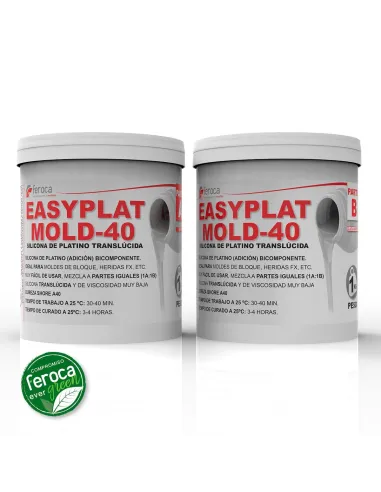
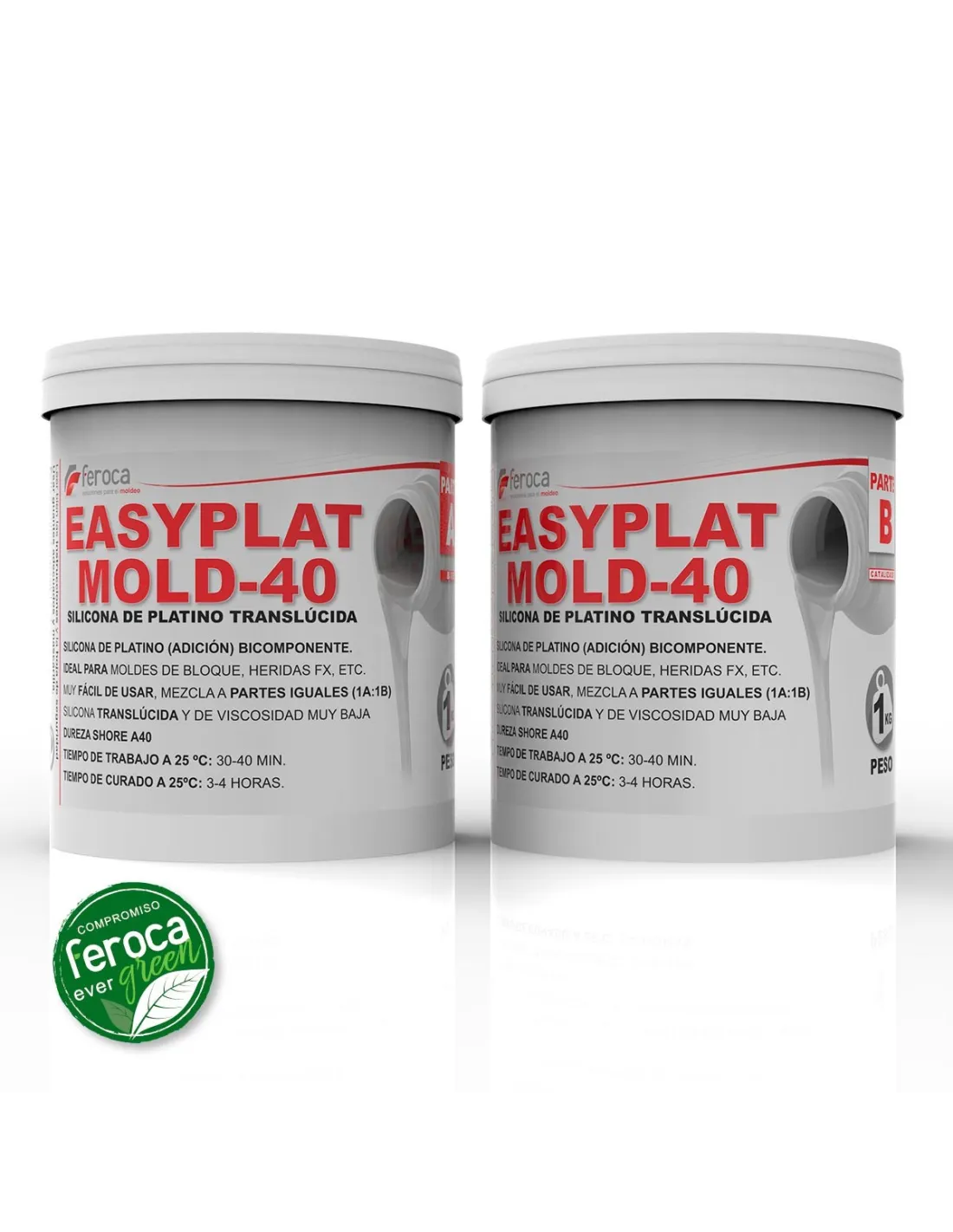
EASYPLAT MOLD-40 is a translucent platinum (addition) silicone with Shore A40 hardness, formulated for block moulds where you need to see the inner piece in order to cut with precision. Its 1:1 mix ratio by weight and volume makes it very easy to use, and its low shrinkage and heat resistance up to 220 ºC ensure durable, reliable moulds for special effects production, transfers, props and much more.
Technical specifications
| Parameter |
Value |
| Type |
Platinum silicone (addition) |
| Colour |
Translucent |
| Shore Hardness |
A40 |
| Mix ratio (weight) |
100A : 100B |
| Mix ratio (volume) |
100A : 100B |
| Working time at 25 ºC |
30 minutes |
| Cure time (demould) |
3 hours |
| Mixed viscosity |
5,000 cps |
| Elongation at break |
300 % |
| Tear resistance |
100 pli |
| Heat resistance |
220 ºC |
| Shrinkage |
Negligible |
| Density |
1.20 g/cm³ |
What it is used for
The translucency of EASYPLAT MOLD-40 is its defining characteristic: it allows you to locate the original piece inside the finished mould and mark the cut line with complete precision. It is the standard choice in special effects, prosthetics and artistic reproduction workshops when a semi-rigid, versatile and long-lasting mould is required.
- Block moulds for complex pieces (translucency makes the opening cut easier)
- Wound moulds and encapsulated silicone pieces for FX and character work
- Texture and skin transfers for theatrical and film prosthetics
- Special effects props and replicas
- Moulds for casting polyurethane resins, wax and plaster
- Production of decorative, jewellery and art pieces
- Food Safe moulds (check FDA compatibility according to application)
How to use it
- Prepare the original: make sure the piece is clean, dry and free from cure-inhibiting contaminants (latex, sulphur, fresh epoxy, tin silicone). Apply a release agent such as 34D if the original is porous or may bond to the silicone.
- Build the containment box: surround the piece with a well-sealed moulding box or wall to prevent leaks.
- Weigh or measure the components: mix part A and part B in an exact 1:1 ratio, both by weight and by volume.
- Mix slowly and carefully: stir for 2–3 minutes, scraping the sides and bottom of the container thoroughly to ensure a homogeneous mix. Avoid incorporating excessive air.
- Degas if possible: apply vacuum in a vacuum chamber for about 2–3 minutes to eliminate bubbles and achieve a flawless surface finish.
- Pour over the original: do so from a low point in a thin stream to allow air to escape. If you need a thicker or brushable layer, add thixotropic additive before pouring.
- Allow to cure: at 25 ºC the mould is ready to demould in 3 hours. Do not accelerate the cure with excessive heat during the first hours.
- Demould carefully: thanks to the translucency, visually locate the piece, mark the cut line and open the mould.
- Pigment if needed: you can add silicone pigments or Key-Pigments for FX directly into the mix before pouring to colour the mould or the reproduced piece.
Warning — Platinum silicone inhibition: EASYPLAT MOLD-40 is an addition (platinum) silicone. Contact with certain materials can inhibit its cure, leaving it tacky or uncured. Avoid contact with: sulphur-containing clays and plasticines, latex, tin (condensation) silicone, freshly cast epoxy or polyester resins, vinyl, petroleum jelly and certain metals. If you are unsure about the compatibility of your original, always carry out a test on a small area before making the full mould.
Usage tips
Control workshop temperature
Ambient temperature directly affects working time. Above 25 ºC the cure accelerates and you may lose pouring time; below it, the cure slows down. In summer, work with components at cellar temperature or cool the containers slightly. In winter, a cold workshop can extend the cure well beyond the stated 3 hours: this is normal and does not affect mould quality.
Make the most of the translucency
One of the great advantages of EASYPLAT MOLD-40 over opaque silicones is that you can see exactly where the piece is once the block has cured. Use a fine permanent marker to draw the cut line on the mould surface before using a scalpel or knife. This reduces errors and allows you to make zigzag cuts that fit together perfectly when the mould is closed.
Skin and FX wound moulds
For wound moulds or skin textures intended for encapsulated silicone, a Shore A40 offers the ideal balance: enough rigidity to hold the shape and enough flexibility to demould pieces with undercuts. If you are going to cast very soft silicone (deadener) in the mould, apply a release agent between silicones to prevent adhesion. Remember that tin silicone is not compatible: always use a release agent spray specifically designed for platinum-on-platinum silicone applications.
Frequently asked questions
What materials can inhibit the cure of a platinum silicone?
Platinum silicones such as EASYPLAT MOLD-40 are inhibited by contact with: sulphur-containing clays and plasticines, latex, tin (condensation) silicone, freshly cast epoxy or polyester resins, vinyl, petroleum jelly and certain metals. The result is a tacky layer or incomplete cure. Always carry out a compatibility test with the original before making the full mould.
Is a release agent necessary when making a block mould?
It depends on the material of the original. For porous pieces (plaster, wood, unglazed ceramic) it is essential to seal and apply a release agent to prevent the silicone from penetrating or bonding. Release agent 34D in paste form works very well in these cases. For non-porous pieces (plastic, metal, cured resin) it is generally not needed, although a test is always advisable.
Can I use this silicone over a tin silicone original?
No. Platinum silicone does not cure over tin silicone: it becomes inhibited and remains tacky. If your original or the inside of a mould has traces of condensation silicone, they are not compatible with EASYPLAT MOLD-40. Always use clean surfaces and, if you need to work with both systems, isolate the surfaces thoroughly with a release agent spray specifically designed for this purpose.
How can I get a thicker silicone for brush application or layering?
Add Thixo Additive to the already prepared EASYPLAT MOLD-40 mix. This thixotropic additive thickens the silicone without altering the cure time or the mechanical properties of the finished mould. It is ideal for brush applications on skin moulds or relief textures.
Can the mould silicone be pigmented before pouring?
Yes. You can add silicone pigments or Key-Pigments for FX directly into the A+B mix before pouring. Bear in mind that adding colour will reduce part of the characteristic translucency of EASYPLAT MOLD-40. If you need to see the inner piece for cutting, we recommend not pigmenting or using minimal amounts.
How long does it take to cure if the workshop is cold or hot?
The 3-hour cure time is referenced at 25 ºC. At lower temperatures (15–18 ºC in winter) the cure can extend to 5–6 hours without affecting mould quality. In heat (30 ºC or above) it accelerates, but available working time is also reduced. In extreme temperatures, test with a small amount before making the full mould.
Is a rigid mother mould necessary when working with this silicone?
For moderately sized block moulds, EASYPLAT MOLD-40 at Shore A40 has enough body to hold its shape without a mother mould. However, for large moulds, elongated pieces or when a high number of castings are planned, it is recommended to build a rigid plaster or resin shell around the mould. This prevents distortion and ensures dimensional accuracy in the reproductions.
How many castings can a platinum silicone mould withstand?
With proper maintenance (cleaning between castings, storage in a cool dark place, use of release agent when the cast material requires it), an EASYPLAT MOLD-40 mould can withstand dozens or even hundreds of castings depending on the cast material and the complexity of the piece. Polyurethane resins cause the most wear on the mould over time; plaster and wax are the most mould-friendly materials.
How much product do I need?Calculate the exact amount before buying and avoid wasting material.
Go to the calculator →