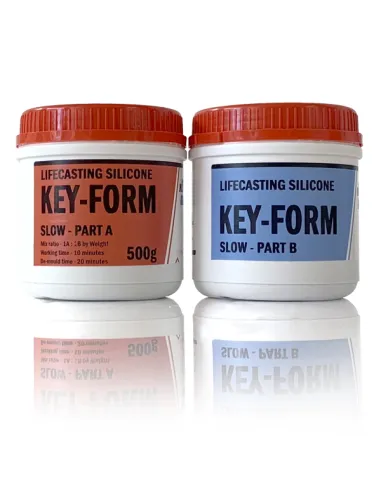
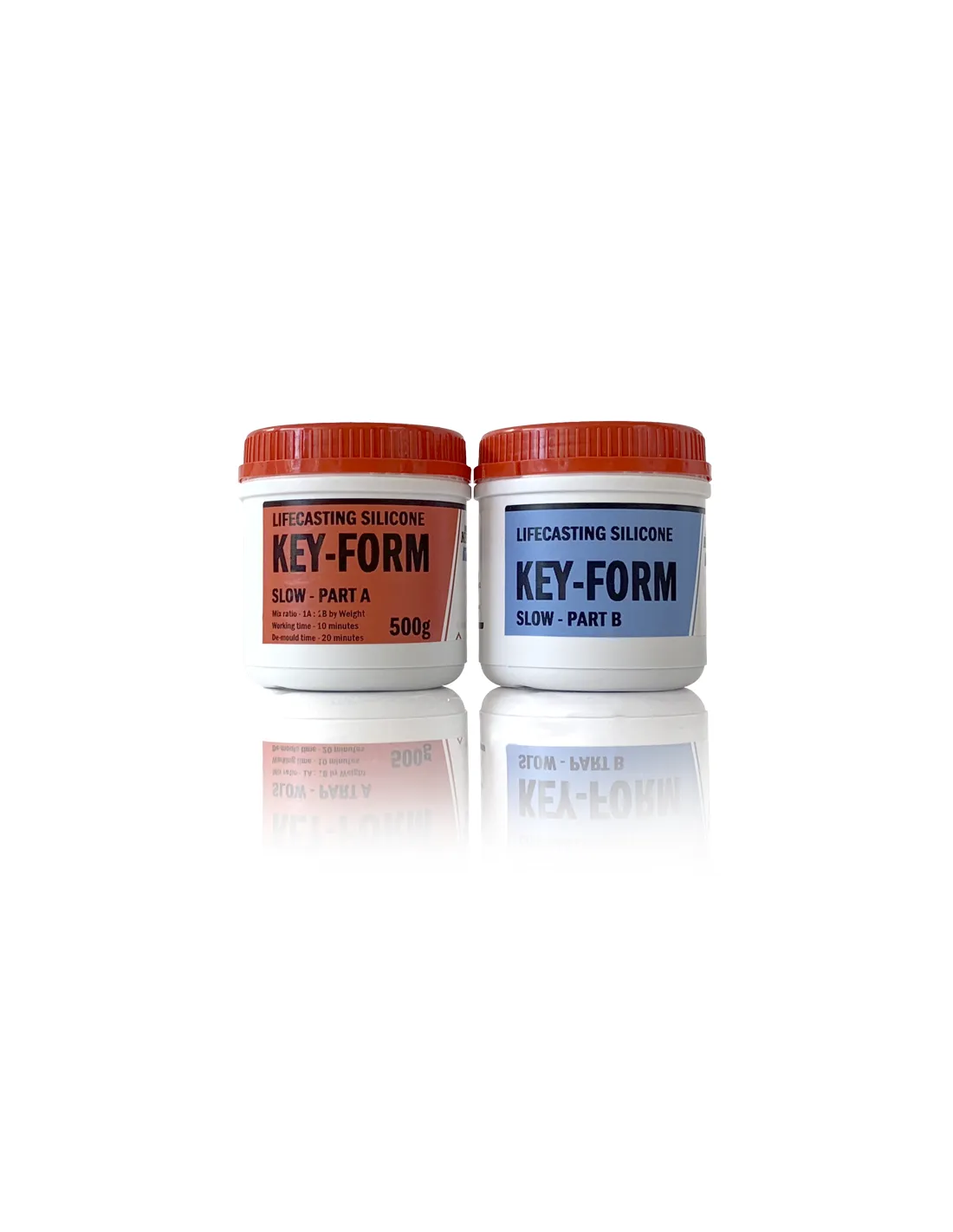
KEY-FORM is a platinum (addition) silicone formulated specifically for body casting on human skin. Its self-releasing formula allows effortless, pain-free removal from hairy areas — beard, eyebrows, body hair — and its 1:1 by volume mix ratio simplifies workshop use. Available in two cure speeds to suit different production needs.
Technical specifications
| Parameter |
Standard |
Slow |
| Silicone type |
Platinum (addition) |
| Mix ratio (volume) |
100A : 100B |
| Mix ratio (weight) |
100A : 100B |
| Cure time |
5–10 min |
10–20 min |
| Self-releasing |
Yes (does not adhere to hair) |
| Primary application |
LifeCast / human body |
What it is used for
KEY-FORM is designed for direct impression-taking on skin, making it the go-to solution for special effects artists, prosthetists and FX makeup professionals who need to accurately reproduce any area of the body. Unlike alginate, the resulting mould withstands multiple castings and does not degrade over time.
- Facial impressions (full face, nose, ears, lips)
- Lifecast of hands, arms, torso and other body areas
- Impressions on hairy areas: beard, moustache, eyebrows, body hair
- Production of reusable moulds for special effects prosthetics
- Mould base for casting plaster, wax, polyurethane resins, acrylic resins, low-melt metals and other reproduction materials
- Production of multiple copies from a single human body mould
How to use it
- Protect hair and surrounding areas with petroleum jelly or another suitable barrier product. Do not apply petroleum jelly directly on areas where you will apply the silicone, as it can inhibit curing — use it only as a perimeter barrier.
- Choose the Standard version (5–10 min) or Slow version (10–20 min) depending on the complexity of the impression and the time you need to apply the material.
- Mix parts A and B in a 1:1 ratio by volume (or by weight) using slow, even strokes to minimise air bubble incorporation.
- Apply KEY-FORM directly onto the model's skin using a spatula, a stiff-bristle brush or a gloved hand. Work from the centre outwards to avoid air pockets.
- Once the silicone layer has been applied, immediately reinforce it with a rigid mother mould using plaster bandages so the mould holds its shape when demoulded.
- Wait for the cure time indicated for the version chosen. The silicone will have cured when it leaves no sticky residue to the touch.
- Demould using gentle movements. The self-releasing formula facilitates separation in hairy areas without the need for additional release agent.
- Cast the desired reproduction material inside the mould (plaster, polyurethane resin, wax, etc.). If you are going to cast various different materials or want to ease separation on smooth surfaces, you can apply 34D release agent.
Important notice — Platinum silicone inhibitionKEY-FORM is an addition-cure (platinum) silicone. Certain materials prevent it from curing upon contact, leaving the silicone sticky or uncured. The most common inhibitors are:
- Clays and plastilinas containing sulphur (most conventional modelling clays)
- Tin compounds and condensation-cure (tin) silicones
- Latex and urethane rubbers
- Freshly cast or incompletely cured polyester resin
- Some paints, epoxies and unsealed metals
- Petroleum jelly in direct contact with the silicone
Before each use, perform a small cure test on the substrate or material you intend to use. If inhibition occurs, seal the surface with spray lacquer or shellac and allow it to dry completely before applying KEY-FORM.
Usage tips
Model preparation
Before applying KEY-FORM, make sure the skin is clean and free of creams, oils or sweat. Apply a thin layer of petroleum jelly as a barrier only around the perimeter of the area to be moulded (hairline, neck contour) to facilitate removal without contaminating the work area. Remember that petroleum jelly in direct contact with the silicone can inhibit surface curing.
Choosing the cure speed
The Standard version (5–10 min) is suitable for small-area impressions or when you already have experience applying the material. Go for the Slow version (10–20 min) when working on large surfaces — full face, hands, torso — or when the process requires more positioning time. Bear in mind that the working time is shorter than the total cure time: mix and apply swiftly. If you need to adjust the consistency of the material for vertical surface work, you can add a small amount of thixotropic additive.
Mother mould and mould storage
A soft silicone mould without a rigid support will deform when heavy materials such as plaster are cast into it. Always reinforce with plaster bandages applied while the silicone is still setting, so the plaster shell fits perfectly. Store the mould inside its mother mould and away from direct sunlight to extend its service life.
Frequently asked questions
Can this silicone be used without release agent on hairy areas?
Yes. KEY-FORM is self-releasing, which means it separates on its own without sticking to hair. You do not need to apply any release agent on beards, eyebrows, moustaches or body hair before moulding. This is precisely one of the reasons it has been formulated specifically for lifecasting.
What is the difference between the Standard and Slow versions?
The difference lies in working time and cure time. The Standard version cures in 5–10 minutes, making it ideal for small areas or experienced users. The Slow version takes 10–20 minutes to cure, giving more time to apply the material on large surfaces or complex geometries. In both cases the quality of the resulting mould is the same.
How many copies can I get from a platinum silicone mould?
A well-maintained KEY-FORM mould withstands significantly more castings than an alginate mould, which generally serves for a single copy. With KEY-FORM you can reproduce the same piece in plaster, wax, polyurethane resins, acrylic resins and low-melt metals, among other materials, without needing to repeat the impression-taking process.
What materials can be cast inside the mould?
KEY-FORM is compatible with a wide range of reproduction materials: plaster and gypsum, wax, polyurethane resins, acrylic resins, polyester resins (once fully cured) and low-melt metals. Remember to apply 34D release agent if the material to be cast may adhere to the silicone.
What happens if the silicone does not cure or remains sticky?
This is a symptom of inhibition. Platinum silicones are sensitive to contact with sulphur (present in many modelling clays), tin compounds, latex, uncured polyester resin, some epoxies and petroleum jelly in direct contact. If you detect inhibition, clean the surface of the original, seal it with spray lacquer or shellac, allow it to dry completely and repeat the test before moulding.
Is it compatible with tin silicones or alginate?
It is not compatible with tin (condensation) silicones: platinum silicone will not cure on them. Alginate does not inhibit the curing of KEY-FORM, but it is not the typical substrate for this silicone either. If you have moulds made with tin silicones and want to work with platinum, make sure there is no direct contact between the two materials.
Can I add thixotropic additive to prevent sagging on vertical surfaces?
Yes. You can incorporate Thixo Additive into the mix to increase viscosity and keep the material in place when applied on vertical surfaces or areas with heavy relief. The thixotropic additive does not alter the cure time — it only modifies the consistency of the product.
Is a mother mould mandatory?
It is not strictly mandatory, but it is highly recommended. Soft silicone deforms when reproduction materials are poured into it, especially plaster or resin. A mother mould made of plaster bandages applied while the silicone is setting ensures the mould retains the correct geometry throughout all castings and considerably extends its service life.
How much product do I need?Calculate the exact amount before buying and avoid wasting material.
Go to the calculator →