Shopping Cart


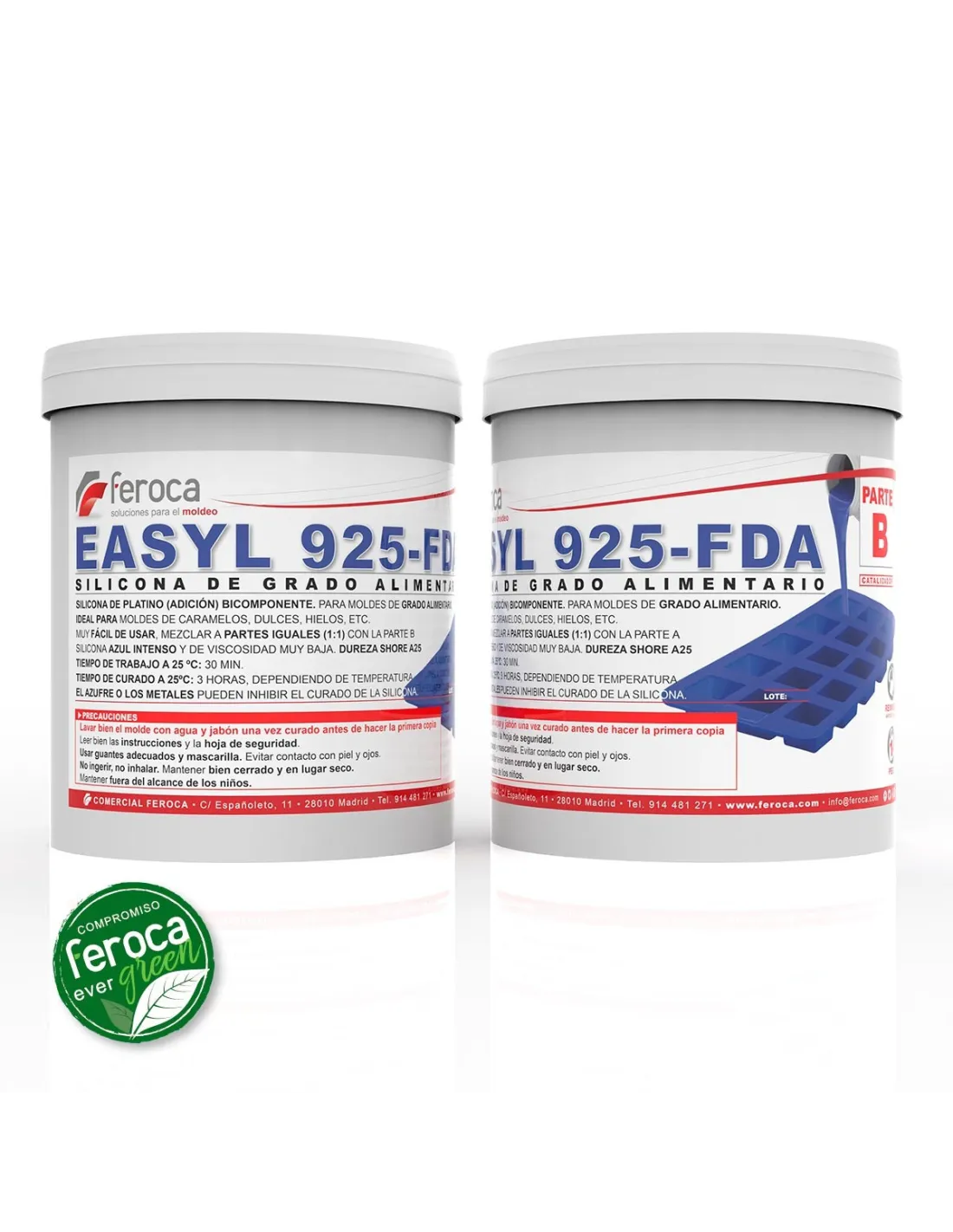
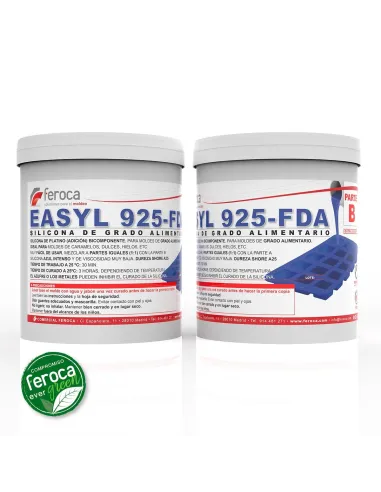
Easyl 925-FDA Blue -Silicone Food Safe-
201355201
€48.00
58,08 € Tax incl.
58,08 € Tax incl.
Food Safe platinum silicone (FDA) Shore A25, blue, 1:1 mix ratio. Moulds for chocolate, sweets and ice. Viscosity 5,000 cps, cure in 3 h.
Easyl 925-FDA Blue is a platinum (addition) silicone with FDA food-safe certification, formulated for making flexible moulds in direct contact with food. Its low viscosity, Shore A25 hardness and 1:1 mix ratio by weight and volume make it a reliable and very easy-to-use solution for professional patisserie, confectionery and catering. The blue colour makes it easy to visualise the mix and detect any uncatalysed areas.
Technical specifications
| Parameter | Value |
|---|---|
| Silicone type | Platinum (addition) |
| Food Safe grade | FDA |
| Colour | Blue |
| Shore Hardness | A25 |
| Mix ratio (weight) | 100A : 100B |
| Mix ratio (volume) | 100A : 100B |
| Mixed viscosity | 5,000 cps |
| Working time at 25 °C | 30 minutes |
| Demould time at 25 °C | 3 hours |
| Elongation resistance | 300 % |
| Tear resistance | 100 pli |
| Thermal resistance (continuous use) | -50 °C to 220 °C |
| Peak temperature (short-term) | Up to 250 °C |
| Shrinkage | Negligible |
| Density | 1.20 g/cm³ |
What it is used for
Easyl 925-FDA Blue is designed for making flexible moulds intended for direct contact with food. Its low viscosity ensures excellent detail reproduction and minimises the formation of bubbles, while its FDA certification guarantees food safety in end use. It is suitable for both artisan production and small industrial runs.
- Chocolate moulds: bars, bonbons and decorative figures
- Moulds for sweets, gummy candies and gelatinous confectionery
- Custom-shaped ice moulds
- Moulds for fondant, marzipan and sugar paste
- Moulds for jelly, panna cotta and cold desserts (flexible down to -50 °C)
- Moulds for decorative butter and soft cheeses
- Moulds for artisan soaps and solid cosmetics (non-food use)
How to use it
- Prepare the master model. Make sure the surface is clean, dry and free of contaminants that could inhibit the cure (latex, sulphur, tin, uncured epoxies). See the inhibition warning below.
- Build the containment wall. Surround the model with cardboard, wood or LEGO walls to contain the silicone. Apply a release agent if the model surface requires it; on non-porous surfaces such as plastic or metal it is usually not necessary.
- Weigh the two parts. Mix part A and part B in a 100:100 ratio by weight or by volume. The 1:1 mix ratio greatly simplifies the process: you can use graduated cups or a basic kitchen scale.
- Mix carefully. Stir slowly with a spatula for at least 2–3 minutes, scraping the sides and bottom of the container thoroughly to avoid uncatalysed areas. A uniform blue colour throughout the mix indicates a correct blend.
- Degas if possible. For moulds requiring a high level of detail, place the mix in a vacuum chamber for 1–2 minutes before pouring. If you do not have a vacuum chamber, pour from a height in a thin stream to release bubbles.
- Pour over the model. Cast the silicone from a low point in the containment wall and let it flow naturally to envelop the detail. Avoid moving the mould once poured.
- Cure at room temperature. Leave to rest at 25 °C for 3 hours before demoulding. Heat accelerates the cure: at 60 °C it can be reduced to 30–45 minutes.
- Demould and clean. Remove the containment wall, extract the model and wash the mould with water and mild soap before the first food use.
- Post-cure the mould in an oven: essential before using it in contact with food. Bake at 180-200 °C following the process detailed under "Post-curing for food use".
Warning — Platinum silicone inhibition: Addition silicones such as Easyl 925-FDA Blue may remain uncured or have sticky areas if they come into contact with certain materials during the process. The main inhibitors are: sulphur-containing clays and plasticines, latex, condensation (tin) silicones, uncured epoxy resins, freshly cast polyester, urethane rubbers and some unsealed metal surfaces. If you are unsure about the compatibility of your model, always carry out a preliminary test with a small amount of silicone on the surface before pouring the full mould.
Usage tips
Post-curing for food use
Post-curing in an oven is essential before the mould is used in contact with food: it completes the cross-linking of the elastomer and removes the residual volatiles from curing. Recommended process:
- Place the demoulded parts loosely in a hot-air circulating oven, without stacking them.
- Bake at 180-200 °C.
- Thin-wall parts: 1-2 hours.
- Thick-wall parts: 3-4 hours.
- Let them cool down naturally after baking.
Food-contact compliance: the raw silicone material itself complies with food-grade specifications. Final food-contact compliance also depends on how the finished part is manufactured, and in particular on the post-curing being carried out correctly by whoever makes the mould.
Operating temperature range: oven and freezer
Once cured and post-cured, the mould works continuously between -50 °C and 220 °C, with short-term peaks of up to 250 °C. In extreme cold it stays flexible at -50 °C without cracking or becoming brittle, so it is equally suitable for deep-freezing and for pastry and baking ovens. Never expose it to a direct flame.
Temperature and cure acceleration
The 3-hour demould time corresponds to 25 °C. If you need to speed up production, you can place the mould in an oven at 60–70 °C for 30–45 minutes once the silicone has been poured. Conversely, working in a cold environment (below 18 °C) considerably extends both the working time and the cure time. Never heat the mix before pouring: this drastically reduces the working time and makes it harder to eliminate bubbles.
How to extend working time on hot days
In summer or in warm workshops, the working time may drop below 30 minutes. Refrigerate parts A and B in a fridge (between 10 and 15 °C) for a few hours before mixing. Do not freeze them. You can also work during the coolest part of the day. Avoid adding retarders not formulated for food-safe silicones, as they would compromise the product's FDA certification.
Mould maintenance and service life
Easyl 925-FDA Blue moulds will last hundreds of uses if treated correctly. Wash them by hand with warm water and mild soap; a dishwasher can degrade the silicone over time. Store them away from direct heat and sunlight, and avoid stacking heavy objects on top that could deform the cavities. If you notice that the mould has absorbed odours or colourants, you can bake the empty piece at 120 °C for 1–2 hours to regenerate the surface.
Frequently asked questions
Is this mould safe for direct contact with food?
Yes. Easyl 925-FDA Blue is certified in accordance with FDA (Food and Drug Administration) regulations for direct contact with food. Once fully cured, the silicone is inert, transfers no odours or flavours and is suitable for use with chocolate, sweets, ice, gelatines and other foods. Always wash the mould with water and mild soap before the first use.
Can it go in the oven or the freezer?
Yes in both cases. Easyl 925-FDA Blue withstands up to 220 °C, making it suitable for baking sponge cakes, bread or pastries in silicone moulds. It also withstands freezing temperatures without any problem, making it ideal for ice moulds and frozen preparations. Do not expose it to direct flame or to temperatures above those indicated. It works continuously from -50 °C to 220 °C, with short-term peaks of up to 250 °C, and stays flexible at -50 °C without cracking. Always post-cure it before its first contact with food.
How long does it take to cure and when can I use it for the first time?
At 25 °C the demould time is 3 hours. However, it is recommended to wait at least 12 hours before the first food use to ensure a complete cure. If you accelerate the cure in an oven at 60–70 °C, this time can be significantly reduced. Incomplete cure does not pose a food safety risk as long as the silicone shows no sticky areas; if it does, the mould must not be used.
What materials can inhibit the cure of this silicone?
As a platinum (addition) silicone, Easyl 925-FDA Blue can be inhibited by contact with: sulphur-containing clays and plasticines, latex, condensation (tin) silicones, uncured epoxy resins, freshly cast polyester and some metals. If the master model is made from any of these materials, apply a coat of compatible sealer or carry out a preliminary test with a small amount of silicone before proceeding with the full mould.
Can I repair a damaged food-safe mould with another silicone?
Only if that silicone is also FDA certified. Using a non-food-safe silicone to repair the mould would cause it to lose its certification and it should not be used in contact with food. For repairs, use the same Easyl 925-FDA Blue or another silicone with an equivalent FDA certification.
How many uses can a mould made with this silicone withstand?
With proper maintenance, an Easyl 925-FDA Blue mould can withstand several hundred uses. The Shore A25 hardness provides enough flexibility to demould easily without damaging the pieces, while the silicone retains its shape. Avoid the dishwasher, prolonged exposure to uncleaned animal fats and storage under pressure to maximise the mould's service life.
Do I need a release agent when using this silicone with chocolate or caramel?
No. One of the advantages of platinum silicone moulds is their naturally non-stick nature. Chocolate, caramel, ice and most food preparations demould without the need to apply any product. In cases of very fatty or sugary preparations that might stick, a light spray of vegetable oil is sufficient.
Is this food-safe silicone available in other hardnesses or colours?
Yes. Feroca offers other FDA food-safe silicone references in the Easyl range. If you need a different hardness, see the Easyl 940-FDA Pink, available in Shore A40 for moulds requiring greater rigidity and sharper edges.
Is post-curing mandatory before using the mould with food?
Yes. Before its first contact with food the mould must be post-cured in an oven: parts placed loosely and unstacked in a hot-air circulating oven, at 180-200 °C, for 1 to 2 hours if the wall is thin and 3 to 4 hours if it is thick, then left to cool down naturally. The raw material complies with food-grade specifications, but the compliance of the finished mould also depends on how it is manufactured and on this post-curing being carried out correctly.
- Color
- Blue
- Working Time
- 30min
- Curing Time
- 3horas
- Shore Hardness
- A25
- Volume Mixing Ratio
- 100A:100B
- Mixed Weight Ratio
- 100A:100B
No reviews
Tap to zoom