Shopping Cart


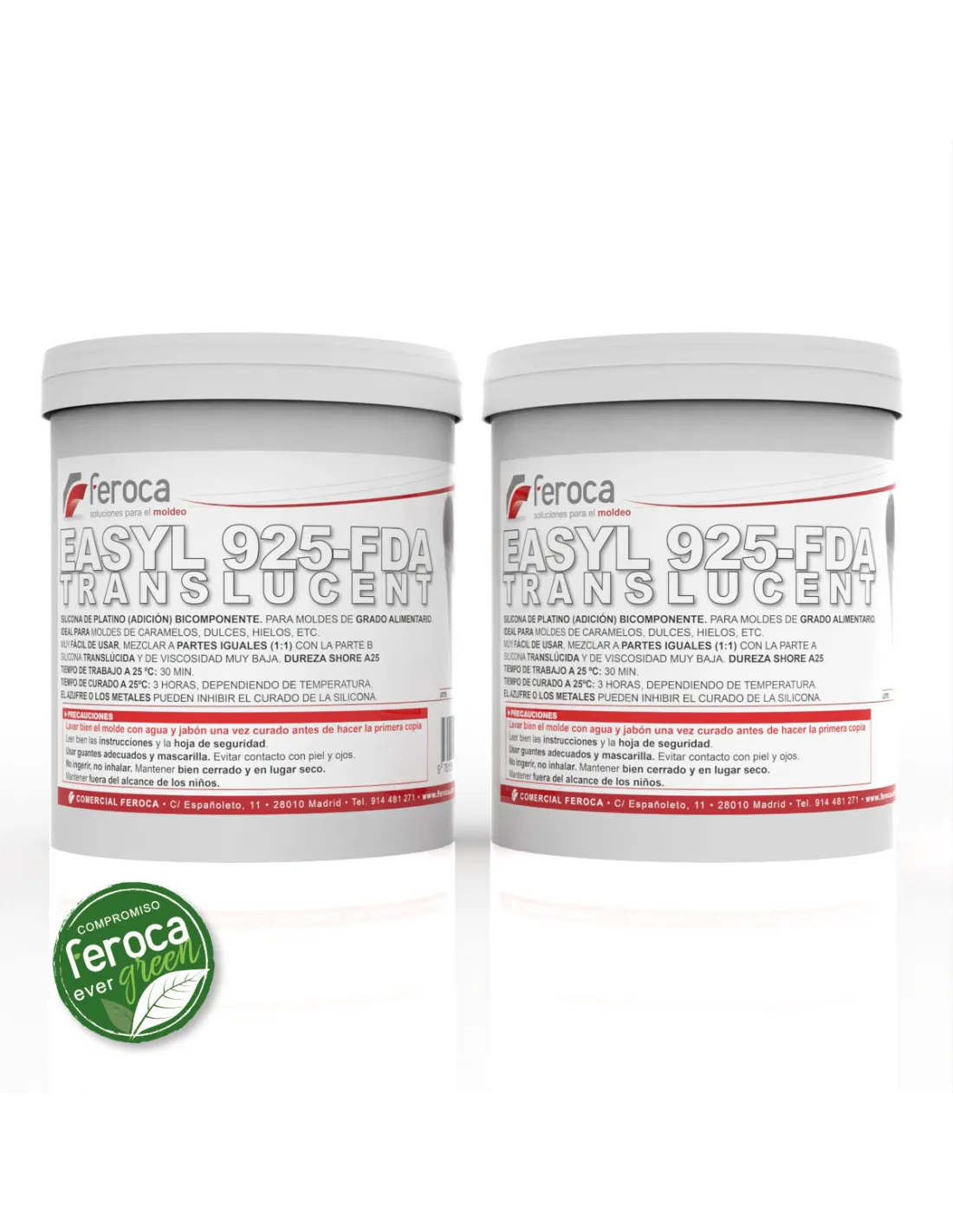
Easyl 925-FDA Translucent -Silicone Food Safe-
201355301
€48.00
58,08 € Tax incl.
58,08 € Tax incl.
Food Safe platinum silicone (FDA) translucent, 1:1 mix ratio, Shore A25. Heat resistance up to 220 °C. Ideal for chocolate, baking and ice moulds.
Easyl 925-FDA is an FDA-certified food-safe platinum (addition) silicone, formulated for making moulds in direct contact with food. With Shore A25 hardness, low viscosity and 1:1 mix ratio by weight and volume, it combines ease of use with excellent technical performance: negligible shrinkage, heat resistance up to 220 °C and translucency that makes it easy to inspect the mould and the finished product.
Technical specifications
| Parameter | Value |
|---|---|
| Type | Platinum (addition) silicone — FDA Food Safe grade |
| Colour | Translucent |
| Shore Hardness | A25 |
| Mix ratio by weight | 100A : 100B |
| Mix ratio by volume | 100A : 100B |
| Mixed viscosity | 5,000 cps |
| Working time | 30 minutes |
| Demould time | 3 hours |
| Elongation at break | 300 % |
| Tear resistance | 100 pli |
| Thermal resistance (continuous use) | -50 °C to 220 °C |
| Peak temperature (short-term) | Up to 250 °C |
| Shrinkage | Negligible |
| Density | 1.20 g/cm³ |
What it is used for
Easyl 925-FDA is designed for making flexible moulds for the food industry and for artisan and professional baking. Its FDA certification makes it suitable for direct contact with food, provided the mould conditioning instructions are followed before first use. The translucency of the material makes it easy to visually inspect the finished piece and to detect bubbles during pouring.
- Moulds for chocolate and artisan confectionery
- Moulds for sweets, gummies and candy
- Moulds for custom-shaped ice cubes
- Moulds for pasta, fondant and marzipan
- Moulds for gelatines and panna cotta (flexible down to -50 °C)
- Moulds for decorative butter
- Reproductions of food-contact parts in industrial and laboratory environments
How to use it
- Prepare the master model making sure it is clean and dry. Do not use sulphur-based clays or tin materials to build the containment dam, as these will inhibit the cure.
- Weigh or measure parts A and B in a 1:1 ratio. Thanks to the equal mix ratio both by weight and by volume, you can use graduated syringes or a scale interchangeably.
- Mix both components for 2–3 minutes with a flat-bottomed spatula, scraping the sides and bottom of the container thoroughly to ensure a homogeneous mixture.
- If you have a vacuum chamber, degas the mixture for 1–2 minutes to remove air bubbles trapped during mixing.
- Pour the silicone in a thin, slow stream from the lowest point of the mould so the material flows and progressively displaces the air.
- Allow to cure at room temperature (25 °C) for at least 3 hours before demoulding.
- Before first use with food, wash the mould with water and mild soap, rinse thoroughly and dry. This step removes any potential traces from the manufacturing process.
- Post-cure the mould in an oven: essential before using it in contact with food. Bake at 180-200 °C following the process detailed under "Post-curing for food use".
Warning — Platinum silicone inhibition: Easyl 925-FDA is an addition (platinum) silicone and may be inhibited by contact with certain materials. If the silicone remains tacky or does not cure, the usual cause is contamination by: sulphur (present in many modelling clays, natural rubber and some modelling materials), tin (condensation) silicones, latex, freshly cast polyester, uncured epoxy resins, urethane rubbers or unsealed metal surfaces. Always perform a cure test on a small area of the model before pouring the full quantity.
Usage tips
Post-curing for food use
Post-curing in an oven is essential before the mould is used in contact with food: it completes the cross-linking of the elastomer and removes the residual volatiles from curing. Recommended process:
- Place the demoulded parts loosely in a hot-air circulating oven, without stacking them.
- Bake at 180-200 °C.
- Thin-wall parts: 1-2 hours.
- Thick-wall parts: 3-4 hours.
- Let them cool down naturally after baking.
Food-contact compliance: the raw silicone material itself complies with food-grade specifications. Final food-contact compliance also depends on how the finished part is manufactured, and in particular on the post-curing being carried out correctly by whoever makes the mould.
Operating temperature range: oven and freezer
Once cured and post-cured, the mould works continuously between -50 °C and 220 °C, with short-term peaks of up to 250 °C. In extreme cold it stays flexible at -50 °C without cracking or becoming brittle, so it is equally suitable for deep-freezing and for pastry and baking ovens. Never expose it to a direct flame.
Temperature and cure time
The 30-minute working time and 3-hour demould time are measured at 25 °C. In colder environments (below 18 °C) curing slows down considerably; in that case, you can heat the mould in an oven at 40–50 °C to accelerate the process without affecting the final properties. Avoid working at temperatures above 35 °C, as working time is significantly reduced.
Chocolate moulds: shrinkage and demoulding
The negligible shrinkage of Easyl 925-FDA ensures that fine relief details and textures are reproduced with precision. For chocolate moulds, a perfectly smooth inner finish is key: any bubble left on the contact surface will leave a mark on the piece. If you do not have a vacuum chamber, pour the mixture in a very thin stream and tap the mould gently on the table to bring bubbles to the surface. Demoulding is straightforward thanks to the Shore A25 flexibility; a Release agent is not necessary in most cases.
Maintenance and mould lifespan
FDA silicone moulds withstand hundreds of uses if handled with care. Always wash with warm water and mild soap after each use; avoid abrasive scrubbers that may scratch the surface. Do not use solvent-based Release agents or sprays containing tin silicones, as these would compromise the food-safe certification and could inhibit future repairs to the mould. Store moulds flat or hanging, away from direct light and ozone sources (electric motors).
Frequently asked questions
Can I repair a food-safe mould with any silicone?
No. To maintain the food-safe grade, any repair or patch must be carried out with the same FDA silicone or with another product that also holds food-safe certification. Using tin (condensation) silicones or silicones without FDA grade for the repair would void the mould's suitability for food contact. Furthermore, tin silicones are incompatible with platinum silicones and may inhibit the cure in the contact zone.
What happens if the silicone remains tacky after curing?
This is the classic symptom of inhibition. Platinum silicones such as Easyl 925-FDA do not cure correctly if they come into contact with materials containing sulphur, latex, tin silicones, polyester or uncured epoxy, among others. Check which materials have been in contact with the model or the containment dam and always perform a preliminary test on a small area before pouring the full mixture.
Is it necessary to apply a Release agent before pouring the silicone?
On most substrates (plaster, sealed wood, PLA, ABS, PETG) Easyl 925-FDA does not adhere and does not require a Release agent. However, on unsealed porous surfaces or on other silicone materials, it is advisable to apply a Release agent or a preliminary sealer coat. Bear in mind that in food applications the Release agent must also be suitable for food contact.
Can I speed up or slow down the cure?
Yes. Heat accelerates the cure: at 40–50 °C in an oven, demoulding can be brought forward considerably. Cold slows it down: below 18 °C working time is extended. Adding retarders is not recommended without verifying their compatibility with the formulation, as excess amounts can ruin the cure. If you need a longer working time, work in a cooler environment or split the process into several castings.
How many times can a food-safe silicone mould be used?
With correct use and maintenance, an Easyl 925-FDA mould can withstand hundreds of cycles. The key is to wash it with water and mild soap after each use, avoid abrasive tools and store it correctly. The 100 pli tear resistance and 300 % elongation give it a service life far superior to lower-quality silicone moulds on the market.
Can I use this material in the oven or freezer?
Yes. Easyl 925-FDA withstands up to 220 °C, making it suitable for conventional and convection ovens. It also withstands freezing temperatures without issue, making it valid for ice moulds, lollies and preparations that require cold demoulding. Do not use it in direct contact with an open flame or in ovens that exceed 220 °C on a sustained basis. It works continuously from -50 °C to 220 °C, with short-term peaks of up to 250 °C, and stays flexible at -50 °C without cracking. Always post-cure it before its first contact with food.
What is the difference between a Shore A25 silicone and a harder one for baking moulds?
A Shore A25 hardness offers an optimal balance between flexibility for demoulding and sufficient rigidity to hold the mould shape during pouring. Softer silicones (Shore A10–A15) are harder to handle and deform easily; harder ones (Shore A40 or above) can make it difficult to demould pieces with undercuts or fine details. For most applications in chocolate, fondant and gelatines, Shore A25 is the most recommended hardness.
Is post-curing mandatory before using the mould with food?
Yes. Before its first contact with food the mould must be post-cured in an oven: parts placed loosely and unstacked in a hot-air circulating oven, at 180-200 °C, for 1 to 2 hours if the wall is thin and 3 to 4 hours if it is thick, then left to cool down naturally. The raw material complies with food-grade specifications, but the compliance of the finished mould also depends on how it is manufactured and on this post-curing being carried out correctly.
- Color
- Translucent
- Working Time
- 30min
- Curing Time
- 3horas
- Shore Hardness
- A25
- Volume Mixing Ratio
- 100A:100B
- Mixed Weight Ratio
- 100A:100B
No reviews
Tap to zoom