Shopping Cart


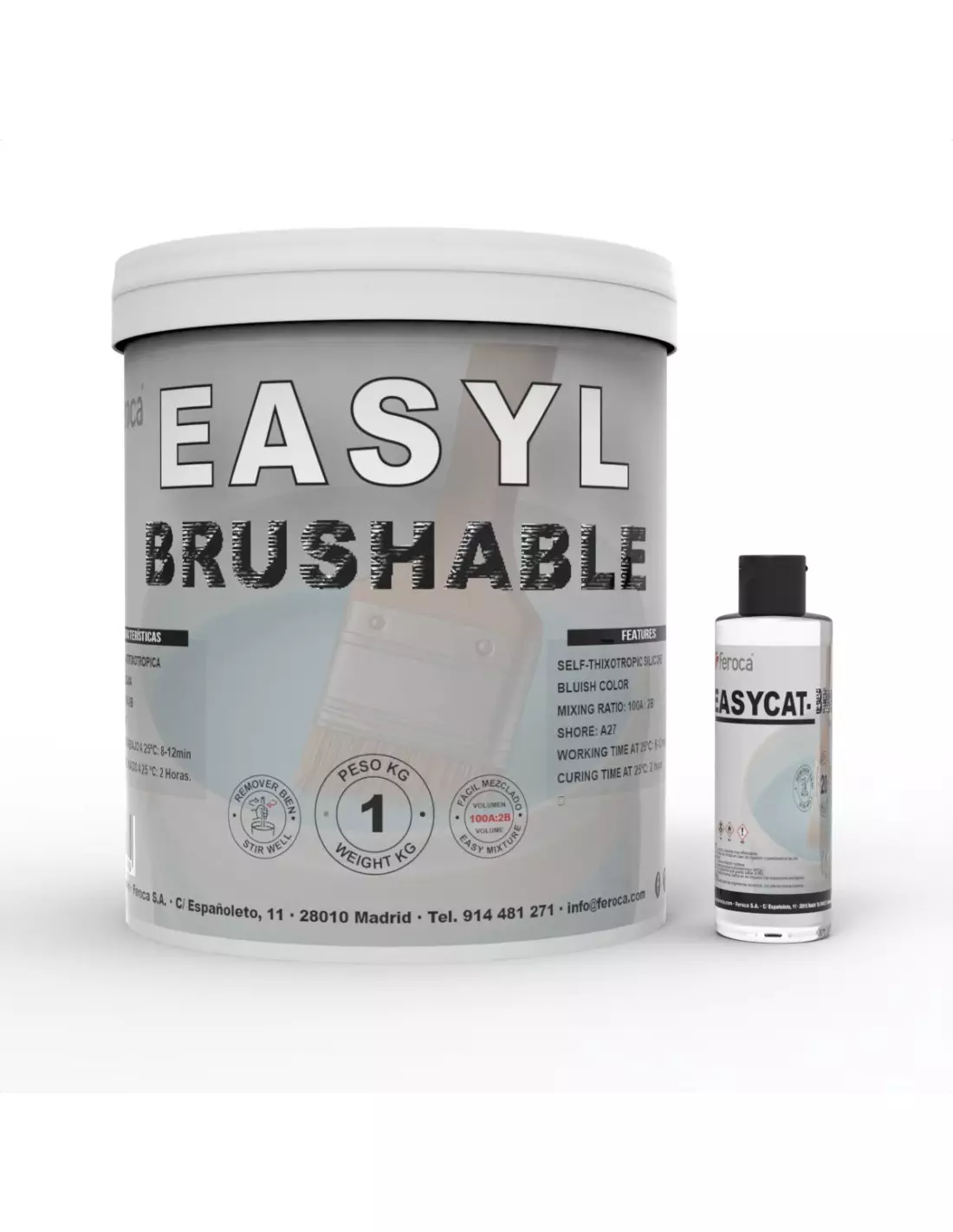
EASYL Brushable - Auto-thixotropic
201358001
€26.00
31,46 € Tax incl.
31,46 € Tax incl.
Self-thixotropic condensation silicone Shore A27. Mix ratio 100A:2B. Non-sagging on verticals. Ideal for brush-on moulds on large-format pieces.
EASYL Brushable is a self-thixotropic condensation (tin) silicone formulated for brush or spatula application. Its paste-like consistency prevents the material from sagging on vertical surfaces or undercuts, and its bluish colour makes it easy to visually check layer thickness during brushing. It is the most efficient solution for making moulds directly on large-format originals without the need for a perimeter frame.
Technical specifications
| Property | Value |
|---|---|
| Silicone type | Condensation (tin) |
| Colour | Bluish |
| Shore Hardness A | 27 |
| Mix ratio | 100A : 2B (base : catalyst, by weight) |
| Rheological behaviour | Self-thixotropic (non-sagging) |
| Working time | 8-12 min at 25 °C |
| Cure time | 2 hours at 25 °C |
| Application method | Brush, spatula or gun |
| Shelf life (25 °C) | 3 months opened and 6 months closed |
What it is used for
EASYL Brushable is designed for making moulds by brushing or layering directly onto pieces that cannot be placed inside a frame. The bluish colour allows you to detect uncovered areas before each layer cures, ensuring a mould with no weak spots or insufficient thickness. It is especially useful when working on-site or with large pieces where pourable silicone is not viable.
- Brush-on moulds for sculptures, figures, reliefs and decorative ornaments
- On-site reproduction of architectural elements: cornices, capitals, mouldings and plinths
- Moulds for casting polyurethane resins and epoxy resins
- Industrial and artistic prototyping in the workshop
- Replicas of large-format museum or heritage pieces
- Shell moulds on originals with complex geometry or deep undercuts
How to use it
- Prepare the original: clean the surface and apply a suitable release agent if the material is porous or at risk of adhesion. Allow to dry completely before applying the silicone.
- Weigh the components: mix 100 parts of base (A) with 2 parts of catalyst (B) by weight. Use a precision scale to respect the ratio; an error in the ratio affects curing.
- Mix: stir vigorously for 2-3 minutes until a uniform colour with no streaks is obtained. The self-thixotropic formulation maintains consistency during mixing; no thickener needs to be added.
- First detail layer: apply a thin layer with a brush over the entire surface of the original, paying special attention to concave areas and fine details. The bluish colour lets you verify that no area has been left uncovered.
- Successive layers: once the first layer is at gel stage (tack-free, approximately 30-40 min), apply additional layers to reach the desired thickness. Each layer should partially cure before the next one is applied.
- Final cure: allow the assembly to cure for a minimum of 2 hours at 25 °C before demoulding. At low temperatures, curing slows down significantly.
- Demoulding: remove the mould carefully, starting from the edges. The Shore A27 hardness provides enough flexibility to demould without damaging the original or the mould.
Tips and advice
Thickness control and uniformity
The bluish colour of EASYL Brushable is a tactical advantage: any area that appears in the colour of the original is an uncovered area. Work with raking light to detect thickness variations before each layer cures. On pieces with a lot of relief, spend more time on shadowed areas and re-entrant angles, where the brush tends to leave less material.
Temperature and working time
The 8-12 minute working time is the actual window you have from the end of mixing until the silicone starts to gel. In summer or in warm workshops, this time shortens: mix in cool containers and work in small batches if the piece is large. At temperatures below 18 °C curing can extend by several hours; if you need to speed it up, you can apply gentle heat with a lamp or keep the piece in a temperature-controlled space.
Building the support mould (mother mould)
Since this is a flexible shell mould, you will need a rigid casing (support mould or mother mould) to hold the mould's shape during casting. It can be built with plaster, fibreglass with resin or rigid foams. Plan the parting lines of the mother mould before you start brushing the silicone, as it is much easier to place partition separators on the original than on the already cured mould. If you are going to cast epoxy resins, make sure the casing is rigid enough to withstand the hydrostatic pressure of the pour.
Frequently asked questions
How many layers need to be applied to get a resistant mould?
It depends on the size and geometry of the piece, but as a general rule 3 to 5 layers are recommended to reach a thickness of 4-6 mm, which is sufficient for most workshop moulds. For large-format pieces or those with a lot of overhang, it is advisable to reach 8-10 mm in the most stressed areas. With EASYL Brushable, the bluish colour helps you detect thin areas before each layer cures, so use it actively to even out the thickness.
Is it necessary to apply a release agent to the original?
It depends on the material of the original. On non-porous surfaces (cured resin, metal, glass) condensation silicone generally does not adhere and demoulding is clean without a release agent. On porous materials (plaster, unsealed wood, cardboard, stone) it is essential to seal the surface beforehand and apply a release agent to prevent the silicone from penetrating or sticking. On pieces with polychromy or delicate finishes, always carry out a test on an inconspicuous area before covering the entire original.
Can I use this silicone for casting epoxy resins?
Yes. EASYL Brushable is compatible with epoxy resins. Bear in mind that epoxy resins generate exothermic heat during curing, especially in thick pours; make sure the support mould can withstand the temperature and does not deform the mould. For frequent casting, the typical number of reproductions for a condensation silicone is approximately 30-40 copies, depending on mould maintenance.
What happens if I use too much catalyst?
An excess of catalyst above 2% by weight speeds up curing and shortens the working time, but can also cause the mould to cure with greater surface brittleness and wear out sooner. Too little catalyst leaves areas uncured or with incomplete curing, with sticky surfaces. Always weigh with a scale; visual estimates are not reliable with ratios as tight as 100:2.
Can I pigment the silicone to distinguish layers?
Yes, you can add silicone-specific pigments. The recommended amount is a maximum of 3% by weight of the total mix; exceeding that percentage can interfere with curing and alter the mechanical properties of the mould. Pigmenting alternating layers with different colours is a useful technique for controlling uniform thickness of each layer during mould construction.
Can I mix this silicone with platinum silicone?
No. Condensation (tin) silicones and addition (platinum) silicones are not compatible. Contact between the two inhibits the curing of the platinum silicone, leaving the surface sticky or uncured. Do not use the same EASYL Brushable mould to cast platinum silicone, nor build a platinum mould directly on a piece that has been treated with tin silicone without a suitable barrier in between.
Is it suitable for food safe use?
No. EASYL Brushable is a condensation silicone for technical and workshop use, without food safe certification. If you need a silicone for food safe moulds, you must use a platinum silicone with FDA or equivalent certification, such as Easyl 940-FDA, and carry out the recommended post-cure.
How long can I store the product unopened?
Condensation silicones have a shelf life of approximately 12 months from the date of manufacture if stored correctly: tightly closed containers, temperature between 15 and 25 °C, away from moisture and heat sources. Once the catalyst has been opened, close it hermetically after each use to prevent moisture absorption, which can alter its activity.
No reviews
Tap to zoom