Shopping Cart


MetalCast -Silicone for metals
201353001
Temporarily out of stock
€36.00
43,56 € Tax incl.
43,56 € Tax incl.
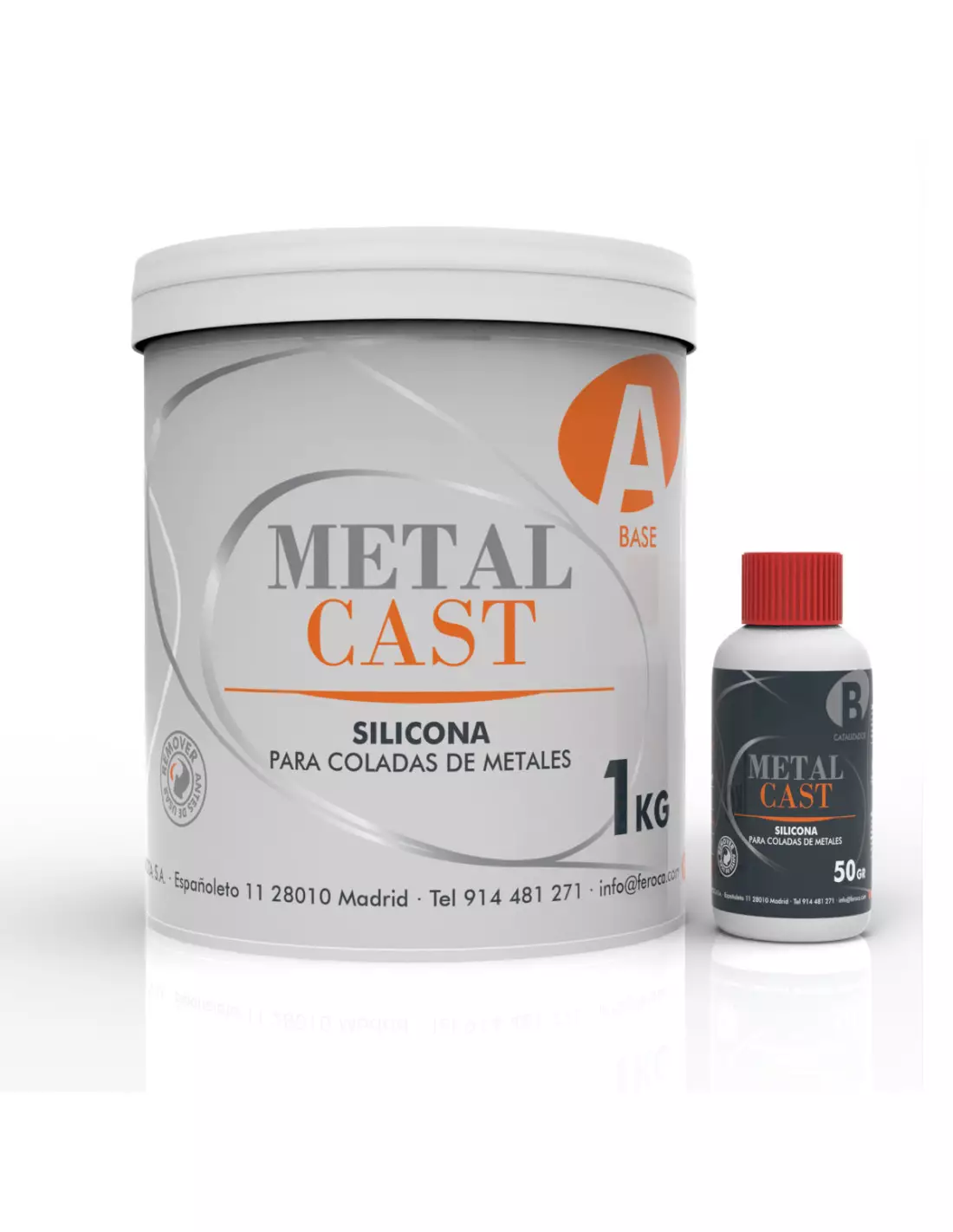
Shore A50 tin silicone for low-melting-point metal moulds up to 300 °C. Ratio 100A:5B, 1,050 g kit.
MetalCast is a Shore A50 condensation (tin) silicone formulated specifically for making moulds intended for casting low-melting-point metals such as lead, tin, bismuth and their alloys. With a tear resistance far superior to other silicones in its category and virtually no shrinkage after curing, it is the most solid option when the mould will receive molten metal repeatedly at temperatures of up to 300 °C.
Technical specifications
| Parameter | Value |
|---|---|
| Silicone type | Tin (condensation) |
| Colour | Red |
| Shore Hardness | A50 |
| Mix ratio (by weight) | 100A : 5B |
| Mix viscosity | 30,000 cP |
| Tear resistance | 8 kg/cm² |
| Working time | 60 minutes |
| Cure time | 24 hours (room temperature) |
| Maximum working temperature | 300 °C |
| Shrinkage | Not appreciable |
| Kit contents | 1,050 g (component A + catalyst B) |
| Shelf life (25 °C) | 3 months opened and 6 months closed |
What it is used for
MetalCast is designed for sculpture workshops, jewellery, special effects, scale modelling and craft manufacturing that need to reproduce parts by casting low-melting-point metals. Its thermal resistance of up to 300 °C and its A50 hardness ensure that the mould retains detail and shape even after multiple pours of molten metal.
- Moulds for casting tin, lead, bismuth and their alloys (such as Peltre PLS)
- Reproduction of jewellery pieces in molten metal
- Manufacture of lead soldiers, miniatures and collectible figures
- Special effects: metallic replicas of props and set dressing
- Technical scale modelling and craft series production of metal parts
- Decorative replicas of sculptures and reliefs in metal
How to use it
- Prepare the original: For best results, use pieces with a simple geometry, as the hardness of the silicone can make demoulding difficult on complex designs. Prepare the original by making sure it is clean, dry and dust-free. On porous surfaces, apply a sealer before moulding, and use a release agent on the areas likely to bond to the silicone.
- Build the containment frame: surround the model with a containment frame (foam board, wood, LEGO) robust enough to hold the liquid mix without leaks.
- Weigh the components: mix component A with catalyst B at a ratio of 100:5 by weight. Use a precision scale to ensure the correct ratio.
- Mix: stir with a spatula for 3–4 minutes, scraping the walls and bottom of the container thoroughly to fully incorporate the catalyst. The resulting mix will have a viscosity of 30,000 cP.
- Pour: pour the mix slowly from a height of approximately 20–30 cm at the lowest point of the containment frame to minimise air bubble incorporation.
- Cure at room temperature: allow to cure for 24 hours without moving the mould. Do not force curing with heat.
- Demould: after 24 hours, carefully remove the containment frame and extract the model. The mould is now ready to receive molten metal.
- First casting: pour the molten metal (max. 300 °C) slowly and continuously. Allow to cool completely before demoulding the metal part.
Usage tips
Temperature and storage
Always work in an environment between 20–25 °C. Low temperatures slow curing and can affect the homogeneity of the mix. Store the components in their original well-sealed containers, away from heat sources and moisture. Ambient humidity can affect the curing of tin silicones, especially the catalyst.
Bubble control
Since MetalCast has a viscosity of 30,000 cP, it is important to pour slowly and from a certain height. If you have a vacuum chamber, degas the mix before pouring: 2–3 minutes at low pressure will eliminate virtually all bubbles and improve fine detail reproduction, which is especially relevant for jewellery pieces or high-definition figures.
Mould maintenance and service life
MetalCast's A50 hardness provides good mechanical resistance to the impact of molten metal. To extend the mould's service life, allow the metal part to cool sufficiently before demoulding, avoiding sharp pulls. Clean the mould between castings with a dry cloth to remove any oxide residue or metal debris. If the original is very complex, you can combine MetalCast with the Metal Moulding Kit, which includes everything needed to get started.
Frequently asked questions
What metals can I cast in this type of mould?
MetalCast is designed for metals and alloys with a melting point of up to 300 °C. Suitable metals include tin, lead, bismuth and their low-melting-point alloys, such as Peltre PLS. It is not suitable for aluminium, zinc or other metals with a melting point above 300 °C, as these would degrade the silicone mould.
How many castings can a silicone mould for metal withstand?
It depends on the metal temperature, the geometry of the part and how carefully it is demoulded. With MetalCast and metals within the recommended range (up to 300 °C), it is reasonable to expect between 20 and 50 castings before the mould begins to show visible degradation in detail or edges. Allowing the part to cool properly before demoulding and avoiding sharp pulls considerably extends the mould's service life.
Is a release agent necessary with tin silicones?
For casting low-melting-point metals, no release agent is needed inside the cured mould, as metal does not bond to silicone. However, it is advisable to apply a release agent to the original before pouring the liquid silicone, especially if the model is porous or made from materials that may bond to it.
Can I speed up curing by applying heat?
Applying direct heat to accelerate MetalCast curing is not recommended. Condensation (tin) silicones cure through reaction with ambient humidity, and uncontrolled heat can cause uneven curing or bubbles in the mass. The ideal approach is to respect the 24-hour cure time at room temperature (20–25 °C).
Can I use this silicone for epoxy resin or polyurethane moulds?
Technically yes, you can use a tin silicone to mould resins, but MetalCast is optimised for metal casting: its A50 hardness and thermal resistance are its key strengths. If your primary use is casting epoxy resin or polyurethane, other tin silicones in the Feroca catalogue with lower hardness — such as Silastic 3481 (A24) — may deliver better results in demoulding and detail reproduction for that use.
What is the difference between a tin silicone and a platinum silicone for this type of application?
For casting low-melting-point metals, tin silicones like MetalCast are the industry-standard option: they are more cost-effective and sufficiently thermally resistant for this use. Platinum silicones have a longer general service life, but they are not designed for repeated contact with molten metal and can prove more expensive without offering advantages in this specific context.
Can silicone oil be added to reduce viscosity and improve flow?
Yes, it is possible to add silicone oil (such as DC Fluid 50) to reduce the viscosity of the mix and improve its flow, which aids in the reproduction of fine details. However, for moulds intended for molten metal, it is recommended not to exceed 5–10% oil relative to the total mix, as excessive dilution can reduce the mechanical and thermal resistance of the mould. Use it only if strictly necessary.
What is the exact mixing ratio for the two components?
MetalCast is mixed at a ratio of 100 parts component A to 5 parts catalyst B, always by weight. Use a precision scale: errors in the ratio cause incomplete curing or mechanical properties below those stated. Do not mix by volume.
- Color
- Red
- Working Time
- 60min
- Curing Time
- 24horas
- Shore Hardness
- A50
- Mixed Weight Ratio
- 100A:5B
No reviews
Tap to zoom