Shopping Cart



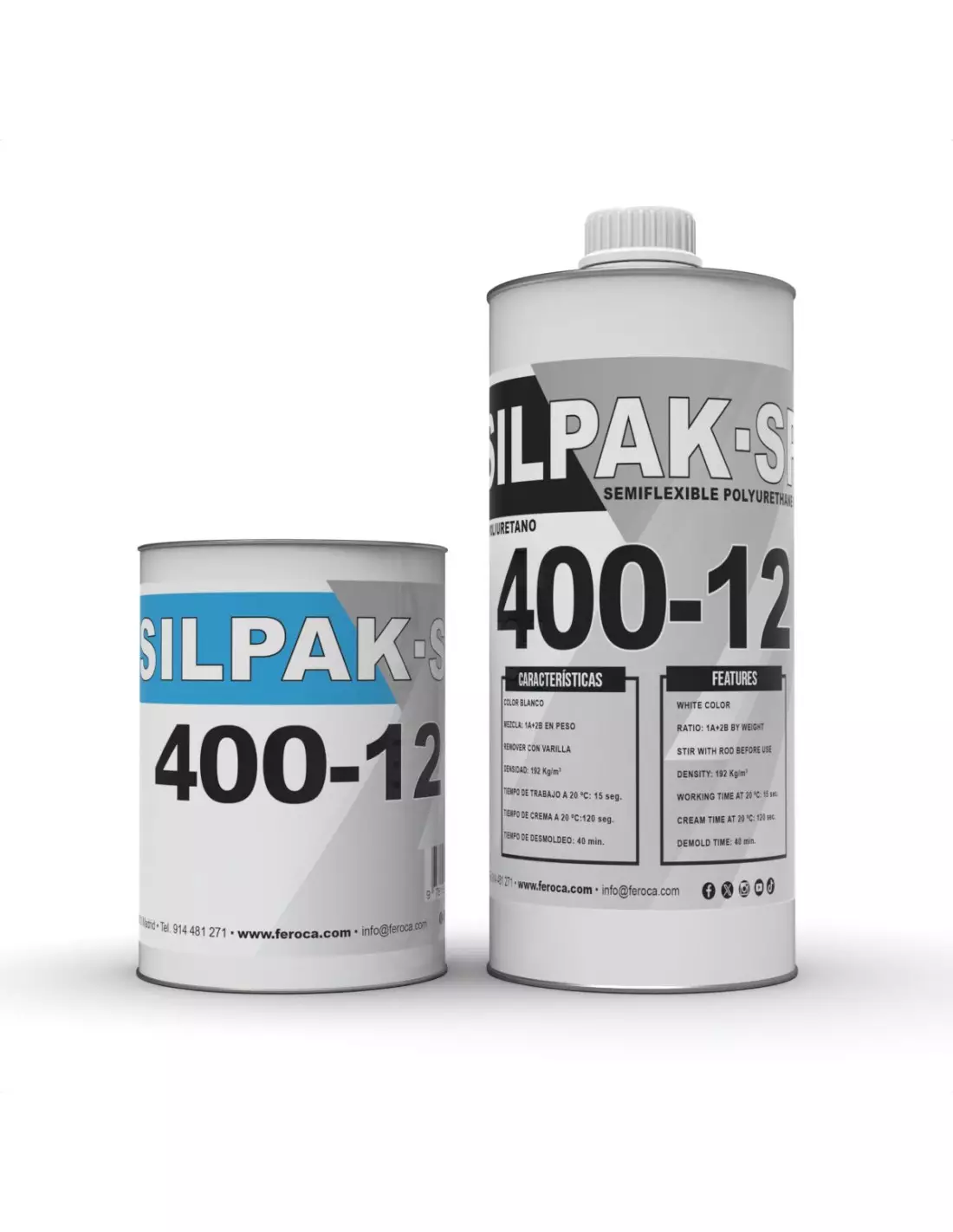
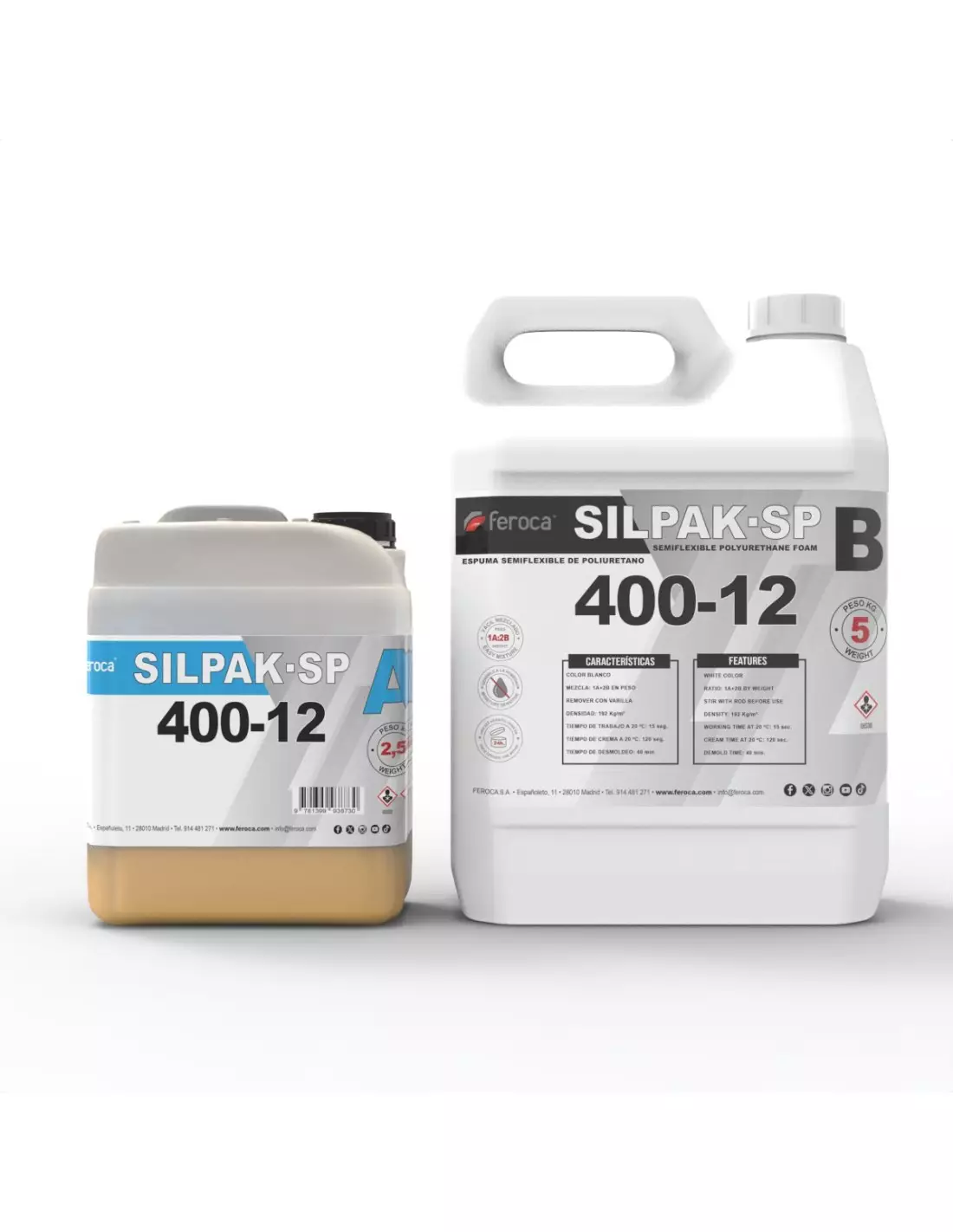
SilPak SP 400-12 Semi-Flexible Foam
433025001
€40.00
48,40 € Tax incl.
48,40 € Tax incl.
2-component semi-flexible polyurethane foam (1A:2B). Density 192 kg/m³, integral skin, 5x expansion. Ideal for taxidermy, props and figures.
The SilPak SP 400-12 is a two-component, CFC-free semi-flexible polyurethane foam with self-skinning capability: it forms a firmer surface skin that makes sanding, painting and post-processing easier. With a density of 192 kg/m³ and an expansion of up to 5 times its volume, it is the go-to option for moulded parts that need body without full rigidity, such as props, archery figures or taxidermy work.
Technical specifications
| Parameter | Value |
|---|---|
| System | Semi-flexible polyurethane, 2 components |
| Mix ratio | 1A : 2B (by weight) |
| Colour | White |
| Density | 192 kg/m³ |
| Expansion | Approximately 5 times the initial volume |
| Cream time | ≈ 120 s |
| Rise time | ≈ 90-120 s |
| Working time | ≈ 15 s |
| Demould time | ≈ 40 min |
| Viscosity part A | ≈ 2000 cP (25 °C) |
| Viscosity part B | ≈ 100 cP (25 °C) |
| Self-skinning | Yes |
| CFC propellants | None |
| Pigmentable | Yes |
What it is used for
The SP 400-12 is particularly valued in special effects workshops, taxidermy and prop manufacturing where a part with firm body but some flexibility and good detail definition is required. The integral skin formed during curing eliminates the need to apply primer coats before painting.
- Archery figures and targets (3D targets)
- Props and set dressing for film, theatre and special effects
- Taxidermy parts: bodies, anatomical forms and bases
- Puppets and articulated dolls
- Armrests, headrests and low-density decorative panels
- Semi-flexible prototypes with a direct surface finish
- Lightweight structural fills in composite parts
How to use it
- Prepare the environment: work at an ambient temperature of between 20 and 25 °C. Both the mould and the components should be at a similar temperature to ensure uniform expansion.
- Apply release agent: cover the entire inner surface of the mould with a suitable release agent for polyurethanes. Without this step, the part will permanently bond to the mould.
- Weigh the components: use a precision scale and respect the ratio of 1 part A to 2 parts B by weight. An error in the proportion directly affects the final density and the cure.
- Mix with a stirring rod: the working time is only 15 seconds, so you must mix vigorously but quickly with a stirring rod, making sure to scrape the walls of the container thoroughly.
- Pour immediately: once mixed, pour the foam into the lowest point of the mould. The expansion (up to 5 times) will fill the cavity. Do not overpour or the mould will not be able to close properly.
- Close the mould and clamp it: the expansion pressure is significant; use clamps or a firm closure system to prevent the mould from opening during the rise time (90-120 s).
- Wait for the demould time: do not open the mould before approximately 40 minutes. The part may appear cured on the outside before the core has completed the reaction.
- Demould and post-process: carefully remove the part, trim any flash and, if needed, sand, paint or apply finishes. The integral skin aids the adhesion of water-based or solvent-based paints and coatings.
Important notice — exothermic reaction and gases: heat is generated and gases are released during polyurethane expansion. Always work in a well-ventilated space. Avoid prolonged contact of uncured components with skin and eyes; use nitrile gloves and eye protection. The unmixed components are moisture-sensitive: seal containers tightly after each use to prevent part B from absorbing ambient moisture, which would cause bubbles and defects in the finished part.
Usage tips
Calculate the quantity carefully before pouring
The SP 400-12 expands up to 5 times its volume. To calculate the amount of mix you need, divide the internal volume of the mould (in cm³) by 5 and multiply by the density (0.192 g/cm³). This gives you the approximate weight of mix to prepare. It is advisable to add a small margin of 5-10% to ensure complete fill, especially in moulds with complex geometries or narrow channels.
Temperature: the factor that most affects the result
Below 18 °C the reaction slows down, expansion is reduced and unfilled areas may remain. Above 30 °C the cream time shortens dramatically and you may lose the mix before pouring. If you work in a cold workshop in winter, gently warm the components in a warm water bath (no more than 30 °C) before mixing. If the mould is cold, warm it too: a cold surface slows expansion at the contact zone and produces a thicker skin than intended.
Self-skinning: make the most of the integral skin
The self-skinning capability of this foam produces a denser, smoother outer layer than the inner core. To maximise this effect, the mould must be clean, properly released and at the correct temperature. If you need a thicker skin (for example, on figures that will receive impacts, such as archery targets), close the mould with more pressure to compact the part. If you are going to pigment the foam, add the pigment to part A before mixing with part B, as part A has higher viscosity and allows more uniform colour dispersion.
Frequently asked questions
How much does this foam expand and how does it affect mould design?
The SP 400-12 expands approximately 5 times its initial volume. This means the mould must have air vents or overflow channels for the gases generated during expansion. If the mould is completely sealed and airtight, the internal pressure can deform it or prevent complete fill. In open moulds, pour only the calculated quantity to avoid overflow.
What release agent should I use with polyurethane foams?
It is essential to use a release agent specifically designed for polyurethanes, as these materials have very high adhesion to most surfaces. Without a release agent, the part will permanently bond to the mould and render it unusable. Apply several thin coats and allow each one to dry before pouring the foam.
Can this foam be pigmented to obtain coloured parts?
Yes, the SP 400-12 is pigmentable. Add polyurethane-compatible pigment to part A before making the final mix with part B. Since part A has higher viscosity, the colour distributes better in that component. Bear in mind that the final colour may be affected by the natural yellowing of polyurethane over time if the part is exposed to UV light without protection.
Can it be used in silicone moulds?
Yes, silicone moulds are very common for polyurethane foams such as the SP 400-12. Silicone does not require a release agent in most cases, although in series production it is advisable to apply a thin coat to extend mould life. Make sure the silicone mould has sufficient rigidity to withstand the expansion pressure, or support it in a rigid containment box.
What is the difference between a semi-flexible foam and a flexible or rigid one?
A rigid foam (such as Easyfoam 300) does not deform under normal pressure and is used for structures, part fills or hard prototypes. A flexible foam (such as Easyflex 60) gives way and compresses easily. The SP 400-12 is semi-flexible: it has body and resistance, but allows some deformation without breaking, making it ideal for figures that receive impacts (such as archery targets) or parts that need to absorb impacts.
Why are there large bubbles or why does the foam not expand correctly?
The most common causes are: temperature too low (below 18 °C), moisture in the components (especially part B, which is water-sensitive), incorrect mix ratio, or insufficient mixing time. Make sure to seal containers tightly after each use, work at the correct temperature and weigh accurately. If the problem persists, check the expiry date of the components.
How long can the unopened components be stored?
Under correct storage conditions (dry place, temperature between 15 and 25 °C, tightly sealed containers) the SP 400-12 components retain their properties for approximately 6-12 months from the date of manufacture. Part B is particularly moisture-sensitive: once the container has been opened, use it promptly and seal it airtight after each use.
Is it suitable for outdoor use or for parts exposed to sunlight?
Polyurethane in general, and this foam in particular, is not naturally UV-resistant: it tends to yellow and degrade with prolonged sun exposure. For outdoor use, a protective coating of paint or varnish with a UV filter must be applied to the finished part. The integral skin of the SP 400-12 facilitates the adhesion of these protective finishes.
No reviews
Tap to zoom